
Fleeced…

Last week, The New York Times quietly acknowledged that the emails recovered from the MacBook Hunter Biden abandoned at a Delaware computer store were authentic. The admission came nearly a year-and-a-half late, after the corrupt media — legacy and social — buried the scandal the New York Post broke just weeks before the November election.
Merely admitting the laptop is legitimate is not enough. Rather, by concurring in the authenticity of the laptop and the emails, the supposed standard-bearers of journalism have also implicitly acknowledged the validity of the scandals spawn by the porn-filled MacBook. And notwithstanding the salacious source of the documentary evidence of the scandals, the scandals are not about Hunter Biden: They are about now-President Biden.
Here are the eight Joe Biden scandals deserving further coverage.

The US Senate passed a bipartisan $1.5 trillion bill on March 10th that included $13.6 billion in aid to Ukraine.
Chuck Schumer touted the aid to Ukraine and pointed to it as a pressing reason for the Senate to quickly pass the massive $1.5 trillion spending bill. This was the same week that inflation hit 7.9% in the US — the highest inflation rate in 40 years.
So where is the money going? Does anyone know? Does anyone care?
Here’s one answer.
The wife of former Ukrainian MP Ihor Kotvitskyi declared 28 million dollars and 1.3 million euros when entering Hungary.
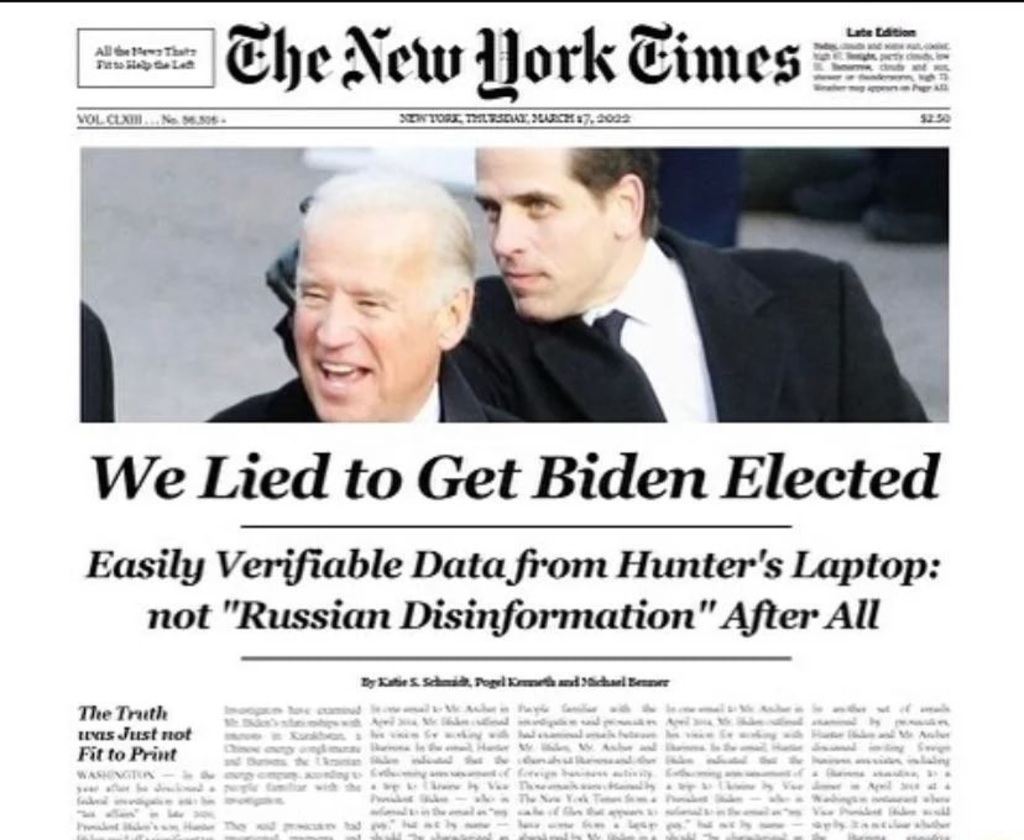
On March 17, 2022, The New York Times stated it had verified the authenticity of a laptop and its data as belonging to the president’s son, Hunter Biden. This was the same laptop holding information that Twitter, Facebook, and other corporate media immediately suppressed when The New York Post, a right-leaning competitor of The New York Times, reported on it three weeks before the 2020 presidential election.
If they had known about one of the Biden family scandals, such as the Hunter Biden laptop information, 17 percent of Joe Biden’s voters wouldn’t have voted for him, found a 2020 post-election poll. This means big tech’s suppression of this story likely made enough difference to tip Joe Biden into his low-margin win in the Electoral College.
Back in October 2020, Twitter and Facebook immediately responded to The New York Post’s publication of information from Hunter Biden’s laptop by effectively banning it from their platforms that effectively monopolize public discussion. Twitter punished the Post for reporting the repeatedly authenticated laptop information by suspending its account for two weeks.
“What this means is that, in the crucial days leading up to the 2020 presidential election, most of the corporate media spread an absolute lie about The New York Post’s reporting in order to mislead and manipulate the American electorate,” commented independent investigative reporter Glenn Greenwald.
Independent journalist Glenn Greenwald laid into corporate media in a Twitter thread on Saturday morning, detailing how government officials and media outlets had effectively colluded to protect President Joe Biden’s embattled son Hunter — particularly during the 2020 presidential election.
Greenwald ultimately left The Intercept, the outlet he cofounded, when he was asked to sanitize an article he was writing about then-candidate Joe Biden, his son Hunter, and their past dealings with both China and Ukraine — and he argued Saturday that multiple media outlets had been drawn into the coordinated effort to protect the Bidens.
His comments come in the wake of a report from The New York Times — which, in addition to confirming that Hunter Biden remains under a federal investigation, let slip that the emails found on the laptop he reportedly abandoned at a Delaware repair shop were, in fact, authentic.
People familiar with the investigation said prosecutors had examined emails between Mr. Biden, Mr. Archer and others about Burisma and other foreign business activity. Those emails were obtained by The New York Times from a cache of files that appears to have come from a laptop abandoned by Mr. Biden in a Delaware repair shop. The email and others in the cache were authenticated by people familiar with them and with the investigation.
The New York Post’s Miranda Devine, author of “The Laptop From Hell,” noted that none of the senior ex-intelligence officials — who swore that reports about Hunter Biden were nothing more than “Russian disinformation” — were willing to walk back their statements.
During the heat of the 2020 campaign, Now-President Joe Biden charged that Donald Trump’s accusation that Hunter Biden’s laptop contained incriminating information of his business ties to China and Ukraine was nothing but a ‘smear.’
“So what about the Americans who really today only want me to ask you about Hunter Biden’s laptop?” KCRG Anchor Beth Malicki asked him in October 2020. “How are you going to get them to see that you are fighting for them when they’re so dead-set against you?”
“By the way, there’s nothing to any of that,” Biden claimed. “Nothing to any of that. It’s all smear. Every major outfit, every serious investigator has pointed out that this is a smear. This is classic Trump.”
“We are four days left and all of a sudden there’s a laptop,” he continued. “And you may recall, there’s also talk about four months before there was a similar thing that somebody had allegedly. There’s overwhelming evidence that — from the intelligence community — that the Russians are engaged.”
“I mean, look, this is — my son’s an honorable man and all the investigations that were done around the issue of what was going on Ukraine, if you notice, every one of the major people who worked for Trump during the impeachment went under oath and under oath said Biden did his job,” he added.

As Special Counsel John Durham continues to expose more details of the “SpyGate” or “Russia collusion” scandal, it can be difficult for any apolitical, non-news-junkie member of the public to grasp the ongoing developments.
After all, for more than five years, the corrupt legacy media has refused to report on scandal or done so with a slanted portrayal of the facts. So most Americans remain unaware of the Democrats’ years-long duplicity that sought to destroy first candidate and then President Donald Trump. Add to that reality the overlapping conspiracies and sprawling cast of characters involved, and it can be difficult to follow the story.
That the scandal is dense, however, does not mean it should be ignored. To the contrary, the duplicity must not be disregarded because what Trump’s political enemies tried to accomplish over the course of five years represents the biggest threat our constitutional republic has seen in the last century.
So for those who care about our country and her future but don’t want to be buried in the minutia of the scandal, here is your big-picture primer.


You must be logged in to post a comment.