
Climate change activist goes rogue releasing ‘mini volcanoes’ to cool atmosphere

AMexico-based startup will next week launch sulphur particles into the stratosphere in a “rogue” move to create a “mini-volcano” effect it says could help cool the planet

The technique, known as stratospheric aerosol injection, mimics the impact of volcanoes by using a weather balloon to release sulphur, creating a cloud of particles that reflect the sun’s rays and have a cooling impact. 

It is one of several geoengineering techniques being studied as a way to cool the planet to avoid breaching internationally agreed limits on global warming. 

The amount of particles that start-up Make Sunsets plans to release in coming days, up to 2kg, will make a minimal difference to overall warming. 

But experts in geoengineering say the launches set a dangerous precedent for private companies or governments to interfere with the planet’s atmosphere. 

The company is backed by two venture capital funds, and is selling “cooling credits” to the public for $15 (£12), which it says pays for 1g of sulphur, expected to produce enough cooling to offset a ton of carbon emissions for a year. 

It released a first balloon in December in Mexico, but will next week launch from California, after the Mexican government released a statement criticising the first effort. 

Co-founder Luke Isemans said the potential risks of what he is doing are outweighed by the known threat of climate change. 
Keep reading

Covid Emergency, Climate Emergency: Same Thing

In February 2022, 1,140 organizations sent President Biden a letter urging him to declare a “climate emergency.” A group of US Senators did the same, in October 2022, and a House bill, introduced in 2021, also called on the president to “declare a national climate emergency under the National Emergencies Act.”

Biden has considered declaring such an emergency, but so far he has declined, to the disappointment of many progressives.

The United Nations (UN) has urged all countries to declare a climate emergency. The state of Hawaii and 170 local US jurisdictions have declared some version of one. So have 38 countries, including European Union members and the UK, and local jurisdictions around the world, together encompassing about 13 percent of the world’s population.

Hillary Clinton was reportedly prepared to declare a “climate emergency” if she had won the 2016 election.

A “climate emergency” is in the zeitgeist. Those words were surely uttered by the billionaires, technocrats and corporate CEOs attending the recent World Economic Forum (WEF) meeting in Davos.

But what does it actually mean for the president of the US to officially declare a “climate emergency?”

Most people don’t realize that under US law, a national emergency declaration triggers a set of emergency powers that allows a president to act without the need for further legislation.

The Brennan Center for Justice compiled a list of the 123 statutory powers that may become available to the president upon declaration of a national emergency (plus 13 that become available when Congress declares a national emergency).

The scope of these powers is difficult to summarize, except to say that if exercised to their maximum extent, they potentially encompass vast areas of American life.

For civil libertarians across the political spectrum, from left to right, a “climate emergency” should be a focus of concern.

Even environmentalists who may instinctively and understandably support the idea should be worried about the potential for the authoritarian model of “emergency” governance that arose during COVID-19 to overtake climate policy.

One can believe in protecting and preserving the planet, as I do, while insisting on environmental policies that are consistent with democracy, civil liberties, and human rights.

Elements of the left and right should be coming together to reject demands that we sacrifice democratic norms, rights, and freedoms for flimsy promises of safety from political and economic elites who seek to exploit a crisis — a cynical ploy that COVID-19 thoroughly exposed.

Keep reading

Scientists Looking to Scatter Moon Dust Around Earth to Combat ‘Climate Change’

A group of scientists has proposed creating a shield made of moon dust positioned between the Earth and the sun as a way to lower the planet’s temperature in a bid to combat “climate change,” a plan that could have devastating consequences.

In a Feb. 8 study published in the journal PLOS, three researchers from the University of Utah proposed their moon dust shield idea while calling climate change an “existential threat.” Large quantities of moon dust between the Earth and the sun can “reduce the amount of sunlight received on our planet,” they claimed while estimating that billions of kilograms of moon dust will be needed annually to maintain the shield. “Because dust grains between Earth and the Sun tend to drift out of alignment, they must be replenished,” the study said.

The “most promising” scenario for creating the shield involves mining lunar dust and ballistically blasting it from the moon on a trajectory toward the Earth-sun L1 Lagrange point, a gravitationally stable point located 900,000 miles from Earth.

The plan is estimated to potentially lower sunlight by 1.8 percent or around six days of sunlight per year, thereby lowering the Earth’s temperature.

Keep reading

Biden admin met with woke group that funded fake study linking gas stoves to asthma

It has been revealed that Energy Secretary Jennifer Granholm met privately with the leader of the group that funded a recent study used to justify calls for bans of gas-powered stoves despite the Biden administration claiming that they weren’t seeking such a ban. 

According to an internal agency calendar obtained by the government watchdog group Americans for Public Trust, Granholm met with the CEO of the Rocky Mountain Institute (RMI) Jules Kortenhorst, Fox News reports.

Climate activist Kortenhorst also chairs the World Economic Forum’s Global Future Council on Net Zero Transition and founded the Energy Transitions Commission.

While the calendar didn’t include an agenda for the meeting, it was held over Zoom and lasted around one hour.

Keep reading

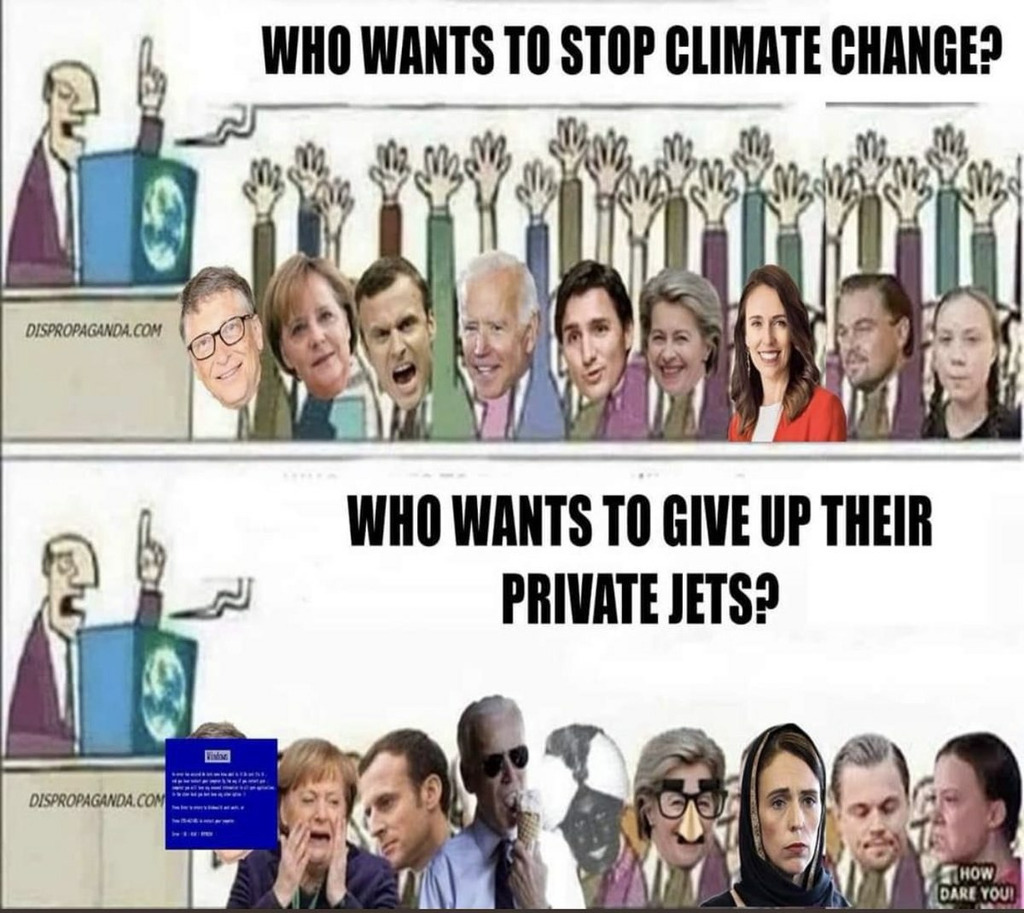
Bill Gates Says It’s OK For Him To Use Private Jets Because He’s “The Solution” To Climate Change

In a cringe inducing interview with a BBC reporter, Bill Gates argued that it’s perfectly fine for him to fly around the world on private jets because he’s doing much more than anyone else to combat climate change.

Gates claimed that because he continues to “spend billions of dollars” on climate change activism, his carbon footprint isn’t an issue.

“Should I stay at home and not come to Kenya and learn about farming and malaria?” Gates said in the interview with Amol Rajan.

“I’m comfortable with the idea that not only am I not part of the problem by paying for the offsets, but also through the billions that my Breakthrough Energy Group is spending, that I’m part of the solution,” Gates added.

Keep reading

Biden’s new adviser is a climate alarmist who claimed to have suffered an ‘acute mental health crisis’ as a result of Trump’s 2016 victory

The President’s Intelligence Advisory Board was created by President Dwight D. Eisenhower in 1956. The board counts among its alumni a Medal of Honor recipient, a steel magnate, a secretary of defense, a retired admiral, and a former state governor.

Joining the board Thursday per President Joe Biden’s apparent wishes: Kim Cobb, a climate alarmist who was admittedly left bedridden as a result of the American people’s election of former President Donald Trump in 2016.

Biden announced his intention to appoint Cobb to the PIAB on Jan. 26.

Cobb noted that she has “much to learn” but hopes “to contribute to the critical work of this esteemed Board.”

Cobb’s biography, lifted from her Brown page and included in the White House’s statement, is seeded with potential clues concerning the president’s decision.

Cobb is a climate scientist who has repeatedly appeared on CNN to discuss the specter of anthropogenic climate change. She co-authored an alarmist UN report in 2021 that simultaneously held that various allegedly man-made climate trends under way are now irreversible and it is still imperative that the world transition off fossil fuels.

Keep reading

Biden Promotes EV Hummer That Pollutes More Than Gas-Powered Sedan

President Biden’s 70-person social media team tweeted a photo of the president in the new Hummer EV. They celebrated the president’s push to ‘electrify and greenify’ America.

The president has signed an Executive Order that sets a new target to make about half of all new vehicles sold in 2030 zero-emissions vehicles. The main idea behind the EV push is to “cut emissions,” according to the Executive Order. 

Though there’s a dirty side to clean energy, one of these inconvenient truths is the very EV the president is sitting in pollutes more than a typical gasoline-powered sedan, according to the American Council for an Energy-Efficient Economy (ACEEE). 

ACEEE revealed the inconvenient truth about the Hummer EV in a report last year: 

Emissions per mile driven are lower for EVs than for similarly sized gasoline-powered cars, but they are not zero. The Chevy Bolt EV is responsible for about 92 grams of carbon dioxide (CO2) per mile when accounting for emissions from the electric grid. (The CO2 calculations are based on the national average, but electric grid emissions vary considerably across the country.) The gasoline-powered Chevy Malibu causes over 320 grams per mile. Comparing larger vehicles, the original Hummer H1 emits 889 grams of CO2 per mile and the new Hummer EV causes 341 grams, demonstrating that behemoth EVs can still be worse for the environment than smaller, conventional vehicles.

Keep reading

No Global Warming for 8 Years and 4 Months, Latest Data Show

The U.K. may have had its warmest year on record in 2022 (at least, according to the Met Office’s frequently adjusted data), but globally the temperature has remained flat now for 100 months, since 2014. Christopher Monckton writes about the inconvenient data in Watts Up With That?

The cold weather on both sides of the Atlantic last month seems to have had its effect on temperature, which fell sharply compared with November, lengthening the New Pause to eight years four months, as measured by the satellites designed, built and operated by Dr. Roy Spencer and Dr. John Christy at the University of Alabama in Huntsville.

The graph shows the least-squares linear-regression trend on the monthly global mean lower-troposphere anomalies. The least-squares method was recommended by Professor Jones of the University of East Anglia as a reasonable method of showing the trend on stochastic temperature data.

Recall that the Pause graph does not constitute a prediction: it simply reports the longest period, working back from the present, during which the temperature trend is not positive.

Keep reading

Woke Lancet Announces ‘Medical Urgency’ of Climate Change

The once-venerable UK Lancet medical journal is charging ahead in its climate change crusade, proclaiming “the ethical and medical urgency of the climate crisis” in its latest issue.

After calling climate change the “biggest global health threat of the 21st century” earlier this month, the Lancet has now praised “health-care professionals participating in Extinction Rebellion action [who] blocked the entrance to the UK’s Department for Business, Energy and Industrial Strategy to protest about impotent responses to climate change.”

In a woke mea culpa confessing that health care is “part of the climate problem,” the Lancet notes that in 2014 “the global health-care industry emitted 2 gigatons of carbon dioxide (CO2), or 4.4% of the world’s total.”

“Visible examples include operating rooms overflowing with trash generated by disposable sterile supplies and surgical equipment, parking areas filled with private transportation reliant on fossil fuels, and constant energy flow to digital monitors and other technologies,” the journal acknowledges.

Moreover, the Lancet continues, “pharmaceuticals — many of which are produced from fossil fuels — are the second most carbon intensive part of health care, after medical instruments and equipment.”

To be more environmentally responsible, physicians can reconsider the carbon impact of some routine prescribing practices, the journal advises.

For example, doctors should consider refusing to participate in the distribution of free drug samples and in this way “help reduce medication overuse and reduce the carbon impact when samples go unused.”

Physicians could also avoid starting patients on 30-day medication supplies by starting with just a 1-week supply, “even at the cost of some convenience to the doctor and patient,” the Lancet counsels.

Keep reading