Reuters Withdraws Xi, Putin Longevity Video After China State TV Pulls Legal Permission to Use It

Reuters News on Friday withdrew a four-minute video containing an exchange between Russian President Vladimir Putin and Chinese lead Xi Jinping discussing the possibility that humans can live to 150 years old, after China state TV demanded its removal and withdrew the legal permission to use it.

The footage, which included the open mic exchange from the military parade in Beijing marking the 80th anniversary of the end of World War II, was licensed by the China state television network, China Central Television (CCTV).

The clips were edited by Reuters into a four-minute video and distributed to more than 1,000 global media clients including major international news broadcasters and TV stations around the world. Other news agency licensees of CCTV also distributed edits of the footage.

Reuters removed the video from its website and issued a “kill” order to its clients on Friday after receiving a written request from CCTV’s lawyer. The letter said the news agency exceeded usage terms of its agreement. The letter further criticized Reuters “editorial treatment applied to this material” but did not specify details.

Reuters said in a statement that it withdrew the videos because it no longer held the legal permission to publish this copyrighted material.

Representatives of CCTV and CCTV’s global arm, China Global Television Network, did not immediately reply to a request for comment. The Chinese embassy in Washington did not immediately reply to a request for comment.

The video and story of the Xi and Putin exchange were widely shared by broadcasters and on social media globally.

“The editorial treatment applied to this material has resulted in a clear misrepresentation of the facts and statements contained within the licensed feed,” wrote HE Danning, legal supervisor of CCTV News Agency, in the letter to Reuters on Friday.

“We stand by the accuracy of what we published,” Reuters said in its statement. “We have carefully reviewed the published footage, and we have found no reason to believe Reuters longstanding commitment to accurate, unbiased journalism has been compromised.”

Keep reading

FDA Official Pressures YouTube Into Removing a Channel For Posting His Own Vaccine Comments

Last week, a top official with the Food and Drug Administration (FDA) apparently filed a bogus copyright claim to get a critic’s YouTube account taken down. This is an inappropriate act of censorship that, not long ago, conservatives would rightly have stood against.

“Jonathan Howard, a neurologist and psychiatrist in New York City, received an email from YouTube on Friday night, which stated that Vinay Prasad, who is the FDA’s top vaccine regulator, had demanded the removal of six videos of himself from Howard’s YouTube channel,” The Guardian reported this week. “Howard’s entire channel has now been deleted by YouTube, which cited copyright infringement.”

On his channel, Howard hosted videos of public health officials—including Prasad, Department of Health and Human Services Secretary Robert F. Kennedy Jr., and National Institutes of Health Director Jay Bhattacharya—making statements during the COVID-19 pandemic that turned out to be untrue or overly myopic. “I had accumulated about 350 videos, almost all of which were short clips of famous doctors saying absurd things,” Howard wrote in a blog post, “that herd immunity had arrived in the spring of 2021 and that RFK Jr. was an honest broker about vaccines, for example.” Howard is also critical of Prasad’s stance on vaccines, which Prasad now has the authority to regulate.

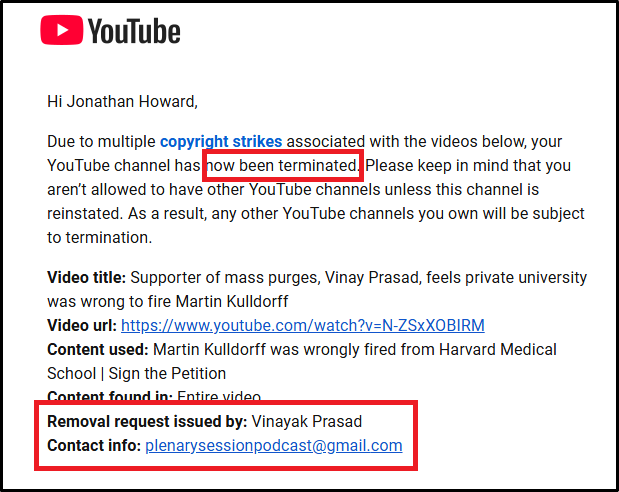
According to an email Howard posted, YouTube “terminated” his channel after “multiple copyright strikes” against his videos, and the “removal request” came from Prasad.

“Publishing someone else’s videos without modification or commentary is a clear copyright violation,” an FDA spokesperson told The Guardian. “The mission of Johnathan Howard was not medical transparency, but personal profit by grifting and stealing someone else’s intellectual property.”

“My YouTube channel had 256 subscribers and its videos were typically seen by dozens of people,” Howard wrote. “I never promoted the channel and made no money from it.” Besides, U.S. law allows for fair use of copyrighted material, which means someone can use protected content for purposes such as “criticism, comment, news reporting,” or “research” without the creator’s permission.

Howard is the author of the book We Want Them Infected, which criticized doctors and public health officials who advocated a herd immunity strategy for dealing with COVID-19. Howard says such warnings fed into anti-vaccine conspiracy theories. His YouTube channel collected videos of people who are now in charge of public health institutions, making what he feels were irresponsible claims during the pandemic.

But whether you agree with Howard or not, it is wrong and hypocritical for Prasad to silence his critics in this way.

Keep reading

Macron’s Global Censorship Push Exposed: Leaked Files Reveal France’s Covert Speech Control Campaign

As European leaders push to shape global speech rules under the guise of trade policy, new internal records reveal that the French government quietly built a system to enforce censorship worldwide.

Leaked internal communications from Twitter, now known as X, expose a sophisticated campaign led by President Emmanuel Macron and aided by state-aligned organizations to pressure the platform into suppressing speech far beyond what French law requires.

While publicly promoting values like free expression, France’s leadership was privately demanding crackdowns on political content, anonymous users, and anything that veered from government-approved narratives.

The latest TWITTER FILES – FRANCE, published by Public, which is worth reading, documents how Paris pioneered the modern censorship-by-proxy model; using lawsuits, coordinated NGO pressure, and personal outreach at the highest levels to mold a global moderation regime in France’s image.

One of the more revealing moments in the documents comes from October 2020, when Twitter’s Public Policy Director in France noted unusual persistence from the Élysée Palace.

“President Macron’s team has been asking me (again!) Jack [Dorsey]’s number because the President wants to text him some supporting words re our new policies and functionalities on Election integrity,” the message read.

The only issue? Dorsey didn’t hand out his number, even to heads of state. Staff reminded Macron’s team that a direct message would be more appropriate, though they acknowledged the President didn’t use Twitter personally. Alternatives like Signal, Telegram, and even iMessage were considered.

Keep reading

Germany Targets X Executives in Unprecedented Criminal Probe over Refusal to Hand Over User Data in “Hate Speech” Cases

German authorities have opened a criminal investigation targeting three managers at X, accusing them of “obstruction of justice” for refusing to directly provide user data in online speech-related cases.

Two of the employees are American, and one of them is reportedly Diego de Lima Gualda, the former head of X’s operations in Brazil, who previously faced off against legal demands in his home country before resigning in April 2024.

The alleged problem for Germany is X’s policy of forwarding German requests for user data to US authorities, following procedures established under a bilateral Mutual Legal Assistance Treaty (MLAT).

That treaty lays out the legal framework for cross-border data sharing, requiring requests from German prosecutors to be reviewed and processed through US legal channels before X is compelled to hand over user information.

Despite this legally grounded process, prosecutors in Göttingen have decided to treat the policy as criminal interference, marking what appears to be the first time in German legal history that social media executives are being investigated for how they respond to international legal requests.

German prosecutors have reportedly been frustrated by X’s unwillingness to grant them direct access to account data, particularly in cases involving posts that include banned symbols like swastikas or comments that authorities allege may amount to defamation.

The inability to obtain data has resulted in stalled investigations and dropped cases, including one where a post containing a swastika could not be traced to its author.

Although X restricted that post within Germany, the company declined to release identifying information.

Keep reading

Here Are Three Ways Americans Can Fight The U.K.’s Orwellian Attempts To Suppress Free Speech

Yesterday, the news came that Graham Linehan was arrested by five police officers the moment he stepped off a plane at Heathrow. Though he’s less well-known in America, Linehan is an Irish comic genius who created two of the most beloved U.K. sitcoms of the last 30 years  Father Ted and The I.T. Crowd. Linehan’s supposed crime is that he has been a persistent online critic of the transgender movement, and his arrest was over three tweets, which you can read here. Nothing about his tweets are debatable as a matter of free speech or incitement. In a sane society, they would all be protected.

For a while now, people have been screaming that the U.K. has transformed itself into an Orwellian police state. The U.K. now arrests as many as 30 people a day for online speech, and like what happened to Linehan, much of what is punished is benign by First Amendment standards.

Yet, the punishments handed down are quite severe, and there are numerous examples of how political U.K. courts operate according two a two-tiered system of justice. One woman got a 31-month sentence for an offensive tweet that was deleted after four hours; the same judge gave a 21-month sentence to someone who participated in a violent mob that tried to kick down the door of a pub looking to possibly attack the people inside.

Still, arresting someone as high profile as Linehan marks a significant escalation. Not because Linehan’s rights deserve more deference than any normal U.K. citizen that’s been arrested for speech, but because the U.K. government is openly inviting the enormous amount of criticism that will come with such a high profile arrest. Just last year, persistent transgender critic J.K. Rowling dared the Scottish police to arrest her under the country’s new and laughably expansive hate crime law. Scottish authorities demurred, not because they couldn’t punish her under the law, but because presumably they realized the blowback that came with arresting one of the most beloved authors of the last century would be too great.

Still, I hope the Linehan arrest shines a harsh spotlight on the U.K.’s increasingly draconian speech laws and leads to much needed reforms — here is a good primer on where the U.K. should start. But for now, the incident should lead those of us in America to act on some inescapable conclusions to help restore freedom of speech in the U.K. and elsewhere.

Keep reading

Starmer’s Regime Just Lit The Fuse On The U.K.’s Free Speech Crisis

Robin Wright, longtime member of the Hollywood glitterati, tells The Times that she feels “liberated” in fleeing the United States for the “freedom” of England. 

“America is a s—show,” the leftist House of Cards star told the London publication, declining to fully go into what she believes to be the present state of American politics.  

Wright, who says she’s found Mr. Right after three failed marriages, including her ill-fated union with “Marxist moron” Sean Penn, loves the “freedom of self” she has found in the United Kingdom. 

The Times’ gushing profile was published on Saturday, just two days before five Metropolitan Police officers arrested Irish comedy writer Graham Linehan at London’s Heathrow Airport on charges of expressing an opinion.

Linehan, co-creator of the popular sitcom Father Ted, was returning from the U.S. to the land of “freedom of self” when the speech police grabbed him “on suspicion of inciting violence via his posts on X.” What violence did he incite? The violence of thought, which in no small part has effectively become outlawed in leftist Prime Minister Keir Starmer’s Jolly Old England. 

Keep reading

Australia’s Senate Orders Release of eSafety Censorship Emails

The Australian Senate has formally ordered the production of all communications between “eSafety” Commissioner Julie Inman Grant and the Global Alliance for Responsible Media (GARM), adding to the scrutiny over the Commissioner’s role in transnational efforts to stifle online political speech.

While the contents of the emails had already come to light through a US House Judiciary Committee investigation, the Senate’s move signals a significant shift, one aimed squarely at holding a senior Australian bureaucrat accountable for her coordination with a foreign activist group pushing to censor views, including those of US President Donald Trump.

Senator Alex Antic, who introduced the motion, confirmed its passage on Wednesday afternoon, posting: “The Senate has voted in favour of my order for production of documents relating to communications between the Office of the eSafety Commissioner and the Global Alliance for Responsible Media.”

Keep reading

How Canada lost its way on freedom of speech

American singer Sean Feucht has completed his 11-city tour of Canada. Well, sort of anyway. Public officials cancelled or denied him permits in nine cities, from Halifax to Abbotsford, B.C. Montreal went so far as to fine a church $2,500 for hosting his concert. As you know by now, these shows were cancelled because some people are offended by Feucht’s viewpoints, such as his claim that LGBT Pride is a “demonic agenda seeking to destroy our culture and pervert our children.”

How can a country that purports to protect freedom of speech tolerate this blatant censorship? The answer is that our free speech law is so difficult to decipher that some officials may have genuinely believed they can shut Feucht down to prevent hateful or discriminatory speech.

As I explain in a new essay for C2C Journal, the problem is that, since the advent of the Charter of Rights and Freedoms in 1982, the Supreme Court has failed to draw a principled line between when governments can and can’t limit expression. This is despite the fact that a principled rule – first articulated by John Stuart Mill in his still-famous 1864 essay On Liberty and established to varying degrees in Canada’s pre-Charter jurisprudence – was ripe for the taking.

Mill argued – persuasively, in my opinion – that governments can limit harmful forms of expression like nuisance noise or imminent physical consequences like inciting an angry mob to burn down a person’s house – but they must never seek to censor content or ideas. A clear, principled line, understandable to every citizen, government official and judge. Something like “golden rule” for understanding the domain, and legitimate boundaries, of free speech.

Keep reading

VICIOUS COMPLIANCE: Smith roasts schools for malicious over-enforcement of graphic book prohibition

Edmonton’s public school board is removing over 200 books, including “The Handmaid’s Tale,” from libraries due to a provincial directive on inappropriate sexual content. The leaked list was verified Friday.

Edmonton Public seems to be practicing “vicious compliance” with the directive, according to Premier Danielle Smith.

The province earlier requested school boards to use discretion in identifying age-inappropriate books for students. By October 1, 2025, all school boards must remove explicit sexual content from library materials under a July 10 ministerial order.

On Thursday, Public School Board chair Julie Kusiek announced that “several excellent books will be removed” this fall, advising those displeased to contact Alberta Education Minister Demetrios Nicolaides. 

Edmonton Public’s book list includes “I Know Why the Caged Bird Sings,” “Brave New World,” and works by Alice Munro and Ayn Rand. Many more books, such as “Nineteen Eighty-Four” and “The Great Gatsby,” will be inaccessible to K-9 students.

Minister Nicolaides announced a review of the board’s book list, seeking clarification on book removals. Alberta Education will ensure policies are implemented to prevent young children’s exposure to sexually explicit books.

Keep reading

UK free speech crackdown sees up to 30 people a day arrested for petty offenses such as retweets and cartoons

Bernadette Spofforth lay in jail on a blue gym mattress in a daze, finding it difficult to move, even breathe.

“I just closed down. But the other half of my brain went into Jack Reacher mode,” she said, referring to the fictional action hero. “Every single detail was in this very vivid, bright, sharp focus.”

She remembers noticing that you can’t drown yourself in the toilet, because there’s no standing water in it and the flush button is too far to reach if your head were in the bowl.  

She’d end up being detained for 36 hours in July 2024. Three girls had just been murdered in Southport, England, at a Taylor Swift-themed dance party. But Spofforth was not under suspicion for the crime.

Instead, horrified, and in the fog of a developing tragedy, she’d reposted on X another user’s content blaming newly arrived migrants for the ghastly crime — clarifying in her retweet, “If this is true.”

Hours later she realized she may have received bad information and deleted the post — but it had already been seen thousands of times. 

The murders resulted in widespread civil unrest in the UK, where mass migration is a central issue for citizens. Four police vehicles arrived at her home days later. Spofforth, 56, a successful businesswoman from Chester, was placed under arrest.

“We’re a year on now and I can honestly tell you that I don’t think I will ever recover,” she told The Post. “I don’t mean that as a victim. Those poor children were victims. But I will never trust anything the authorities say to me ever again.”

Her story is one repeated almost hourly in the UK, where data suggests over 30 people a day are arrested for speech crimes, about 12,000 a year, under laws written well before the age of social media that make crimes of sending “grossly offensive” messages or sharing content of an “indecent, obscene or menacing character.”

Social media continues to be flooded with videos of British cops banging on doors in the middle of the night and hauling parents off to jail—all over mean Facebook posts and agitated words on X.

Keep reading