
Follow the money…

American liberals are obsessed with finding ways to silence and censor their adversaries. Every week, if not every day, they have new targets they want de-platformed, banned, silenced, and otherwise prevented from speaking or being heard (by “liberals,” I mean the term of self-description used by the dominant wing of the Democratic Party).
For years, their preferred censorship tactic was to expand and distort the concept of “hate speech” to mean “views that make us uncomfortable,” and then demand that such “hateful” views be prohibited on that basis. For that reason, it is now common to hear Democrats assert, falsely, that the First Amendment’s guarantee of free speech does not protect “hate speech.” Their political culture has long inculcated them to believe that they can comfortably silence whatever views they arbitrarily place into this category without being guilty of censorship.
Constitutional illiteracy to the side, the “hate speech” framework for justifying censorship is now insufficient because liberals are eager to silence a much broader range of voices than those they can credibly accuse of being hateful. That is why the newest, and now most popular, censorship framework is to claim that their targets are guilty of spreading “misinformation” or “disinformation.” These terms, by design, have no clear or concise meaning. Like the term “terrorism,” it is their elasticity that makes them so useful.
When liberals’ favorite media outlets, from CNN and NBC to The New York Times and The Atlantic, spend four years disseminating one fabricated Russia story after the next — from the Kremlin hacking into Vermont’s heating system and Putin’s sexual blackmail over Trump to bounties on the heads of U.S. soldiers in Afghanistan, the Biden email archive being “Russian disinformation,” and a magical mystery weapon that injures American brains with cricket noises — none of that is “disinformation” that requires banishment. Nor are false claims that COVID’s origin has proven to be zoonotic rather than a lab leak, the vastly overstated claim that vaccines prevent transmission of COVID, or that Julian Assange stole classified documents and caused people to die. Corporate outlets beloved by liberals are free to spout serious falsehoods without being deemed guilty of disinformation, and, because of that, do so routinely.
This “disinformation” term is reserved for those who question liberal pieties, not for those devoted to affirming them. That is the real functional definition of “disinformation” and of its little cousin, “misinformation.” It is not possible to disagree with liberals or see the world differently than they see it. The only two choices are unthinking submission to their dogma or acting as an agent of “disinformation.” Dissent does not exist to them; any deviation from their worldview is inherently dangerous — to the point that it cannot be heard.
The data proving a deeply radical authoritarian strain in Trump-era Democratic Party politics is ample and have been extensively reported here. Democrats overwhelmingly trust and love the FBI and CIA. Polls show they overwhelmingly favor censorship of the internet not only by Big Tech oligarchs but also by the state. Leading Democratic Party politicians have repeatedly subpoenaed social media executives and explicitly threatened them with legal and regulatory reprisals if they do not censor more aggressively — a likely violation of the First Amendment given decades of case law ruling that state officials are barred from coercing private actors to censor for them, in ways the Constitution prohibits them from doing directly.
Democratic officials have used the pretexts of COVID, “the insurrection,” and Russia to justify their censorship demands. Both Joe Biden and his Surgeon General, Vivek Murthy, have “urged” Silicon Valley to censor more when asked about Joe Rogan and others who air what they call “disinformation” about COVID. They cheered the use of pro-prosecutor tactics against Michael Flynn and other Russiagate targets; made a hero out of the Capitol Hill Police officer who shot and killed the unarmed Ashli Babbitt; voted for an additional $2 billion to expand the functions of the Capitol Police; have demanded and obtained lengthy prison sentences and solitary confinement even for non-violent 1/6 defendants; and even seek to import the War on Terror onto domestic soil.
“Political correctness is fascism pretending to be manners.”—George Carlin
Cancel culture—political correctness amped up on steroids, the self-righteousness of a narcissistic age, and a mass-marketed pseudo-morality that is little more than fascism disguised as tolerance—has shifted us into an Age of Intolerance, policed by techno-censors, social media bullies, and government watchdogs.
Everything is now fair game for censorship if it can be construed as hateful, hurtful, bigoted or offensive provided that it runs counter to the established viewpoint.
In this way, the most controversial issues of our day—race, religion, sex, sexuality, politics, science, health, government corruption, police brutality, etc.—have become battlegrounds for those who claim to believe in freedom of speech but only when it favors the views and positions they support.
“Free speech for me but not for thee” is how my good friend and free speech purist Nat Hentoff used to sum up this double standard.
San Francisco has had enough. The city’s mayor recently declared that “the reign of criminals who are destroying our city, it is time for it to come to an end,” and she promised to “take the steps to be more aggressive with law enforcement.”
Her get-tough pledge is, of course, shameless — if only there had been a municipal leader who could have done something before now! — but when wokeness has lost the mayor of San Francisco, it has a public-relations problem.
Following electoral defeats in Virginia, and facing a likely wipeout in next year’s midterm elections, many Democrats are scrambling away from identity politics. From crime to education to the workplace, it poisons everything, and Americans are sick of it.
Thus, we may hope that Scott McConnell is correct in predicting that wokeness “will be rolled back, its practitioners and cultural preferences first widely mocked and then ignored, its victims rehabilitated and in some cases honored.” But we should not be too sure; even if wokeness is politically toxic now, it might nonetheless win in the long run.
Identity politics’ likely resilience was highlighted in a response by Ed West as well as in a Reason article by Greg Lukianoff chronicling how the first wave of political correctness in the 1990s persisted despite its unpopularity. Put simply, identity politics holds power in key institutions, especially in tech, academia, education, the media, and Big Business. While voter anger might spook politicians on issues such as crime, wokeness in all its forms will be hard to root out of its institutional fortresses.
Thus, identity politics will remain as a powerful force in American life even if Democratic politicians avoid and downplay its more unpopular ideas (and they aren’t all giving up yet). Like a weed, snicking the head off wokeness will not kill it. Unless it is actively uprooted, wokeness will continue to embed itself within powerful institutions, just as it was doing before it broke into public view over the last few years.
Liberals are three times more likely than conservatives to report people on social media to Big Tech companies for possible terms and regulations violations, a new poll suggests.
According to the Cato 2021 Speech and Social Media National Survey, of the 2,000 people polled, liberals, even moderate ones, were far more likely to encourage Big Tech-led censorship of their peers on apps such as Twitter, Facebook, and Instagram.
“This behavior is highly tied to political ideology,” the poll notes.
While 65 percent of strong liberals, 44 percent of moderate liberals, and 32 percent of moderates testified that they reported another user for “sharing offensive content or false information,” only 21 percent of moderate conservatives and 24 percent of strong conservatives said they did the same.
In addition to reporting people to Big Tech companies, 80 percent of strong liberals and 68 percent of moderate liberals said they have blocked or unfriended someone for their posts “about politics or science.” Only 48 percent of moderates, 44 percent of moderate conservatives, and 46 percent of strong conservatives reported doing the same.
The survey also found that “altogether, conservatives are more likely than liberals to have personal or near personal experience of being penalized by social media companies for the content they’ve posted to their accounts.”
The poll reinforces an alarming trend indicating a shrinking level of tolerance and a desire for censorship among the left. In a recent poll of 850 private and public college, university, and trade school students spread across the United States, Generation Lab and Axios found “Young Dems more likely to despise the other party.”
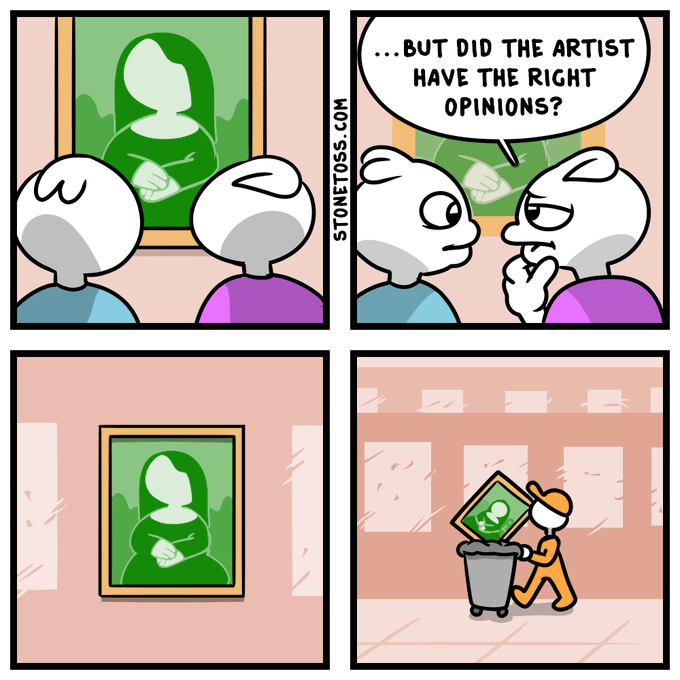
Hide your classic rock LP’s. The thought police at the New York Times are coming for them.
The New York Times opinion section has run a column advocating for classic rock songs like Don McLean’s “American Pie” to be reconsidered and maybe even “toppled” like historic Confederate statues, arguing that reevaluating beloved songs will help create a world that is “inclusive and more just.”
Other rock singers ripe for cancellation include Eric Clapton, Jerry Lee Lewis, Johnny Cash, and even Elvis Presley.
Jennifer Finney Boylan, who is a male-to-female transgender, laid out the case in the op-ed titled “Should Classic Rock Songs Be Toppled Like Confederate Statues?”
“As we take another look at the sins of our historical figures, we’ve also had to take a hard look at our more immediate past and present, including the behavior of the creators of pop culture,” Boylan wrote. “That reassessment extends now to the people who wrote some of our best-loved songs.”
Chief among the candidates for cancellation is “American Pie,” the 1971 classic song by Don McLean. Boylan cited past allegations of domestic violence made against McLean as justification for the song’s cancellation.
“I want to live in a world where I can be moved by art and music and literature without having to come up with elaborate apologies for that work or for its creators,” the columnist wrote.
From streaming services removing older episodes of “The Office” to scholars and teachers losing their jobs and suffering serious professional consequences, cancel culture is running rampant in America today. However, new data from the canonical American National Election Studies (ANES) reveals that significant numbers of Americans believe that cancel culture has gone too far. Self-censoring and easy offense are on the rise. And contrary to popular belief, younger Americans are just as likely as their older counterparts to view cancel culture as a net negative. Americans’ opinions of cancel culture and hypersensitivity fall along traditional ideological, educational, and racial lines, suggesting that this movement is anything but something exclusively spawned by younger Americans.
Specifically, the latest round of ANES data shows that non-trivially large numbers of Americans across all generational cohorts report censoring their speech at similar frequencies. Forty-five percent of Gen Zers (Americans ages 18 to 24) as well as 45 percent of Millennials (ages 25 to 40) say that they self-censor themselves at least occasionally. Forty-one percent of their Gen X parents (ages 41 to 57) report doing this, and 40 percent of their Boomer grandparents (ages 57 to 75) say the same. Ironically, those in the Silent Generation – Americans between ages 76 and 93 – are far less likely to report silencing themselves, with only 29 percent reporting doing so. Even if the eldest cohort is more open, the fact remains that almost 4 in 10 Americans readily concede that they limit and watch what they say on a fairly regular basis and think this is not healthy behavior in a democratic polity.
The Tokyo Olympic organizing committee fired the director of the opening ceremony on Thursday because of a Holocaust joke he made during a comedy show in 1998.
Organizing committee president Seiko Hashimoto said a day ahead of the opening ceremony that director Kentaro Kobayashi has been dismissed. He was accused of using a joke about the Holocaust in his comedy act, including the phrase “Let’s play Holocaust.”
“We found out that Mr. Kobayashi, in his own performance, has used a phrase ridiculing a historical tragedy,” Hashimoto said. “We deeply apologize for causing such a development the day before the opening ceremony and for causing troubles and concerns to many involved parties as well as the people in Tokyo and the rest of the country.”
White House Press Secretary Jen Psaki on Friday doubled down on the government’s censorship of Americans.
Psaki on Thursday casually admitted the federal government is censoring American citizens and flagging “problematic” social media posts.
“We’ve increased disinformation research and tracking within the Surgeon General’s office,” Psaki said Thursday. “We’re flagging problematic posts for Facebook that spread disinformation.”
On Friday Psaki took it to another level and said Americans who post “misinformation” should be completely unpersoned and should have no access to online platforms.


You must be logged in to post a comment.