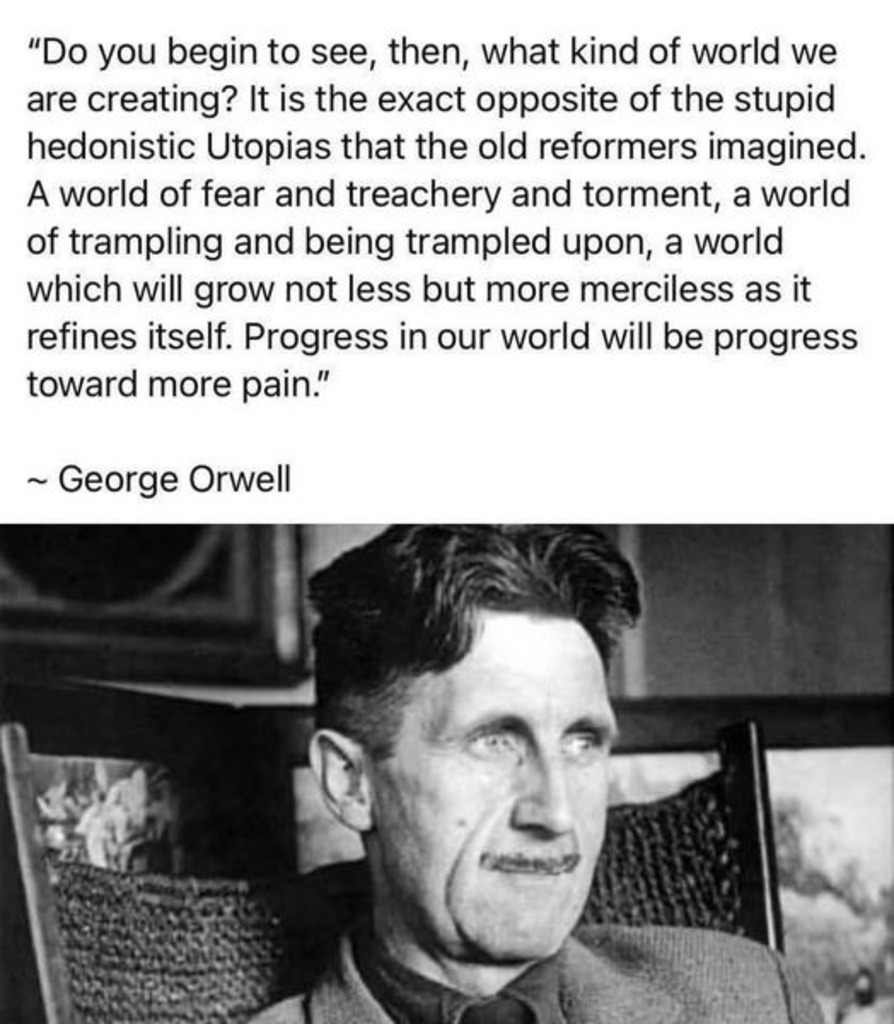
Sound familiar yet?


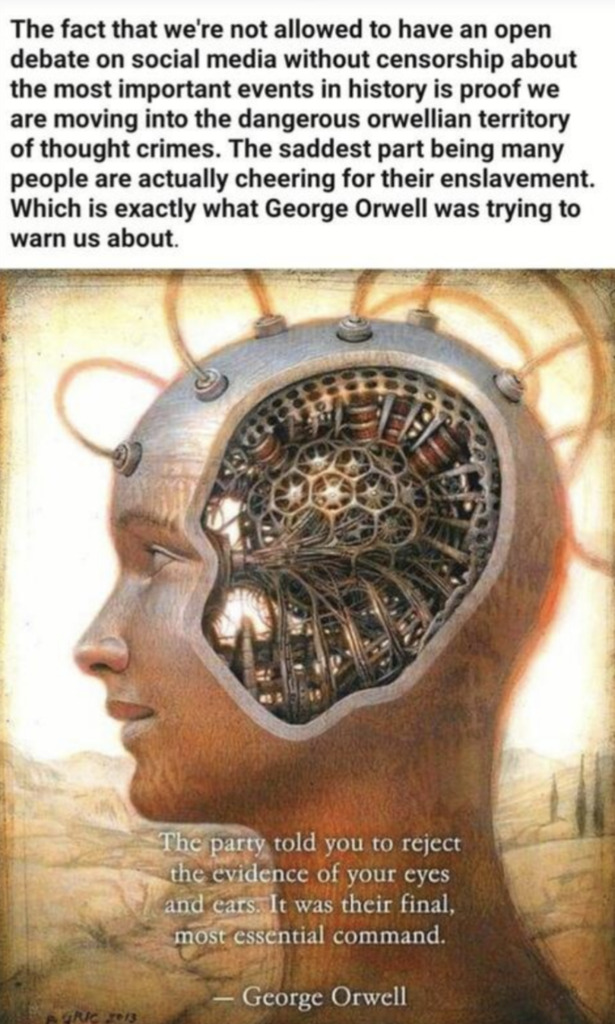

The ideal citizen of Orwell’s Oceania bubbled with rage a mile wide and a millimeter deep and could forget in an instant passions that may have consumed him or her for years. We just did this, with a pandemic that had the country steaming with indignation until it was quietly declared over the moment Putin rolled over Ukraine’s borders. We switched from “the pandemic of the unvaccinated” to “Putin’s price hikes” in a snap. National outrage moved a few lobes over with zero fuss, and now we hate new people; instead of “anti-vax Barbie,” we’re barring Russian and Belarussian kids from the Paralympics.
It appeared that there had even been demonstrations to thank Big Brother for raising the chocolate ration to twenty grams a week. And only yesterday, he reflected, it had been announced that the ration was to be reduced to twenty grams a week. Was it possible that they could swallow that, after only twenty-four hours? – 1984
A heartbeat ago politicians and pundits all over were denouncing Canadian trucker protests over reports of swastikas. “Conservative Party members can stand with people who wave swastikas,” said Prime Minister Justin Trudeau. This was despite the fact that even Snopes concluded the photographed “swastikas” weren’t expressions of neo-Nazi sentiment, but protesters comparing Justin Trudeau’s government to Nazis.
Now the swastika in the Ukrainian context has been un-banned by Facebook, you can buy Azov Battalion mugs and t-shirts on Amazon, and we have headlines like “Are there really neo-Nazis fighting for Ukraine? Well, yes — but it’s a long story.” In an effort to argue that Putin is worse than Hitler, we have people like Atlantic Council senior fellow Anders Aslund saying “Hitler had more arguments for his attack on Poland,” and former U.S. Ambassador and Stanford professor Michael McFaul saying on live TV that Hitler “didn’t kill ethnic Germans, German-speaking people.”
This isn’t to say the Russian propaganda about “deNazifying” Ukraine should be taken seriously, but it’s amazing, isn’t it, how quickly our conventional wisdom changes its stance even toward something like neo-Nazism — an absolute one day, an Amazon impulse buy the next.

Over the last 6 years, Facebook, now Meta, has clamped down on any and all calls for violence by users on its platform. Users who advocated for violence were banned and some of them were reported to authorities in the company’s attempt to make its platform a more peaceful place. But all that has changed now as the world slips into a scene from George Orwell’s dystopian novel, 1984.
On Thursday night, Reuters reported that Meta Platforms will now allow Facebook and Instagram users in some countries to call for violence against Russians in what they refer to as a “temporary change to its hate speech policy.”
Users can now openly advocate for the assassination of world leaders, so long as they are considered political enemies of the West. Russian President Vladimir Putin and Belarusian President Alexander Lukashenko are fair game in Meta’s new world.
“As a result of the Russian invasion of Ukraine we have temporarily made allowances for forms of political expression that would normally violate our rules like violent speech such as ‘death to the Russian invaders.’ We still won’t allow credible calls for violence against Russian civilians,” Meta spokesperson Andy Stone said in a statement.
If the user gets too detailed about how and where they are going to kill these Russians, only then will Facebook and Instagram draw the line.
Citing the Reuters story, Russia’s US embassy demanded that Washington stop the “extremist activities” of Meta allowing its users to call for violence.
“Users of Facebook & Instagram did not give the owners of these platforms the right to determine the criteria of truth and pit nations against each other,” the embassy said on Twitter Thursday night in response to the change.

Imagine waking up one day unable to access your bank account because of your political beliefs. Imagine faking your facial expression whenever people were around to avoid committing “facecrime.” Imagine if the economy ground to a halt like a train that ran out of fuel. Does it sound far off?
It may sound like paranoid hyperbole to say we are living in a dystopia. But the core of valuable dystopian fiction is exploring what elements of our society have effects that would, if taken to the extreme, destroy our freedom and go against human dignity.
My Out of Frame colleagues have analyzed the meaning and relevance of a variety of dystopian fiction: Demolition Man, The Hunger Games, Arcane, The Matrix, The Handmaid’s Tale, Brave New World, V for Vendetta. But what dystopia is most relevant right now? Here are three contenders (excluding examples that bear similarity purely due to the presence of a pandemic).

 Hellbound and Down
You must be logged in to post a comment.