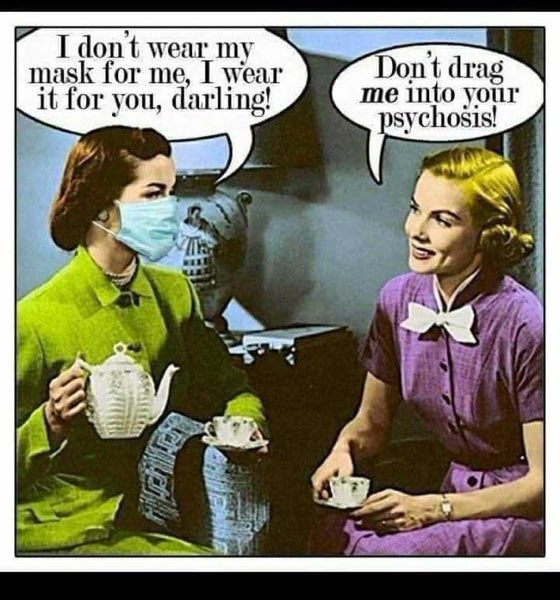
I’m perfectly fine over here…


The New York Times asked700 epidemiologists to describe their COVID-19 habits, how their thinking has changed since the pandemic began, and when they think it will be safe for normal life to resume. Dismayingly, several answered that last question with a resounding never.
“I expect that wearing a mask will become part of my daily life, moving forward, even after a vaccine is deployed,” Amy Hobbs, a research associate at the Johns Hopkins Bloomberg School of Public Health, told The Times.
Marilyn Tseng, an assistant professor at California Polytechnic State University, said life would never revert to the way it was, though the preventative measures currently practiced—masks and social distancing—will feel “normal” in time. Similarly, Vasily Vlassov, a professor at HSE University in Moscow, said life was perfectly normal now because this is the new normal.
Others disagreed. Michael Webster-Clark of the University of North Carolina at Chapel Hill said he expected “further relaxation of most precautions by mid-to-late summer 2021″ following widespread availability of the vaccine. Some epidemiologists said their own risk aversion would decrease after they were vaccinated, but many said they would remain just as cautious until”80 percent or more” of the entire population had received the vaccine.
Private jet company executive, Paul Alexander, 57, was arrested last week for allegedly trafficking and soliciting sex from two minors.
The Central Jet Charter CEO was arrested following a month-long probe by the NYPD and the state prosecutor’s office, according to a press release from the NY Attorney General. The investigation was dubbed “Operation Mile High,” on account of Alexander’s profession.

The Department of Defense released the first images of a Covid-19 vaccination record card and vaccination kits Wednesday.Vaccination cards will be used as the “simplest” way to keep track of Covid-19 shots, said Dr. Kelly Moore, associate director of the Immunization Action Coalition, which is supporting frontline workers who will administer Covid-19 vaccinations.
“Everyone will be issued a written card that they can put in their wallet that will tell them what they had and when their next dose is due,” Moore said. “Let’s do the simple, easy thing first. Everyone’s going to get that.”Vaccination clinics will also be reporting to their state immunization registries what vaccine was given, so that, for example, an entity could run a query if it didn’t know where a patient got a first dose.Moore said many places are planning to ask patients to voluntarily provide a cell phone number, so they can get a text message telling them when and where their next dose is scheduled to be administered.Every dose administered will be reported to the US Centers for Disease Control and Prevention, said Claire Hannan, executive director of the Association of Immunization Managers.The CDC did not immediately respond to CNN’s inquiry about whether such a database would include a record of everyone immunized.




You must be logged in to post a comment.