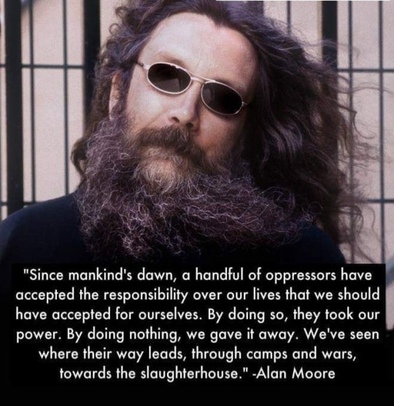
Alan Moore on responsibility and power…





If, through biotechnology, we could drastically enhance ourselves—such that our ability to absorb and manipulate information was unlimited, we experienced no disquiet, and we did not age—would we? Should we? For advocates of radical enhancement, or “transhumanism,” answering “yes” is a no-brainer. Accordingly, they press for the development of technologies that, by manipulating genes and the brain, would create beings fundamentally superior to us.
Transhumanism is far from a household term, but, whether or not they use the word publicly, its adherents are in places of power, especially in Silicon Valley. Elon Musk, the world’s richest person, is devoted to boosting “cognition” and co-founded the company Neuralink toward that end. Having raised more than $200 million in new funding in 2021, in January, Neuralink proclaimed its readiness to start human trials of brain-implantable computer chips for therapeutic purposes, to help those with spinal-cord injuries walk again. But Musk’s ultimate target in exploring brain-computer connections is “superhuman,” or “radically enhanced,” cognition—a top transhumanist priority. Those with radically heightened cognitive ability would be so advanced that they wouldn’t even really be human anymore but, instead, “posthuman.”
In transhumanist fantasy, posthumans could, philosopher Nick Bostrom assures us, “read, with perfect recollection and understanding, every book in the Library of Congress.” Similarly, according to futurist and transhumanist Ray Kurzweil—who has worked at Google since 2012—they would rapidly absorb the entire contents of the World Wide Web. Pleasure would be pervasive and boundless: Posthumans will “sprinkle it in [their] tea.” On the flip side, suffering wouldn’t exist, as posthumans would have “Godlike” control of their moods and emotions. Of course, posthuman bliss would not be supreme absent immortality. This last facet, the quest to conquer aging, already garners substantial backing from Silicon Valley. In 2013, Larry Page, Google’s co-founder—and CEO of its parent company, Alphabet, until December 2019—announced the launch of Calico Labs, whose mission is to understand aging and subvert it. A growing list of startups and investors, dedicated to the “reprogramming” of human biology with the defeat of aging in view, has entered the mix. This list now includes Amazon founder Jeff Bezos, who, in January, contributed to the $3 billion that launched Altos Labs.
Today, transhumanism’s name recognition has spread beyond Silicon Valley and academia. In 2019, an opinion piece in the Washington Post stated that “the transhumanism movement is making progress.” And a 2020 essay in the Wall Street Journal suggested that, by making “our biological fragility more obvious than ever,” COVID-19 may be “just the kind of crisis needed to turbocharge efforts” to achieve transhumanists’ goal of immortality.
You’re probably already familiar with certain enhancements—like athletes using steroids to gain a competitive advantage, or individuals using ADHD drugs like Ritalin and Adderall off label in search of a cognitive boost. But a chasm separates such enhancements from transhumanism, whose devotees would have us engineer a species-level upgrade of humanity into posthumanity. And key to all of transhumanism’s planned advancements, mental and physical, is a specific understanding of “information” and its causal dominance in relation to features that advocates prize. This focus on information is also transhumanism’s fatal flaw.
A state panel considering reparations for slavery in California, which entered the Union in 1850 as a free state, voted 5-4 on Tuesday to limit benefits to those who could actually show they were descended from slaves, not all who happen to be black.
As Breitbart News began reporting in 2020, Democrats in California passed legislation at the height of the Black Lives Matter riots to create a commission to consider the issue of reparations, even though the state was a free state at its birth:
Despite California’s free history, the reparations task force is assigned the mission of evaluating the history and impact of slavery on the United States as a whole.
The goal, as with many California policies, is to be a model for liberal policies elsewhere — or, as Newsom said, according to The Hill, to be “a paradigm that we hope will be resonant all across the United States.”
The nine-member panel, which did not appear to have any white or Hispanic members, launched last year, amid statements about the importance of slavery to the U.S. as a whole, and the anniversary of deadly race riots in Tulsa, Oklahoma, in 1921.
However, the panel could not agree for months on whether the proposed reparations for slavery should only include those who descended from black slaves, or those who could be construed broadly as victims of so-called “systemic racism.”
Finally, the panel decided to focus on descendants of slaves, for pragmatic reasons, the San Francisco Chronicle reported:
While the panel has have much work left to do, it is sharply divided after an emotional fight over the eligibility rules. The task force was split between two factions that are miles apart in their interpretation of whether reparations should be distributed using a lineage or race-based test.
…
[Chair Kamilah] Moore said while it might be hard for some to document their ancestry, a race-based standard would be far more challenging because it would require the state to define Blackness when a person’s racial identify can be subjective and could enable a host of false claims based on physical attributes like skin color.
…
Moore also evoked the stance of Secretary of State Shirley Weber, a former legislator who wrote the bill to create the task force. Weber previously implored members to keep their initial focus on reparations for people descended from slavery, so the effort doesn’t become so broad that nothing gets done. She has said people whose families came later did so willingly and without the economic burden of generations of unpaid labor.
The reparations would apply to all descendants of slaves in the U.S., not merely those who made their way to California.
The world’s first study to look for the presence of plastics in human blood detected particles in 77 per cent of those tested, new research has found.
PET plastic, most commonly used to produce drinks bottles, food packaging and clothes, was the most prevalent form of plastic in the human bloodstream.
The authors said plastic particles can enter the body from the air as well as through food and drink.
Dick Vethaak, professor of ecotoxicology and water quality and health at the Vrije Universiteit Amsterdam in the Netherlands, told The Independent the findings were “certainly alarming because it shows that people apparently ingest or inhale so much plastic that it can be found in the bloodstream”.
“Such particles can cause chronic inflammation,” he added.
Sen. Graham, Lindsey [R-SC], Sen. Kennedy, John [R-LA], Sen. Booker, Cory A. [D-NJ], Sen. Whitehouse, Sheldon [D-RI], Sen. Lummis, Cynthia M. [R-WY], Sen. Feinstein, Dianne [D-CA], Sen. Collins, Susan M. [R-ME], and Sen. Paul, Rand [R-KY] are all backing a bill that empowers mainstream media at the expense of smaller outlets and independent content creators.
The senators are co-sponsoring the Journalism Competition and Preservation Act which has been accused of actually hindering competition.
We obtained a copy of the bill for you here.
Instead of promoting competition in the world of media, the bill would allow mainstream media companies, like CNN, The New York Times, The Washington Post, and MSNBC to form an alliance and collectively bargain with Big Tech platforms.
These mainstream outlets would be able to form new deals with online platforms that would force tech platforms to uprank their own content at the expense of independent content creators and independent voices.
The bill has a provision allowing legacy media to exclude companies that are not “similarly situated,” meaning independent journalists and small media companies will not get the benefits of the bargains with Big Tech.
Tennessee’s Senator Marsha Blackburn has warned the bill would result in more censorship by Big Tech. Florida’s Sen. Marco Rubio aired similar concerns, saying the bill would strengthen the “collusion between Big Media and Big Tech.”
In a virtual meeting of Disney executives in response to Florida’s controversial parental rights bill, an executive producer for the iconic entertainment giant disclosed that her team has implemented her “not-at-all-secret gay agenda.”
Latoya Raveneau said she and her colleagues are regularly “adding queerness” to children’s programming.
The video was publicized exclusively by Christopher Rufo, whose research on Critical Race Theory in K-12 public schools has prompted parental activism across the nation.
Rufo also posted video of Disney corporate president Kathy Burke saying that “as the mother [of] one transgender child and one pansexual child,” she supports having “many, many, many LGBTQIA characters in our stories.” She said she wants a minimum of 50% of characters to be LGBTQIA and racial minorities.


You must be logged in to post a comment.