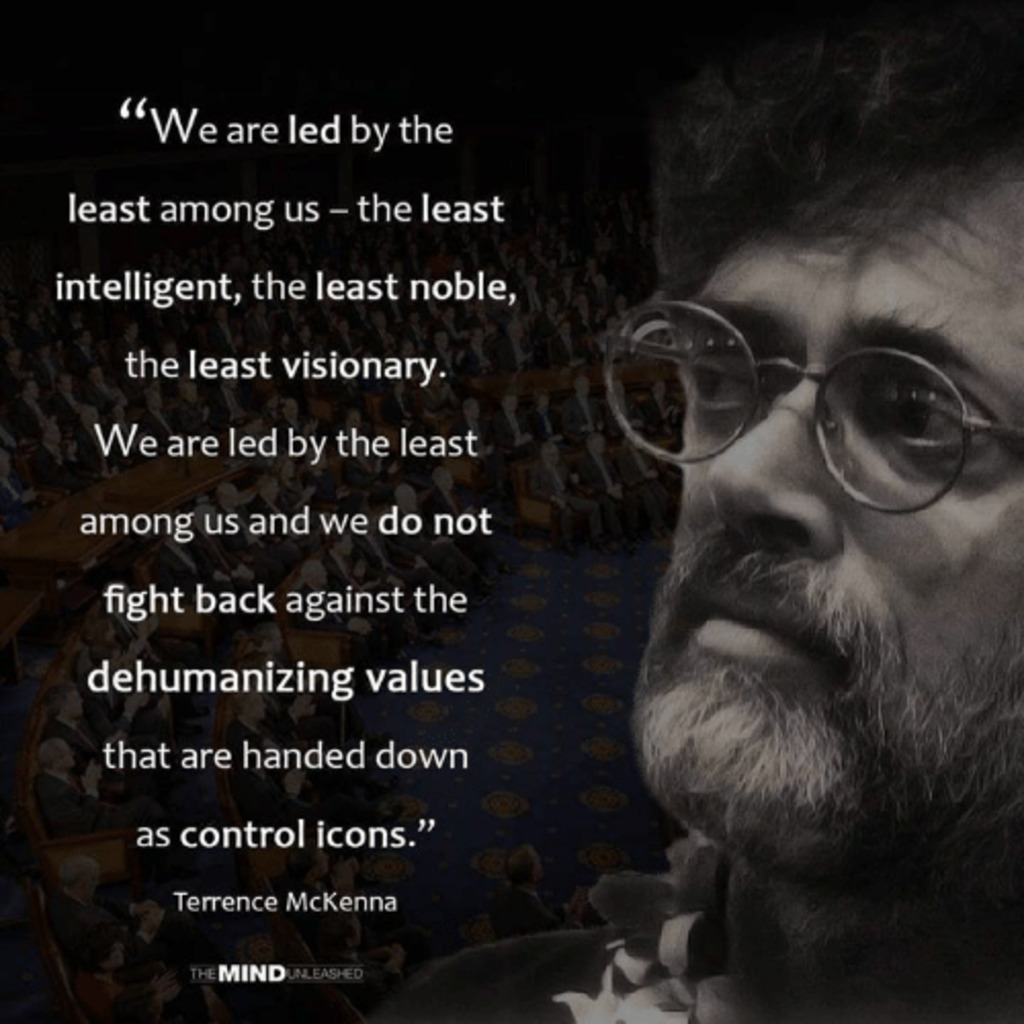
Terence McKenna on politicians…

Tardigrades are tiny organisms that can survive extreme environments including being chilled to near absolute zero. At these temperatures quantum effects such as entanglement become dominant, so perhaps it is not surprising that a team of physicists has used a chilled tardigrade to create an entangled qubit.
According to a preprint on the arXiv server, the team cooled a tardigrade to below 10 mK and then used it as the dielectric in a capacitor that itself was part of a superconducting transmon qubit. The team says that it then entangled the qubit – tardigrade and all – with another superconducting qubit. The team then warmed up the tardigrade and brought it back to life.
To me, the big question is whether the tardigrade was alive when it was entangled. My curiosity harks back to the now outdated idea that living organisms are “too warm and wet” to partake in quantum processes. Today, scientists believe that some biological processes such as magnetic navigation and perhaps even photosynthesis rely on quantum effects such as entanglement. So perhaps it is possible that the creature was alive and entangled at the same time.
In the preprint, the researchers say that the entangled tardigrade was in a latent state of life called cryptobiosis. They say they have shown that it is “possible to do a quantum and hence a chemical study of a system, without destroying its ability to function biologically”.
Newly released emails show Anthony Fauci and his boss at the US National Institutes of Health (NIH) wanted to conduct a “quick and devastating” take-down of health experts who proposed a lockdown-free Covid-19 control strategy.
The emails, released on Friday by the House Select Subcommittee on the Coronavirus Crisis, show retiring NIH Director Francis Collins telling Fauci in October 2020 to discredit the Great Barrington Declaration (GBD) – a statement that proposes working towards achieving herd immunity through “focused protection” of the most vulnerable.
Days after the GBD was released, Collins notified Fauci and other health officials about how the proposal from “three fringe epidemiologists” was getting a “lot of attention” and called for a “quick and devastating published take down of its premises.”
In July 2019 the FBI raided Jeffrey Epstein’s home in New York City. The FBI agents found damning information and evidence throughout his 7-story residence. The evidence included “numerous black binders” with white labels that had “clear pages containing thumbnail photos with CDs attached.”
FBI agents also found several items in a safe including “binders with CDs, various items of jewelry, external hard drives, lose diamonds, large amounts of U.S. currency and passports.”
The FBI later said the evidence in the safe went missing. Chris Wray’s FBI said they went back a few days later and the evidence had disappeared.
Thousands of previously hidden Pentagon documents show that the US air wars in the Middle East have been marked by “deeply flawed intelligence” and have killed thousands of civilians, many of them children, according to a shocking new report in the New York Times Saturday afternoon.
The 5-year Times investigation received more than 1,300 reports examining airstrikes in Iraq and Syria from September 2014 to January 2018, more than 5,400 pages in all. None of these records show any findings of wrongdoing on the actions of the US military.
The Times reporting confirms many of the previous reports by whistleblowers Daniel Hale, Chelsea Manning and others. On July 27, 2021, whistleblower Hale was sentenced to 45 months in federal prison for exposing the true civilian toll of the US drone program. “I am here because I stole something that was never mine to take — precious human life,” Hale said at his sentencing.
From the Times report:
The trove of documents — the military’s own confidential assessments of more than 1,300 reports of civilian casualties, obtained by The New York Times — lays bare how the air war has been marked by deeply flawed intelligence, rushed and often imprecise targeting and the deaths of thousands of civilians, many of them children, a sharp contrast to the American government’s image of war waged by all-seeing drones and precision bombs.
The documents show, too, that despite the Pentagon’s highly codified system for examining civilian casualties, pledges of transparency and accountability have given way to opacity and impunity. In only a handful of cases were the assessments made public. Not a single record provided includes a finding of wrongdoing or disciplinary action. Fewer than a dozen condolence payments were made, even though many survivors were left with disabilities requiring expensive medical care. Documented efforts to identify root causes or lessons learned are rare.
The air campaign represents a fundamental transformation of warfare that took shape in the final years of the Obama administration, amid the deepening unpopularity of the forever wars that had claimed more than 6,000 American service members. The United States traded many of its boots on the ground for an arsenal of aircraft directed by controllers sitting at computers, often thousands of miles away. President Barack Obama called it “the most precise air campaign in history.”
“It just doesn’t sit right with me,” begins a TikTok by a user named Evelyn Juarez. It’s a breakdown of the tragedy at Astroworld, the Travis Scott concert in early November where eight people died and more than 300 were injured. But the video isn’t about what actually happened there. It’s about the supposed satanic symbolism of the set: “They tryna tell us something, we just keep ignoring all the signs,” reads its caption, followed by the hashtags #wakeup, #witchcraft, and #illuminati.
Juarez, a 25-year-old in Dallas, is a typical TikToker, albeit a quite popular one, with 1.4 million followers. Many of her videos reveal an interest in true crime and conspiracy theories — the Gabby Petito case, for instance, or Lil Nas X’s “devil shoes,” or the theory that multiple world governments are hiding information about Antarctica. One of her videos from November suggests that a survey sent to Texas residents about the use of electricity for critical health care could signify that “something is coming and [the state government] knows it.”
Her beliefs are reminiscent of many others on the internet, people who speak of “bad vibes,” demonic spirits, or a cosmic calamity looming just over the horizon, one that the government may be trying to keep secret. Juarez tells me she was raised Christian, although at age 19 she began to have a more personal relationship with God outside of organized religion.
Today, she identifies more as spiritual, as an increasing number of young people do, many of them working out their ideas in real time online. They may talk about manifesting their dreams and faceless sex traffickers waiting to install tracking devices on women’s parked cars. Some might act almost as prophets or shamans, spreading the good word and guiding prospective believers, while others might just lurk in the comments. They might believe all or only some of these ideas — part of the draw of internet spirituality is that it’s perfectly pick-and-choosable — but more than anything, they believe in the importance of keeping an open mind to whatever else might be out there.
I asked Joseph Russo, a professor of anthropology at Wesleyan University, if this loosely related web of beliefs could ever come together to form into its own kind of religion. “I think it already has,” he says.
The necessity to control mass population in order to execute a political agenda is familiar from history.
During the 20th century, for example, both National Socialist Germany and the Soviet Union understood that indoctrinating the youths of their nations was the key to regime success.
Today’s youth appear to have been similarly brainwashed into being terrified of Covid-19, despite the fact that the virus has little effect on young people. Cases in point: I am most often scolded, chased down, or harassed by younger people when I dare to enter a business massless, in defiance of the needless local mandate.
I do get a certain number of adult busybodies threatening to deny me service (even though I qualify as medically exempt), but it’s mostly the younger demographics that seem desperate to conform.
It’s remarkable that forty years ago, it was our nation’s youth that refused to comply with authority. 1960’s America was about defying the Establishment. How did we get here?
Children under 17 account for 6.3 million positive tests in the U.S., out of 51.2 million in total. That’s 12 percent of the total cases for a group that represents about 25 percent of the total population. However, it has proven impossible to determine the number of cases that are symptomatic, and how many children had the Delta variant, which usually presents with fewer symptoms than the original strain.
Just under 700 children have died, nearly all of them as a result of multiple co-morbidities.
That’s the data. So why are kids so afraid? What we’re witnessing in America is the inevitable result of three trends.

Google has announced new notifications in Google Drive that show that the platform has restricted the sharing and access of files that violate its policies. In a blog post, the tech giant said that it will restrict the sharing of files that violate its Terms of Service and abuse program policies.
If a file is flagged for violating policies, the owner will still have full access but sharing will not be possible and those who already had a link will no longer have access.
The owner of the file will receive an email informing them their files have been restricted. They will be able to appeal the decision by requesting a review of their own document.
“When a Google Drive file is identified as violating Google’s Terms of Service or program policies, it may be restricted. When it’s restricted, you may see a flag next to the filename, you won’t be able to share it, and your file will no longer be publicly accessible, even to people who have the link,” the post states.


You must be logged in to post a comment.