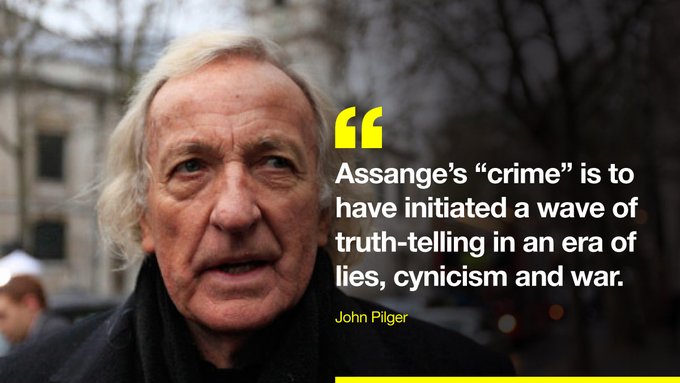
Reporters Claim Facebook is Censoring Information on Julian Assange Case

Craig Murray, the former British ambassador to Uzbekistan and longtime confidant of Julian Assange, has been fastidiously reporting on the Australian publisher’s extradition hearing to the United States. Yet few people have been reading it. This, according to Murray, is because of a deliberate decision by online media giants to downplay or suppress discussion of the case. On his blog, Murray wrote that he usually receives around 50 percent of his readers from Twitter and 40 percent from Facebook links, but that has dropped to 3 percent and 9 percent, respectively during the hearing. While the February hearings sent around 200,000 readers to his site daily, now that figure is only 3,000.

To be plain that is very much less than my normal daily traffic from them just in ordinary times. It is the insidious nature of this censorship that is especially sinister – people believe they have successfully shared my articles on Twitter and Facebook, while those corporations hide from them that in fact it went into nobody’s timeline,” he added.

Asked about the situation by former New York Times reporter Chris Hedges, Murray explained that

Anybody who is at all radical or takes any view of anything that is outwith the official establishment view gets used to occasional shadow banning, but I have never seen anything on this scale before.”

“90% of my traffic has just been cut off by what seems to be a general algorithm command of some kind to downplay Assange,” he added. “I think it is as simple as that.”

Keep reading

CRUMBLING CASE AGAINST ASSANGE SHOWS WEAKNESS OF “HACKING” CHARGES RELATED TO WHISTLEBLOWING

BY 2013, the Obama administration had concluded that it could not charge WikiLeaks or Julian Assange with crimes related to publishing classified documents — documents that showed, among other things, evidence of U.S. war crimes in Iraq and Afghanistan — without criminalizing investigative journalism itself. President Barack Obama’s Justice Department called this the “New York Times problem,” because if WikiLeaks and Assange were criminals for publishing classified information, the New York Times would be just as guilty.

Five years later, in 2018, the Trump administration indicted Assange anyway. But, rather than charging him with espionage for publishing classified information, they charged him with a computer crime, later adding 17 counts of espionage in a superseding May 2019 indictment.The alleged hacking not only didn’t happen, according to expert testimony, but it also couldn’t have happened.

The computer charges claimed that, in 2010, Assange conspired with his source, Chelsea Manning, to crack an account on a Windows computer in her military base, and that the “primary purpose of the conspiracy was to facilitate Manning’s acquisition and transmission of classified information.” The account enabled internet file transfers using a protocol known as FTP.

New testimony from the third week of Assange’s extradition trial makes it increasingly clear that this hacking charge is incredibly flimsy. The alleged hacking not only didn’t happen, according to expert testimony at Manning’s court martial hearing in 2013 and again at Assange’s extradition trial last week, but it also couldn’t have happened.

The new testimony, reported earlier this week by investigative news site Shadowproof, also shows that Manning already had authorized access to, and the ability to exfiltrate, all of the documents that she was accused of leaking — without receiving any technical help from WikiLeaks.

Keep reading

London Court Hears Details Of CIA Plot To Poison Julian Assange, Steal DNA From Family Members

Now in its second week, Julian Assange’s extradition hearing at the Old Baily in London just heard explosive testimony based on previously reported revelations that the CIA had actively plotted to assassinate him, by either poisoning or via a kidnapping plot.

The testimony is part of the defense team’s attempt to frame the US extradition case as entirely political in nature, and not based on breaking US law, but also toward convincing the judge that the WikiLeaks founder would certainly face extreme and excessive punishment, which would be cause for Britain to block the extradition.

Though mainstream media has by and large ignored much of the bombshell testimony from the hearing since last week, this latest cloak-and-dagger type information detailing just how far US intelligence was willing to go is impossible to ignore.

Keep reading

Julian Assange: Press Shows Little Interest in Media ‘Trial of Century’

Labeled the media “trial of the century,” WikiLeaks founder Julian Assange’s extradition hearing is currently taking place in London—although you might not have heard if you’re relying solely on corporate media for news. If extradited, Assange faces 175 years in a Colorado supermax prison, often described as a “black site” on US soil.

The United States government is asking Britain to send the Australian publisher to the US to face charges under the 1917 Espionage Act.  He is accused of aiding and encouraging Chelsea Manning to hack a US government computer in order to publish hundreds of thousands of documents detailing American war crimes, particularly in Afghanistan and Iraq. The extradition, widely viewed as politically motivated, has profound consequences for journalists worldwide, as the ruling could effectively criminalize the possession of leaked documents, which are an indispensable part of investigative reporting.

WikiLeaks has entered into partnership with five high-profile outlets around the world: the New York TimesGuardian (UK), Le Monde (France), Der Spiegel (Germany) and El País (Spain). Yet those publications have provided relatively little coverage of the hearing.

Keep reading

YouTube To End Election “Interference”… By Interfering With The Free Press

Ever heard of destroying something in order to save it? Check out the latest genius move in the name of virtue-signaling from YouTube.

The world’s largest video platform, with more than 2 billion users a month, will ban videos containing information that was obtained through hacking and could meddle with elections or censuses. That would include material like hacked campaign emails with details about a candidate. The update follows the announcement of a similar rule that Google, which owns YouTube, unveiled earlier this month banning ads that contain hacked information. Google will start enforcing that policy Sept. 1. 

Which is preposterous. If some kind of news from some kind of hack is hot, all that matters is whether it’s true or not, not whether it changes public perceptions. YouTube is focused on those ‘perceptions’ though and has changed its policy to make sure there is no change of perceptions. Status quo, anyone? They’re very fond of the status quo. It’s a stupid idea because we all know what this is about – the 2016 hacked John Podesta emails and all the interesting news about what Democrats say to each other away from the cameras and public relations spin operations. It was mostly inside baseball, and didn’t affect the election, but the Democrats, bitter about Hillary Clinton’s election loss, and still not admitting the problem was their bad candidate who refused to go to Wisconsin, continue to say it did.

This YouTube move accommodates their looney logic, which is a partisan political statement right there.

Keep reading

How We Could Wind Up Banned From Discussing An October Surprise On Social Media This Election

This by itself is an alarming assault on human communication and press freedom. If there is authentic information out there about either of the candidates who are up for the most powerful elected position on the planet, the world is entitled to know about it, regardless of how that information was acquired. Monopolistic tech oligarchs have no business barring us from learning about and discussing that information.

Immensely powerful people should not be permitted to have secrets from the public anyway. The amount of power one has should be directly inverse to the amount of secrecy they are permitted to have. If you’re anywhere near the presidency of the United States of America, the secrecy you are entitled to should be zero.

If a hacker is able to get ahold of accurate information about Donald Trump or Joe Biden, that information is ours. We’re entitled to it. Anyone who tries to obstruct our access to that information is stealing from us. It’s absolutely ridiculous that we have a society where people are permitted to both rule over us and keep secrets from us as it is without government-aligned tech plutocrats silencing our attempts to learn what those secrets might be.

Keep reading