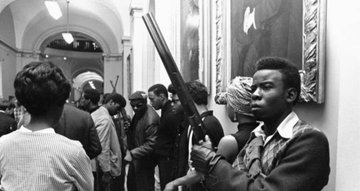
6 Other Times People Broke Into the U.S. Capitol

On Wednesday, protesters with a pro-Trump “Stop the Steal” rally broke through Capitol Police and breached the premises of the U.S. Capitol Building. Some of them even made it to the Capitol Rotunda and the Senate Floor. The U.S. Capitol has survived many invasions in the past, and it will endure through this one, as well.

Keep reading

Rage at Capitol assault makes excuses for summer riots all the more disgraceful

Wednesday’s mob assault on Capitol Hill was shocking and brazen: Hundreds of MAGA-hat-wearing rioters broke into the seat of American democracy. They stormed the halls, looting property and assaulting law enforcers, all in service of an absurd political demand: reversing the outcome of an election.

Now where had I witnessed such scenes before? The answer: in blue-governed cities in my native Pacific Northwest throughout last summer and into the fall and winter.

The right-wing political violence was met with universal rebuke from politicians of both parties and the media. But many of those who are loudest in condemning the Capitol Hill riot went radio-silent when rioters destroyed and looted in the name of Black Lives Matter.

Keep reading

Capitol Siege Shines Light On Vast Underground Tunnel Network

Even before this week’s unprecedented siege of the U.S. Capitol by a mob of supporters of President Donald Trump, which you can read about in the War Zone‘s rolling coverage of the events as they unfolded, there were ominous indicators of what was to come. This included the discovery of pipe bombs in the vicinity of nearby Congressional office buildings earlier in the day, which had prompted evacuations, at least in part through underground tunnels. When the Capitol itself was breached, members of Congress and Vice President Mike Pence, among others, were also ushered to safety via subterranean passageways.

These incidents highlighted the large tunnel network that lies under Capitol Hill, as well as other underground links throughout Washington, D.C. Many of these are used on a day-to-day basis just to conveniently get between government buildings without going outside, but, as was shown yesterday, they also have a clear value in helping people escape to safety during a crisis. Legislators had already been advised to make increased use of them on Jan. 6, simply to avoid encountering pro-Trump protesters.

Keep reading

Capitol Incident a Dress Rehearsal

With the normalization of mass shootings in the United States it is more than understandable that members of Congress feared for their lives when they learned protestors had forced their way into the Capitol in unknown numbers and were roaming around at will. 

But by the time it was over we knew that: only five weapons were seized by police so most of the intruders were probably unarmed; the only shots fired were by police who killed an unarmed female protestor; video and photos showed the demonstrators taking pictures of chambers and art work like they were tourists; and the occupiers were peacefully led out of the Capitol six hours later.  (Had they been anti-racism protestors one wonders how differently it would have ended.)

A dramatic event such as this is an old-time reporter’s dream, to just describe the facts and details as they emerged, painting a picture in words in print or on the radio. With so many mobile phone pictures and video as well as TV cameras everywhere, that journalistic function has been greatly diminished if not extinguished. In its place are preaching, partisan, editorialists masquerading as mainstream journalists.  

By the time it was over it was clear what had not happened:  it wasn’t a “coup,” it wasn’t an “insurrection,” it had nothing to do with Putin, or China or Iran and it wasn’t like Pearl Harbor, as Sen. Chuck Schumer ridiculously tried to call it. 

It wasn’t the storming of a “temple of democracy,” interrupting Congress’ “sacred duty,” or “desecrating” the “hallowed halls” of the Capitol. Such quasi-religious rhetoric inflates the self-importance of officials elevating themselves above the people they are supposed to serve. 

Keep reading

COMPUTERS WITH ACCESS TO CLASSIFIED MATERIAL STOLEN FROM CAPITOL

SOFREP source inside the Pentagon has confirmed that several classified SECRET laptops were stolen from the Capitol Building during Wednesday’s chaotic events. According to the source, who spoke to SOFREP under the condition of anonymity, some of the computers were left open and logged into the government’s classified network known as the SIPRNet.

SIPRNet, or the Secret Internet Protocol Router Network, is, simply put, the Department of Defense’s classified version of the civilian internet. It is a network of secure computers and servers that allows users from the Department of Defense, the Department of State, and other government bodies to transmit classified information.

On Thursday, following the breach of the Capitol building, the SIPRNet was shut down for a portion of the day before an update was pushed out, according to several SOFREP sources.

On Friday morning, according to sources inside, the operations center of the United States Army Special Operation Command, USASOC, sent out an email to all personnel saying that any SIPRNet computers not accounted for by the end of the day would be dropped from the network. A USASOC spokesperson confirmed the email but said it was “part of an ongoing administrative effort” which was “in no way related” to the events in Washington DC.

The Department of Justice has expressed concern over the theft of computers from the Capitol and has warned that some secret information may now be in play. On Wednesday, following the breach of the Capitol and the subsequent securing of the building, Senator Jeff Merkley posted on Twitter a video of the damage to his office which is located on a lower level of the building. In the video, he reports that his laptop was stolen.

Keep reading

D.C. Cop Speaks Out, Says Cops Were Among Rioters Storming Capitol, Flashed Badges to Get In

As the Free Thought Project reported this week, mainstream media outlets ran with headlines that police at the Capitol building were caught off guard and didn’t expect people to breach a series of fences leading up to the building. However, these protests were planned for weeks with Trump acting as the ring leader, instructing his followers to march on the capitol, carrying out plans that were publicly available on social media for weeks. Despite many on the right claiming Antifa was behind the violence, we are now learning something far more sinister was afoot.

It is now widely known that police officers removed the barricades after video emerged showing them removing barricades and allowing the rioters in to continue to the capitol steps.

Keep reading

Watch The Capitol Police Open The Doors And Invite Protesters In

Capitol police appeared to let a mass of Trump demonstrators right into the Capitol building at one entry point Wednesday after the crowd breached the perimeter surrounding the complex.

“I disagree with it but I respect what you’re trying to do,” one officer can be heard in the video.

Keep reading

MSM Already Using Capitol Hill Riot To Call For More Internet Censorship

The New York Times has published two new articles titled “The storming of Capitol Hill was organized on social media” and “Violence on Capitol Hill Is a Day of Reckoning for Social Media“, both arguing for more heavy-handed restrictions on speech from Silicon Valley tech giants.

In the former, NYT’s Sheera Frenkel writes “the violence Wednesday was the result of online movements operating in closed social media networks where people believed the claims of voter fraud and of the election being stolen from Mr. Trump,” citing the expert analysis of think tank spinmeister Renee DiResta of “Tulsi Gabbard is a Russian asset” fame. As usual no mention is made of DiResta’s involvement in the New Knowledge scandal in which a Russian interference “false flag” was staged for an Alabama Senate race.

“These people are acting because they are convinced an election was stolen,” DiResta said. “This is a demonstration of the very real-world impact of echo chambers.”

“This has been a striking repudiation of the idea that there is an online and an offline world and that what is said online is in some way kept online,” DiResta adds.

Keep reading