
According to a peer reviewed study published in a respected journal by the world’s most authoritative vaccine scientists, Bill Gates DTP vaccine killed 10 times more African girls than the disease itself. The vaccine apparently compromised their immune systems. Although, such study was never performed before 2017, Bill Gates and the Vaccine Alliance GAVI and WHO pushed the vaccines on unsuspecting African babies.
Tag: vaccines
Wife of ‘perfectly healthy’ Miami doctor, 56, who died of a blood disorder 16 days after getting Pfizer Covid-19 vaccine is certain it was triggered by the jab, as drug giant investigates first death with a suspected link to shot
The grieving wife of a leading Florida doctor has told DailyMail.com how her ‘perfect’ husband died from a mystery blood disorder – just days after getting the Pfizer Covid-19 vaccine.
Heidi Neckelmann says obstetrician Gregory Michael, 56 – her ‘best friend’ and partner of 28 years – was active, healthy and had no pre-existing conditions before getting the jab on December 18.
However he died from a stroke Sunday morning after suddenly developing a rare autoimmune illness that causes the body to destroy its own platelets, the tiny fragments that help blood to clot.
Distraught Heidi, 58, thinks the groundbreaking Pfizer-BioNtech vaccine may have somehow been the trigger.
‘In my mind his death was 100 percent linked to the vaccine. There is no other explanation,’ she told DailyMail.com, fighting back tears.
‘He was in very good health. He didn’t smoke, he drank alcohol once in a while but only socially. He worked out, we had kayaks, he was a deep sea fisherman.
‘They tested him for everything you can imagine afterwards, even cancer, and there was absolutely nothing else wrong with him.’
Pfizer told DailyMail.com Wednesday that it was aware of Dr. Michael’s ‘highly unusual’ death and was investigating further.
However a spokesman cautioned: ‘We don’t believe at this time that there is any direct connection to the vaccine.’
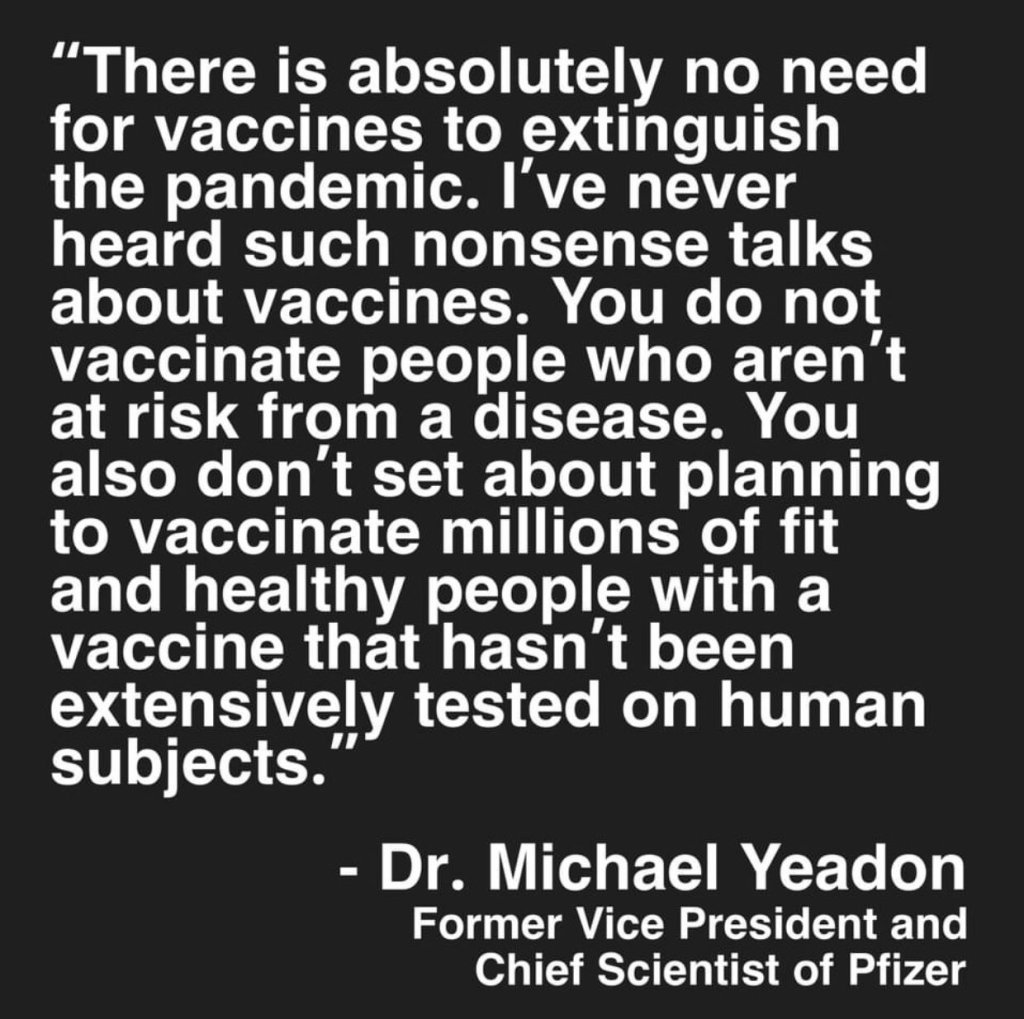
Michael Yeadon on vaccines…
Peru Slams Pfizer Over Legal Immunity For COVID Vaccine Side Effects
Health minister Pilar Mazzetti told lawmakers that she has been in “constant contact” with Pfizer since July. She was not able to elaborate in-depth due to a confidentiality agreement with the American multinational pharmaceutical company. But she did say contract disputes materialized in December.
“With Pfizer, there are some details where there is no agreement,” Mazzetti said. She added, “this has to do with prices and the delivery schedule” as well as “the waiving of important elements such as … jurisdictional immunity.”
“One indeed needs the vaccine, but it is also true that there are aspects related to aspects of our sovereignty that the country has to protect … it has to do with risk for future generations,” she said.
She told lawmakers, “we hope that the controversy will be resolved so we will be able to determine when the vaccine will arrive.”
Pharmacist accused of spoiling COVID-19 vaccine believed it would change people’s DNA, officials say
The pharmacist accused of intentionally spoiling nearly 600 doses of the Moderna COVID-19 vaccine at a clinic made his initial appearance in a Wisconsin court Monday.
Steven Brandenburg is the pharmacist accused of intentionally spoiling vials of vaccine at the Grafton Aurora Medical Center on Dec. 24.
According to a probable cause statement, Brandenburg removed the box containing the vaccine from a refrigerator and let it out for 12 hours, rendering it useless.
Brandenburg told investigators that he believed the vaccine was not safe for people and would “harm them and change their DNA,” the probable cause said.
Brandenburg, according to the Grafton Police Department, is an “admitted conspiracy theorist.”
Brandenburg was arrested on Dec. 31 on charges of first degree recklessly endangering safety, adulterating a prescription drug, and criminal damage to property.
Experimental COVID-19 mRNA Vaccines Are Operating System Designed To Program Human DNA, Says Moderna
Messenger RNA (mRNA) is found in all living cells. These strands of genetic code act as chemical intermediaries between the DNA in our chromosomes and the cellular machinery that produces the proteins we need to function: mRNA provides the instructions this machinery needs to assemble these proteins.
Moderna’s mRNA-1273 is programmed to make your cells produce the coronavirus’ infamous spike protein that gives the virus its crown-like appearance (“corona” is crown in Latin) for which it is named.
Moderna has made public that mRNA platforms are an “operating system” designed to program human DNA and turn their cells into efficient drug delivery systems.
D.C. Passes Bill to Immunize Children Without Parental Knowledge, Consent
Last month, the District of Columbia passed B23-017, a bill that allows children to be vaccinated without the knowledge or consent of their parents, the Washington Post noted.
The “Minor Consent for Vaccinations Amendment Act” permits a child aged 11 years or older “to consent to receive a vaccine where the vaccination is recommended by the United States Advisory Committee on Immunization Practices. It also establishes that if a minor is able to comprehend the need for, the nature of, and any significant risks inherent in the medical care then informed consent is established.”
The Post noted: “A bill passed by the D.C. Council on Tuesday would allow children as young as age 11 to obtain vaccinations without their parents’ consent. Under the legislation, if a doctor determines that a minor is capable of informed consent, they would be able to seek government-recommended vaccinations their parents object to on religious grounds. They also could get vaccinated against the human papillomavirus — which is recommended for older children but opposed by some parents because the virus is sexually transmitted and they object to their teenagers having sex.”
The bill not only permits children of this age to provide consent to doctors and other vaccine administrators without a parent’s knowledge or consent, but also requires insurance companies, school administrators, and medical personnel to conceal from parents that their child has been vaccinated.
Real estate moguls allegedly help rich pals jump COVID vaccine line
NYC real estate brothers Bill and David S. Mack allegedly personally arranged for a host of their wealthy friends from Manhattan and the ritzy Palm Beach Country Club to get the COVID-19 vaccine at a Florida retirement home.
While elderly Florida residents line up overnight for the vaccine, sources say the Macks allegedly “made a list” of one-percenters given the chance to receive the vaccine, and some even allegedly flew in on private jets from NYC for the jab.
The vaccine was administered at the not-for-profit nursing home Joseph L. Morse Health Center in Palm Beach, conveniently located on David S. Mack Drive in West Palm Beach, where — wait for it — David S. Mack is the chairman.
One source said, “David and Bill Mack arranged for their friends from the Palm Beach Country Club to be vaccinated for COVID-19. They apparently made a list of people who could get the vaccine, who one can only assume are their wealthy friends and clients.
Cuomo Creates New COVID Vaccination Obstacles To Help Fight Racism
Should a clinic administer the vaccine to somebody before their turn, they could face a fine of up to $1MM.
The reasoning behind the executive order appears to be preventing a “black market” for vaccines, or otherwise tying the system to wealth
Instead, Cuomo is creating another obstacle to swift distribution of vaccines, which could risk more of them possibly spoiling. He has also prioritized addicts in state rehabs for vaccination.
At this point, distributing vaccines to people out of turn hasn’t emerged as a problem. Instead, 3 weeks into the most ambitious vaccination campaign in modern US history, far fewer people than expected are being immunized against the virus as the process moves slower than officials had projected and has been beset by confusion and disorganization in many states. Of the more than 12 million doses of vaccines from Moderna and Pfizer-BioNTech that have been shipped, fewer than 3MM have been administered, per data from the CDC. As of Sunday, the state of NY has doled out roughly 1/3rd of the nearly 775K doses that have been distributed.
Rate Of Adverse Reactions To COVID Vaccines Already 50x Higher Than Flu Shot
With reports this morning of another otherwise-healthy patient dying suddenly after receiving her first dose of a COVID-19 vaccine, many skeptics in both Europe and the US still have serious reservations about the jabs, even as big pharma and their allies in the US and British governments insist that they are 100% safe. Everyone claiming otherwise is not only wrongheaded, but acting in a deliberately malicious manner.
This is why commentary like a video posted by DoubleLine’s Jeffrey Gundlach where he questions the sky-high efficacy numbers published after the Moderna and Pfizer-BioNTech trials has elicited such vehement repudiation.
However, as new questions about efficacy and timing arise, independent journalist Alex Berenson, one of the most prominent skeptics of lockdowns and masks in the US, noted in a twitter thread earlier on Tuesday that the percentage of patients experiencing severe or potentially life-threatening reactions to the COVID-19 vaccines could be much higher than the data collected by the CDC are letting on.
The CDC’s VAERS reporting system was set up to track vaccine-related injury, Most patients can expect to experience some kind of adverse reaction, but for the vast majority of patients, symptoms will be relatively mild and clear up within a couple of days. But amid a rush of reports about patient deaths, Berenson points out that the number of patients seeing serious complications per the number of doses distributed is roughly 50x higher than the rate of ‘adverse’ reactions caused by the flu vaccine.


You must be logged in to post a comment.