Apple and Meta Gave User Data to Hackers Who Used Forged Legal Requests

Apple and Meta provided basic subscriber details, such as a customer’s address, phone number and IP address, in mid-2021 in response to the forged “emergency data requests.” Normally, such requests are only provided with a search warrant or subpoena signed by a judge, according to the people. However, the emergency requests don’t require a court order.

Snap Inc. received a forged legal request from the same hackers, but it isn’t known whether the company provided data in response. It’s also not clear how many times the companies provided data prompted by forged legal requests.

Cybersecurity researchers suspect that some of the hackers sending the forged requests are minors located in the U.K. and the U.S. One of the minors is also believed to be the mastermind behind the cybercrime group Lapsus$, which hacked Microsoft Corp., Samsung Electronics Co. and Nvidia Corp., among others, the people said. City of London Police recently arrested seven people in connection with an investigation into the Lapsus$ hacking group; the probe is ongoing.

Keep reading

Bi-partisan bill would push Big Tech and Big Media to make content distribution deals

Sen. Graham, Lindsey [R-SC], Sen. Kennedy, John [R-LA], Sen. Booker, Cory A. [D-NJ], Sen. Whitehouse, Sheldon [D-RI], Sen. Lummis, Cynthia M. [R-WY], Sen. Feinstein, Dianne [D-CA], Sen. Collins, Susan M. [R-ME], and Sen. Paul, Rand [R-KY] are all backing a bill that empowers mainstream media at the expense of smaller outlets and independent content creators.

The senators are co-sponsoring the Journalism Competition and Preservation Act which has been accused of actually hindering competition.

We obtained a copy of the bill for you here.

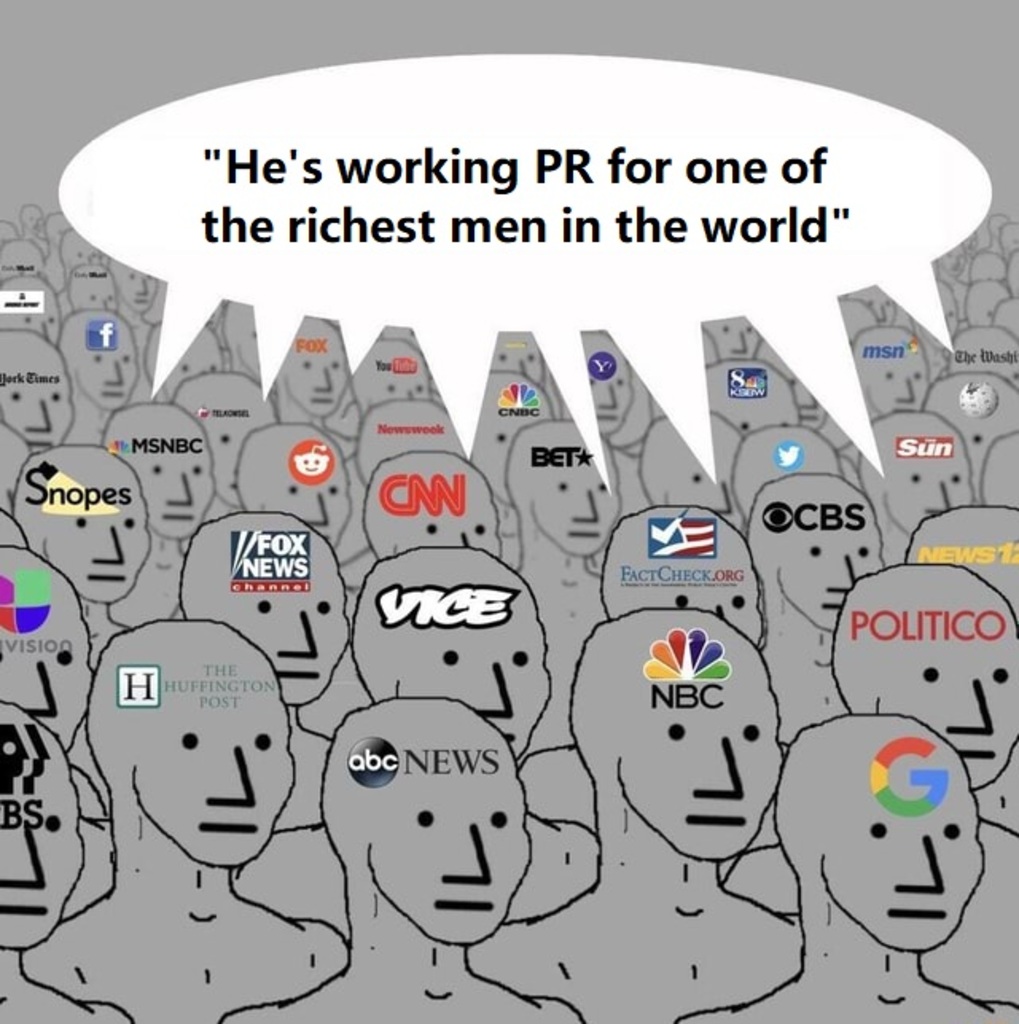
Instead of promoting competition in the world of media, the bill would allow mainstream media companies, like CNN, The New York Times, The Washington Post, and MSNBC to form an alliance and collectively bargain with Big Tech platforms.

These mainstream outlets would be able to form new deals with online platforms that would force tech platforms to uprank their own content at the expense of independent content creators and independent voices.

The bill has a provision allowing legacy media to exclude companies that are not “similarly situated,” meaning independent journalists and small media companies will not get the benefits of the bargains with Big Tech.

Tennessee’s Senator Marsha Blackburn has warned the bill would result in more censorship by Big Tech. Florida’s Sen. Marco Rubio aired similar concerns, saying the bill would strengthen the “collusion between Big Media and Big Tech.”

Keep reading

Meta paid GOP operatives to push negative stories about TikTok

Meta has hired a top GOP consulting firm to gin up rage against TikTok and deflect political scrutiny away from Facebook and Instagram, according to a report on Wednesday. 

The consulting firm, Targeted Victory, pushed to “get the message out that while Meta is the current punching bag, TikTok is the real threat especially as a foreign owned app that is #1 in sharing data that young teens are using,” according to an internal email from February reported by the Washington Post.  

Targeted Victory reportedly advanced Meta’s agenda by pushing news stories blaming dangerous online trends such as the “slap a teacher challenge” on TikTok — even though the trend actually originated on Facebook. 

The group also helped place op-eds and letters to the editor in local papers like the Denver Post and Des Moines Register, raising concerns about China “deliberately collecting behavioral data on our kids,” according to the report. 

Meta CEO Mark Zuckerberg has blamed TikTok for Facebook’s slowing user growth, which has contributed to its stock tanking 32.5% so far this year

Keep reading

Thought Police: Germany Conducts Mass Raids over Online ‘Insults’ Against Politicians

Federal police in Germany have conducted mass raids across 13 states on Tuesday over online ‘insults’ levied against politicians.

A large number of apartments and houses were raided in Germany on Tuesday as Federal police in the country look to prosecute those who made allegedly hateful remarks against elected officials online.

In total, federal authorities have said that they have checked over 600 statements for so-called “criminal content”, with 100 people being “searched and questioned” across 13 different German states.

According to a report by Der Spiegel, a significant number of raids have also been conducted, with the houses and apartments of those suspected of posting illegal online messages being searched by law enforcement for incriminating evidence.

Keep reading

The Kids Online Safety Act Is a Heavy-Handed Plan to Force Platforms to Spy on Young People

Putting children under surveillance and limiting their access to information doesn’t make them safer—in fact, research suggests just the opposite. Unfortunately those tactics are the ones endorsed by the Kids Online Safety Act of 2022 (KOSA), introduced by Sens. Blumenthal and Blackburn. The bill deserves credit for attempting to improve online data privacy for young people, and for attempting to update 1998’s Children’s Online Privacy Protection Rule (COPPA). But its plan to require surveillance and censorship of anyone under sixteen would greatly endanger the rights, and safety, of young people online.

KOSA would require the following:

  • A new legal duty for platforms to prevent certain harms: KOSA outlines a wide collection of content that platforms can be sued for if young people encounter it, including “promotion of self-harm, suicide, eating disorders, substance abuse, and other matters that pose a risk to physical and mental health of a minor.”
  • Compel platforms to provide data to researchers
  • An elaborate age-verification system, likely run by a third-party provider
  • Parental controls, turned on and set to their highest settings, to block or filter a wide array of content

There are numerous concerns with this plan. The parental controls would in effect require a vast number of online platforms to create systems for parents to spy on—and control—the conversations young people are able to have online, and require those systems be turned on by default. It would also likely result in further tracking of all users.

Keep reading

Social media company Minds and Daryl Davis tell Joe Rogan about new anti-censorship project

Minds.com co-founder Bill Ottman and activist Daryl Davis went on the “Joe Rogan Experience” to unveil their #ChangeMinds deradicalization initiative.

The team at blockchain-based social network Minds and Davis published a research paper outlining how “deplatforming actually intensifies extremism,” and argue how a new approach to online moderation is necessary.

One part of the discussion had Davis outlining his experiences on having debates with others on the Minds platform. While Rogan brings up how Davis convinced members of the KKK to change their viewpoints on race—as explored in his previous appearance—here the longtime activist refines his main point.

In explaining how a hypothetically intense discussion plays out, Davis highlights the importance of having the other person’s “walls come down.” That is to say, if Davis and a racist who hates black people can listen to each other’s viewpoints, at all whatsoever, it can have a significant impact on the racist in the long run.

Internet entrepreneur and Minds CEO Bill Ottman builds off the “walls coming down” point by adding how neuroscientist Sam Harris previously studied people’s actual brain waves with regards to how an individual subconsciously reacts to being presented with ideas or concepts they don’t like.

The key to #ChangeMinds, according to Ottman and Davis, is building long-term relationships between people of opposing viewpoints as its own main objective.

In describing the research paper, Minds staffers stated that their “paper examines the adverse effects of social media censorship and proposes an alternative moderation model based on free speech and Internet freedom.”

Keep reading

How Dem officials, the media and Big Tech worked in concert to bury the Hunter Biden story

Everlasting, undying, soul-rending shame be upon you, Facebook and Twitter and Politico and all the others who covered up, denied and suppressed this newspaper’s true and accurate reporting about Hunter Biden’s laptop in 2020. You should be hurling yourselves at the feet of the American people, begging forgiveness. You should be renting billboards saying, “WE LIED.”

But most importantly, you should be hauled before Congress to answer humiliating questions.

These and other information purveyors owe us — not just this paper, but this country — restitution for what now looks like the most egregious and willful fake-news scam of our time. This paper’s scoops on Hunter Biden’s laptop in 2020 were labeled “Russian misinformation” (Politico), a “hoax” (Steven Brill of “fact-check” site NewsGuard), discredited by “many, many red flags” (NPR) and a “hack and leak” operation that had to be throttled (Facebook’s Mark Zuckerberg).

Keep reading

People Overestimate The US War Machine And Underestimate The US Propaganda Machine

The European Endowment for Democracy is a spinoff of the US government-funded “NGO” National Endowment for Democracy, which according to its own co-founder was set up to do overtly what the CIA used to do covertly, namely orchestrate coups and manage narratives to advance US interests. A page on an NED website says that “All EU member states are members of EED’s Board of Governors, together with members of the European Parliament and civil society experts.”

So this is a media outlet funded by a government-run “NGO” being forcefully pushed in front of millions of western eyeballs by a major Silicon Valley corporation that people have come to rely on for getting information about the world. In the same way Silicon Valley facilitates government censorship by proxy, it also facilitates government propaganda by proxy.

The Globe and Mail reports that the Canadian government also put $200,000 toward Kyiv Independent’s funding. The outlet is being so loudly amplified by Twitter that not only has its Twitter account secured nearly two million followers since its creation in November, but one of its reporters (who calls the neo-Nazi Azov Battalion his “brothers in arms“) has gained a million followers since the start of the Russian invasion.

Do you see how sophisticated just that one tiny component of the US-centralized empire‘s propaganda campaign is? How many seemingly disparate and unrelated elements it has? Multiple countries, NGOs, an ostensibly independent social media platform, an ostensibly independent news outlet. It’s very difficult to see how any of it connects at all if you don’t know where to look. And almost nobody knows where to look.

This highly advanced perception management operation is happening all around the world about any issue the empire has a vested interest in. As anti-imperialist author and podcaster Justin Podur recently put it, “The US Empire is based on the mastery of storytelling. Making reality through propaganda.”

Keep reading

This Is the End of Free Speech Online

The internet has changed radically in the past decade or so. Where social-media giants once boasted about being ‘the free speech wing of the free speech party’, in recent years, Facebook, Twitter, YouTube and other platforms have become increasingly censorious, cracking down on dissenting views and offensive speech. Big Tech has relished this role as the unofficial arbiter of acceptable thought. But while the likes of Facebook may have severely wounded free speech online, it could be the UK government that deals the killer blow.

This week the long-awaited Online Safety Bill was published, which aims to make the UK the ‘safest place to be online in the world’ – in other words, the country with the most strictly regulated and censored internet of any liberal democracy. This mammoth piece of legislation was five years in the making, and those five years show. The bill is vast in scope, and terrifying in its implications for free speech.

Most significant is the ‘duty of care’ the bill imposes on social-media firms. Tech platforms will be legally required to prevent users from seeing both illegal content and ‘legal but harmful content’.

What actually constitutes ‘harmful content’ has yet to be revealed. If the Online Harms White Paper (published in 2020) is any guide, then this is likely to include content which might cause psychological harm, disinformation and trolling or harassment. Of course, all of these ‘harms’ are subjective. ‘Trolling’ can extend from playful banter to persistent harassment. Which views tech firms consider to be ‘disinformation’ has less to do with lies and truth than political expediency.

Once this list of harms is approved by parliament, the culture secretary will have the power to add more categories of harm, and firms will be required to report new ‘emerging harms’ to Ofcom, the UK’s communications regulator. So we should expect the bill’s censorious remit to expand over time.

Firms which fail to comply with the new duty-of-care requirements, or are obstructive or provide false information to Ofcom, can be fined up to 10 per cent of their annual worldwide revenue, and platform executives can be sentenced to up to two years in jail. These severe penalties have allowed UK culture secretary Nadine Dorries to claim that she is taking on Big Tech, and that she is holding Silicon Valley firms ‘accountable’. But it is not Big Tech firms that suffer when free speech is curtailed online. Indeed, they have already demonstrated their indifference to free speech.

After all, it is not Facebook, Twitter or Google that produce the ‘harmful’ content the government wants to eliminate. It is us, the users of social media, the deplorable, unruly citizens, who are saying things that our political masters would rather we did not say. It is our ability to express ourselves that will be curtailed by this legislation, not theirs. And this is why this bill is so troubling.

Keep reading