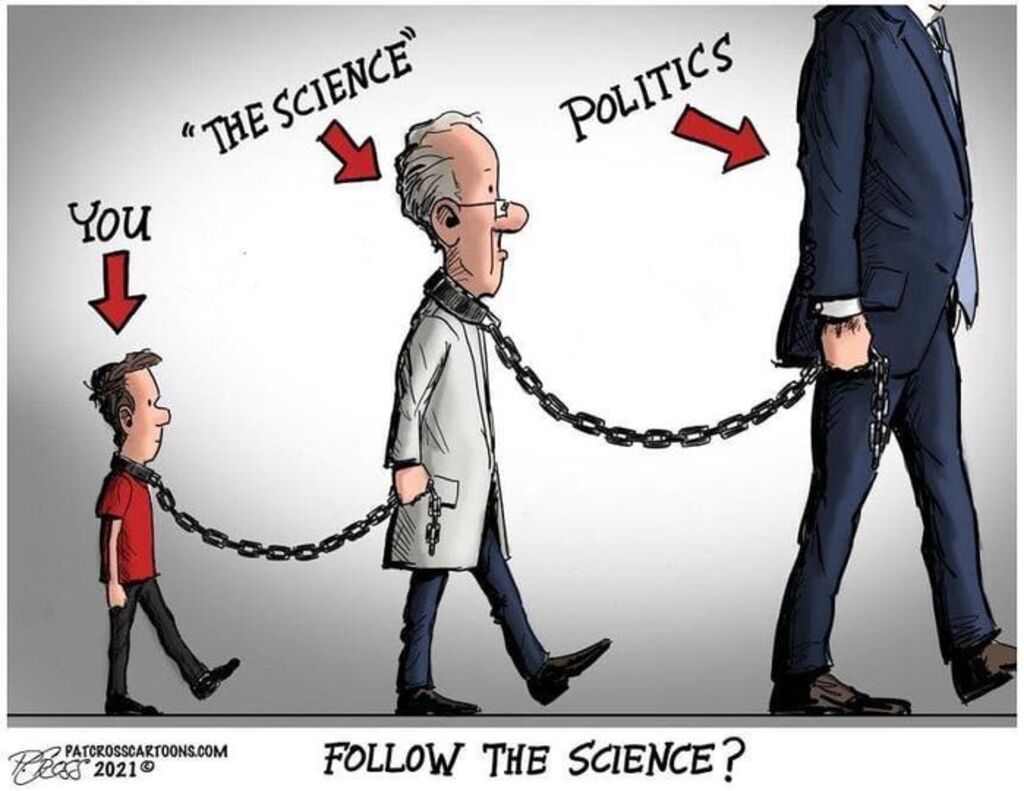
Follow the mon…er…science!

It was a common theme heard throughout 2020 — Donald Trump would dispute recommendations from the Center for Disease Control, and in the course of ‘’ignoring science’’ put lives at risk. As far back as February Trump was said to have discounted advice from the CDC regarding flying American citizens back from Asia. Frequently we were told how the administration would discard recommendations from the agency on matters such as initial quarantine orders, reopening the economy, how he would listen to administration officials first, and refused to follow guidance on opening schools and churches.
According to Bloomberg News, ‘’Ordinarily, presidents listen to experts because it serves their own political interests. That’s not happening this time.’’ These issues, of course, caused consternation and accusations he was ignoring science, elevating things to scandal levels, we were told. It then becomes rather telling how changing the curtains in the oval office makes these exact same actions far less serious and grave for the nation.
For two consecutive days this week we have seen bright and shiny new White House Press Secretary Jen Psaki at the podium during her daily press briefings contradicting the CDC, directly. While her words were reported what is notable is the distinct lack of wailing to be heard from the press corps.

Geologist and earth scientist Professor Ian Plimer says the “climate is cyclical” as a new study claims Earth is heading to an ice age.
“We are getting towards the end of the warm period, the peak of the warmth was about 5,000 years ago and we are heading for the next inevitable ice age,” he told Sky News host Cory Bernardi.
Professor Plimer says every occurrence of icebergs expanding and shrinking happened with “more carbon dioxide in the atmosphere than now”.
All wireless and/or “Smart” technology is vulnerable to hacking (see 1, 2, 3, 4, 5) and other significant mishaps (see 1, 2). Serious warnings about Internet of Things (IoT) technology’s high failure rate and enormous vulnerability to hackers have been ongoing for years. Last August, IBM warned about a security flaw in millions of IoT devices including “Smart” Meters and medical implants.
In December, President Trump signed IoT Cybersecurity Improvement Act of 2020 to create standards and guidelines on the use and management of IoT devices by federal agencies.
Nevertheless, sensors that operate and transmit wirelessly are still being used and/or considered for critical tasks including sewage maintenance. Scientists at MIT have taken this even farther.
A team has proposed using nanobots to create the ‘internet of thoughts’, where instant knowledge could be downloaded just by thinking it.
An international team of scientists led by members of UC Berkeley and the US Institute for Molecular Manufacturing predicts that exponential progress in nanotechnology, nanomedicine, artificial intelligence (AI) and computation will lead this century to the development of a human ‘brain-cloud interface’ (B-CI).
Writing in Frontiers in Neuroscience, the team said that a B-CI would connect neurons and synapses in the brain to vast cloud computing networks in real time.
Such a concept isn’t new with writers of science fiction, including Ray Kurzweil, who proposed it decades ago. In fact, Facebook has even admitted it is working on a B-CI.
However, Kurzweil’s fantasy about neural nanobots capable of hooking us directly into the web is now being turned into reality by the senior author of this latest study, Robert Freitas Jr.

A team of researchers from the University of Vermont and Tufts University has succeeded in developing robots composed exclusively of living biological cells. Dubbed “xenobots,” these living robots can perform a range of basic functions, from locomotion and object manipulation to collective behavior. Their creation promises to deliver significant advances in biology and in medicine, in particular. However, it also potentially carries serious risks, insofar as the researchers themselves admit that experimenting with living cells creates the scope for unforeseen consequences.
Putting such risks aside for one moment, the team’s development of “xenobots” is impressive. First, the scientists at Vermont simulated possible configurations of individual biological cells on a supercomputer. They used what’s called an evolutionary algorithm to test thousands of possibilities and find the best candidates, ‘best’ in terms of the known biophysics of biological cells, which in this case were frog cells.
Hitler and his henchmen victimized an entire continent and exterminated millions in his quest for a co-called “Master Race.”
But the concept of a white, blond-haired, blue-eyed master Nordic race didn’t originate with Hitler. The idea was created in the United States, and cultivated in California, decades before Hitler came to power. California eugenicists played an important, although little known, role in the American eugenics movement’s campaign for ethnic cleansing.
Eugenics was the racist pseudoscience determined to wipe away all human beings deemed “unfit,” preserving only those who conformed to a Nordic stereotype. Elements of the philosophy were enshrined as national policy by forced sterilization and segregation laws, as well as marriage restrictions, enacted in twenty-seven states. In 1909, California became the third state to adopt such laws. Ultimately, eugenics practitioners coercively sterilized some 60,000 Americans, barred the marriage of thousands, forcibly segregated thousands in “colonies,” and persecuted untold numbers in ways we are just learning. Before World War II, nearly half of coercive sterilizations were done in California, and even after the war, the state accounted for a third of all such surgeries.
California was considered an epicenter of the American eugenics movement. During the Twentieth Century’s first decades, California’s eugenicists included potent but little known race scientists, such as Army venereal disease specialist Dr. Paul Popenoe, citrus magnate and Polytechnic benefactor Paul Gosney, Sacramento banker Charles M. Goethe, as well as members of the California State Board of Charities and Corrections and the University of California Board of Regents.
Eugenics would have been so much bizarre parlor talk had it not been for extensive financing by corporate philanthropies, specifically the Carnegie Institution, the Rockefeller Foundation and the Harriman railroad fortune. They were all in league with some of America’s most respected scientists hailing from such prestigious universities as Stamford, Yale, Harvard, and Princeton. These academicians espoused race theory and race science, and then faked and twisted data to serve eugenics’ racist aims.
Stanford president David Starr Jordan originated the notion of “race and blood” in his 1902 racial epistle “Blood of a Nation,” in which the university scholar declared that human qualities and conditions such as talent and poverty were passed through the blood.


You must be logged in to post a comment.