It bears repeating…


Sailing through the smooth waters of vacuum, a photon of light moves at around 300 thousand kilometers (186 thousand miles) a second. This sets a firm limit on how quickly a whisper of information can travel anywhere in the Universe.
While this law isn’t likely to ever be broken, there are features of light which don’t play by the same rules. Manipulating them won’t hasten our ability to travel to the stars, but they could help us clear the way to a whole new class of laser technology.
Physicists have been playing hard and fast with the speed limit of light pulses for a while, speeding them up and even slowing them to a virtual stand-still using various materials like cold atomic gases, refractive crystals, and optical fibers.
This time, researchers from Lawrence Livermore National Laboratory in California and the University of Rochester in New York have managed it inside hot swarms of charged particles, fine-tuning the speed of light waves within plasma to anywhere from around one-tenth of light’s usual vacuum speed to more than 30 percent faster.
This is both more – and less – impressive than it sounds.
To break the hearts of those hoping it’ll fly us to Proxima Centauri and back in time for tea, this superluminal travel is well within the laws of physics. Sorry.
In a scenario straight out of “The Twilight Zone,” a group of NASA scientists working on an experiment in Antarctica have detected evidence of a parallel universe — where the rules of physics are the opposite of our own, according to a report.
The concept of a parallel universe has been around since the early 1960s, mostly in the minds of fans of sci-fi TV shows and comics, but now a cosmic ray detection experiment has found particles that could be from a parallel realm that also was born in the Big Bang, the Daily Star reported.
The experts used a giant balloon to carry NASA’s Antarctic Impulsive Transient Antenna, or ANITA, high above Antarctica, where the frigid, dry air provided the perfect environment with little to no radio noise to distort its findings.
A constant “wind” of high-energy particles constantly arrives on Earth from outer space.

Back in 2014, HuffPost ran an article that discussed 12 words that have been so overused and misused that “they really don’t mean anything anymore.” Words like “literally,” “awesome,” “honestly,” and “unbelievable” all rightly made the list.
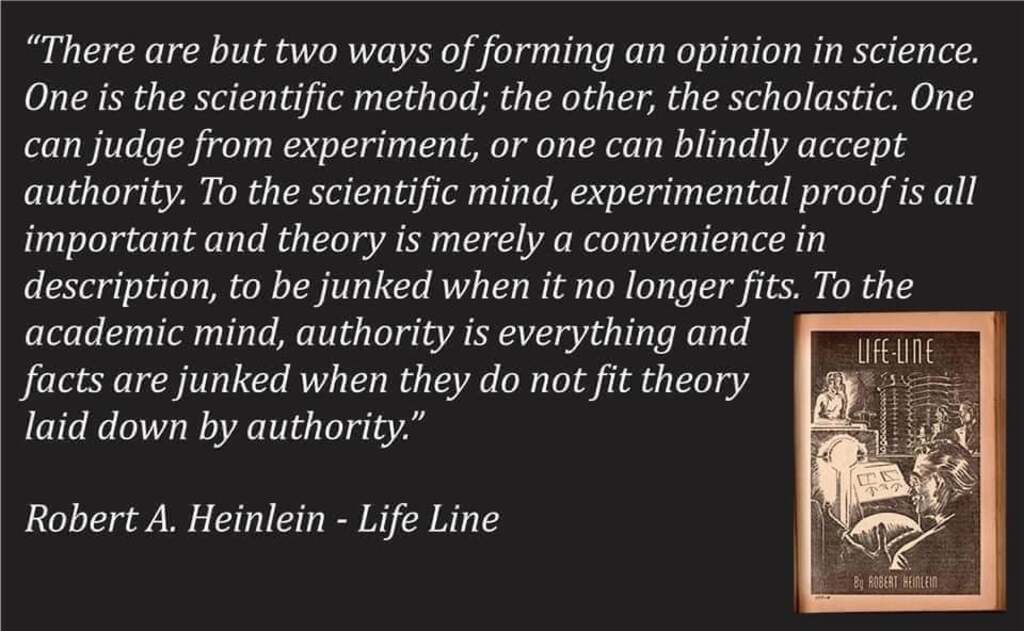
I’d like to submit a 2021 revision, suggesting that we add the word “science” to the archive. Whatever it once meant, over the course of this last year mankind has watched it be sautéed, filleted, and utterly obliterated on the altar of Covid, face masks, and vaccines to the point it has become void of any objective definition.
Just in recent days the butchery of science has become epic.
Scientific research findings that are probably wrong gain far more attention than robust results, according to academics who suspect that the bar for publication may be lower for papers with grabbier conclusions.
Studies in top science, psychology and economics journals that fail to hold up when others repeat them are cited, on average, more than 100 times as often in follow-up papers than work that stands the test of time.
The finding – which is itself not exempt from the need for scrutiny – has led the authors to suspect that more interesting papers are waved through more easily by reviewers and journal editors and, once published, attract more attention.
“It could be wasting time and resources,” said Dr Marta Serra-Garcia, who studies behavioural and experimental economics at the University of California in San Diego. “But we can’t conclude that something is true or not based on one study and one replication.” What is needed, she said, is a simple way to check how often studies have been repeated, and whether or not the original findings are confirmed.
The study in Science Advances is the latest to highlight the “replication crisis” where results, mostly in social science and medicine, fail to hold up when other researchers try to repeat experiments. Following an influential paper in 2005 titled Why most published research findings are false, three major projects have found replication rates as low as 39% in psychology journals, 61% in economics journals, and 62% in social science studies published in the Nature and Science, two of the most prestigious journals in the world.
Working with Uri Gneezy, a professor of behavioural economics at UCSD, Serra-Garcia analysed how often studies in the three major replication projects were cited in later research papers. Studies that failed replication accrued, on average, 153 more citations in the period examined than those whose results held up. For the social science studies published in Science and Nature, those that failed replication typically gained 300 more citations than those that held up. Only 12% of the citations acknowledged that replication projects had failed to confirm the relevant findings.
The academic system incentivises journals and researchers to publish exciting findings, and citations are taken into account for promotion and tenure. But history suggests that the more dramatic the results, the more likely they are to be wrong. Dr Serra-Garcia said publishing the name of the overseeing editor on journal papers might help to improve the situation.
At the end of a recent 800-meter race in Oregon, a high-school runner named Maggie Williams got dizzy, passed out and landed face-first just beyond the finish line. She and her coach blamed her collapse on a deficit of oxygen due to the mask she’d been forced to wear, and state officials responded to the public outcry by easing their requirements for masks during athletic events.
But long before the pandemic began, scientists had repeatedly found that wearing a mask could lead to oxygen deprivation. Why had this risk been ignored?
One reason is that a new breed of censors has been stifling scientific debate about masks on social-media platforms. When Scott Atlas, a member of the Trump White House’s coronavirus task force, questioned the efficacy of masks last year, Twitter removed his tweet. When eminent scientists from Stanford and Harvard recently told Florida Gov. Ron DeSantis that children should not be forced to wear masks, YouTube removed their video discussion from its platform. These acts of censorship were widely denounced, but the social-media science police remain undeterred, as I discovered when I recently wrote about the harms to children from wearing masks.

Tardigrades are one of nature’s most indestructible lifeforms. These microscopic animals can survive both freezing and boiling temperatures, pressures equivalent to those six miles under the ocean, and even the vacuum of outer space.
But for one pair of scientists, a lingering question remained: can tardigrades survive being shot out of a gun headlong into an impact target?
It’s a worthy hypothetical in any context, but there also happens to be a legitimate scientific reason to conduct such an experiment. For decades, scientists have speculated about the possibility that hardy organisms might be able to survive trips between planets by hitchhiking on meteorites. This theory of interplanetary cross-pollination, known as panspermia, has implications for understanding how life might have emerged on Earth and whether it is common elsewhere in the universe.
With this in mind, Alejandra Traspas and Mark Burchell, a PhD student and professor of space science at the University of Kent, respectively, sought to determine whether spacefaring tardigrades would be able to withstand the sudden impact of arrival at an alien world.
In a study published this month in the journal Astrobiology, the researchers point out that “there is no knowledge of how [tardigrades] survive impact shocks” and so “accordingly, we have fired tardigrades at high speed in a gun onto sand targets, subjecting them to impact shocks and evaluating their survival.”
“We had no real info, only guesswork,” Burchell said in an email. He noted that past studies of tardigrade-scale seeds break apart when they impact at speeds over 2,200 miles per hour, and at shock pressures of 1 gigapascal (GPa), which suggested that it “might be an interesting regime to test” actual tardigrades in the same conditions.Tech
“The results were however a surprise in that the tardigrades seemed to recover from impacts, right up to speeds which started to physically tear them into pieces,” Burchell added.

You must be logged in to post a comment.