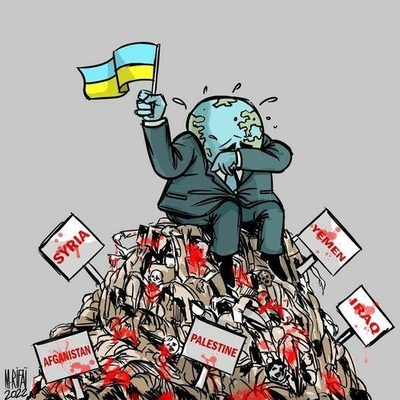
International Law Is A Meaningless Concept When It Only Applies To US Enemies

Australian whistleblower David McBride just made the following statement on Twitter:

“I’ve been asked if I think the invasion of Ukraine is illegal.

My answer is: If we don’t hold our own leaders to account, we can’t hold other leaders to account.

If the law is not applied consistently, it is not the law.

It is simply an excuse we use to target our enemies.

We will pay a heavy price for our hubris of 2003 in the future.

We didn’t just fail to punish Bush and Blair: we rewarded them. We re-elected them. We knighted them.

If you want to see Putin in his true light imagine him landing a jet and then saying ‘Mission Accomplished’.”

As far as I can tell this point is logically unassailable. International law is a meaningless concept when it only applies to people the US power alliance doesn’t like. This point is driven home by the life of McBride himself, whose own government responded to his publicizing suppressed information about war crimes committed by Australian forces in Afghanistan by charging him as a criminal.

Neither George W Bush nor Tony Blair are in prison cells at The Hague where international law says they ought to be. Bush is still painting away from the comfort of his home, issuing proclamations comparing Putin to Hitler and platforming arguments for more interventionism in Ukraine. Blair is still merily warmongering his charred little heart out, saying NATO should not rule out directly attacking Russian forces in what amounts to a call for a thermonuclear world war.

They are free as birds, singing their same old demonic songs from the rooftops.

Keep reading

NATO is Not a Defensive Alliance

Indeed, from its founding NATO has been an aggressive alliance designed to hem in the then Soviet Union, and to to threaten it with destruction by US nuclear weapons which were and still are stored in member countries, sometimes actually mounted on missiles and available for rapid loading onto US and NATO bombers parked on air bases all over Europe. That hemming-in process today, following decades of further expansion of NATO following the Soviet Union’s collapse, includes adding members located right up on the Russian border in countries like Poland, Estonia and Latvia (where US rockets and nuclear-capable planes are minutes away from critical Russian targets like army and air bases, as well as major navy ports.

NATO was founded in early April 1949 when the Soviet Union didn’t even have a single nuclear weapon and was not expected by US scientists and security people to get one for another 5-10 years. Yet the organization was also founded at a time that the US, which was working round the clock to industrialize production of its new, initially hand-made atomic bombs, had already assembled and stockpiled over 200 of these city-destroying weapons. That is a pretty awesome arsenal for a country that at that time had no rival in destructive capability.

Add to that reality the fact that the US was also already well on the way to producing a vastly more powerful hydrogen bomb (a project that Los Alamos scientists began almost immediately working on right after the August 1945 surrender of Japan). Significantly, in the late 1940s the Pentagon, on President Truman’s orders, had re-activated the assembly-line for producing B-29 bombers — the only plane at the time able to deliver its atomic weapons — while also developing more powerful heavy bombers like the B-36 and B-52. Why the rush? Because there were plans to launch a preemptive nuclear blitz on the Soviet Union. These plans, updated as the US arsenal of atom bombs expanded towards the 300-400 number that Pentagon strategists advised Truman would be needed to destroy the USSR as an industrial society. The succession of operational plans for that attack had such cringe-inducing names as Operation Sizzler, Scorch, Broiler, and Dropshot. (The only reason such a genocidal first-strike on the Soviet Union never happened in the early ’50s when the US stockpile finally reached that attack goal of over 300 bombs, was that on Aug. 29, 1949, the USSR successfully exploded its first atom bomb, shocking the US war department and leading to cancellation of any Washington plans for an early attack.)

Three years later, on Nov. 1, 1952, the US successfully exploded its first thermonuclear bomb, a weapon a thousand times more powerful than the atom bomb dropped on Nagasaki.

Keep reading

Biden administration to waive sanctions so Russian energy firm can build Iranian nuclear plant

As we’ve said before, the Biden administration has some mixed feelings about getting into a direct confrontation with Russia over its invasion of Ukraine. At first, the administration sanctioned everything but energy and continued buying oil from Russia, with the explanation that the United States imports only 10 percent of its oil from Russia. Then there’s climate envoy John Kerry, who’s counting on Russia to be a partner in things like the Paris Accords. And speaking of Kerry, there’s also his precious Iran nuclear deal to consider.

Adam Kredo of the Washington Free Beacon is reporting Wednesday that the Biden administration’s new Iran deal will remove sanctions so that a Russian energy firm can build Iran a nuclear power plant.

Kredo writes:

Russia’s top state-controlled energy company is set to cash in on a $10 billion contract to build out one of Iran’s most contested nuclear sites as part of concessions granted in the soon-to-be-announced nuclear agreement that will guarantee sanctions on both countries are lifted.

Keep reading

US senator repeats call to assassinate Putin

US Senator Lindsey Graham (R-South Carolina) is undeterred by the backlash over his suggestion earlier this month that someone should assassinate Russian President Vladimir Putin. In fact, he’s ramping up his violent political rhetoric amid the Ukraine crisis.

“I hope he will be taken out, one way or the other,” Graham told reporters on Wednesday in Washington. “I don’t care how they take him out. I don’t care if we send him to The Hague and try him. I just want him to go.”

Graham confirmed that he sees murdering Putin as a desirable option for removing the Russian president, just as he implied in a March 3 Twitter post in which he asked, “Is there a Brutus in Russia? Is there a more successful Colonel Stauffenberg in the Russian military?” 

At the time, Kremlin spokesman Dmitry Peskov denounced the “hysterical stirring-up” of anti-Russian sentiment in the US, calling it a “Russophobic meltdown” of sorts.

Keep reading

CIA Brags It Has Trained Ukrainian Troops To Fight Russians Since 2015

Yahoo News report published Wednesday detailed a secret Central Intelligence Agency training program used to get Ukrainian troops prepared for a war with Russia.

The clandestine operations started soon after Ukrainian President Victor Yanukovych was overthrown in a US-backed coup.

According to the Yahoo article, a “select group of veteran CIA paramilitaries” were sent into the Donbas region of Ukraine to train troops in 2015.

The mainstream narrative being promoted by Yahoo is that because America helped, “the Ukrainian military has defied predictions of a rapid collapse, holding key cities against the Russian advance and inflicting punishing losses to Russian troops and materiel.”

Of course, there is no mention of how Russia might feel about American intelligence agencies helping the Ukrainian military with a hot war.

How would America react to Russian or Chinese intelligence training Mexican drug cartels just across the southern border?

Keep reading