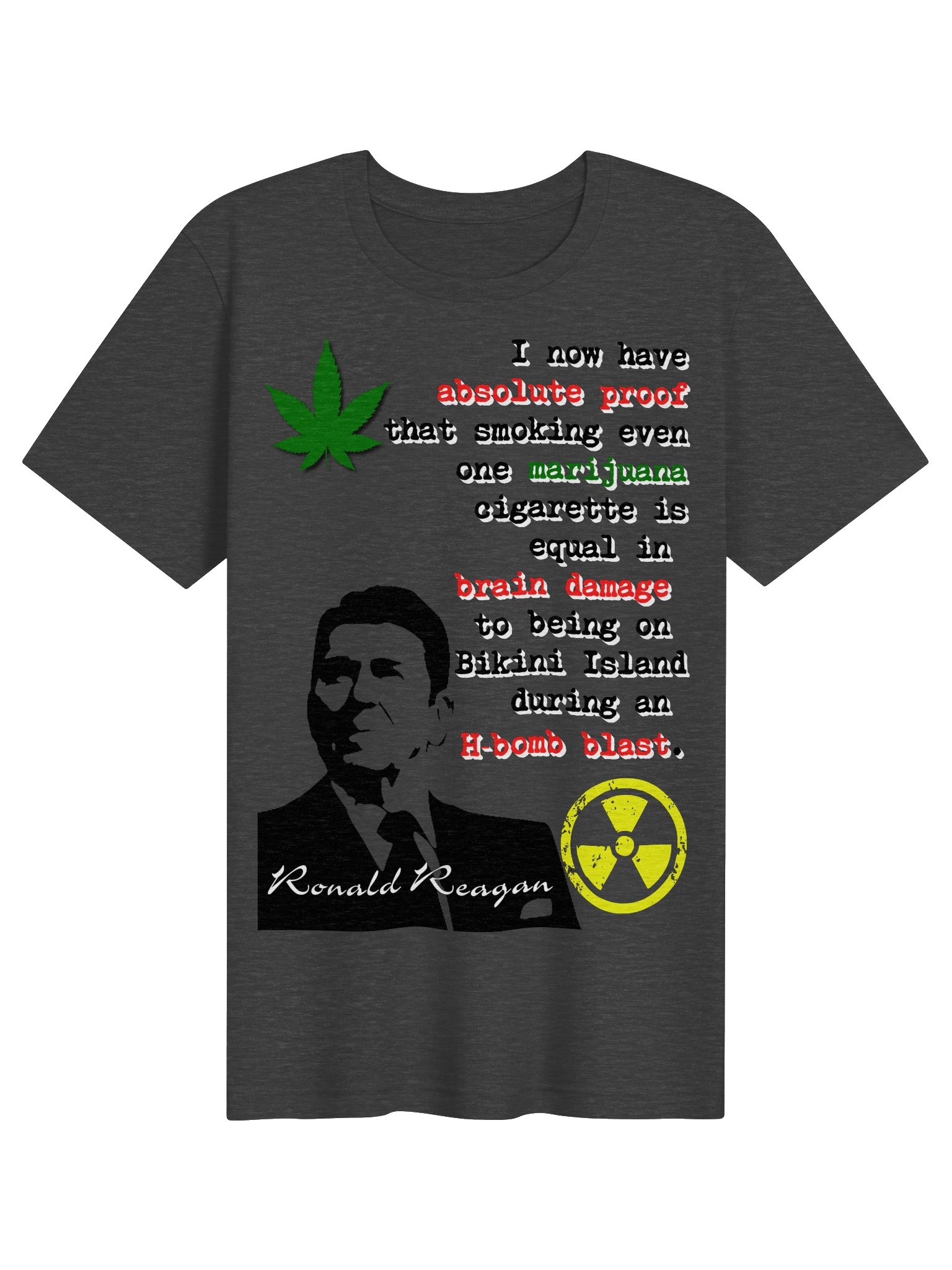
Get one while they’re hot, HERE!

Get one while they’re hot, HERE!
Ronald Reagan, the 40th President of the United States, passed away 22 years ago on June 5th, 2004, at 93 years of age. When it comes to Reagan’s legacy in the political establishment, he is lauded as perhaps one of the best presidents in American history. Upon his death much of the nation was brought to a veritable standstill, as his funeral acted as an unofficial national day of mourning.
As Reagan’s casket was brought out of the Capitol rotunda, cannons fired in his honor, the reading of his funeral rites broadcast in New York’s Times Square as well as on televisions around the world. Over 100,000 people attended his funeral to pay their respects, including multiple former presidents, government officials, and diplomats from around the world. In a CBS News broadcast the day of his death, Reagan’s personal biographer Edmund Morris described him as “looking and acting presidential, a man with dignity”.
Morris describes Reagan’s “largest mission in life” as “the moral leadership of the United States”. In Morris’s words Reagan saw himself as a savior sent to tame the government and get it off the backs of the American people. But beyond the aggrandizement and grandstanding, when one takes a more critical look at the legacy left behind, what is revealed is a much darker history than American political revisionists like to admit. One fraught with systemic corruption and the exploitation of the American people.
In this article, we will take a look at Ronald Reagan’s true legacy, and while not exhaustive, highlight several policy decisions that still impact the lives of American citizens today.
Naturally, we shall start with foreign policy, as it is arguably the most impactful and extensive. In this area Reagan is typically hailed as a hero more than most in the annals of American exceptionalist revisionist history. He started off his presidency in January of 1981 being credited with bringing an end to the Iran hostage crisis, as Iran would agree to release 52 Americans after 444 days in captivity shortly after Reagan was sworn into office.
This immediately did wonders for Reagan’s image as a diplomatic tough guy that Americans could look up to. But the reality is much more sinister. Acclaimed investigative journalist and founder of Consortium News Robert Parry (1948 – 2018) spent decades amassing evidence ignored by the DC political beltway proving that, in truth, members of the Reagan campaign, particularly campaign manager and future CIA director William Casey, undertook efforts to sabotage attempts by the Carter administration to free the American hostages for political gain. Casey and others would covertly meet with Iranian officials in Madrid during the summer of 1980 and strike a secret deal insuring that Iran would agree to only release the hostages on the day of Reagan’s inauguration in exchange for arms shipments.
With this act of political subterfuge, Reagan’s presidency began with a borderline act of treason, treating American lives as bargaining chips.
Of course, this was only the beginning. As secret dealings with Iran would scandalize the entire Reagan presidency. The Iran Contra affair, beginning in 1985, would go on to leave a lasting and disastrous blight both inside and outside of the United States.
During the height of the Cold War, the staunchly anti-communist Reagan administration would go to any lengths no matter how deplorable to exert American imperialist dominance across the globe. When the leftist Sandinista government came to power in Nicaragua, the Reagan administration sought to oust them with a coup. When Congress denied funding for this operation, Reagan would once again turn to his pal William Casey, now director of the CIA, and their Iranian allies, as well as the cartel.
The CIA would begin making covert arms shipments to Iran via Israel, despite an embargo in place at the time, using the revenue to fund an insurgency by the Contras, a right wing militant terrorist group fighting to oust the Sandinista government. At the same time, the CIA would put itself in business with the Contras cartel allies in a plot to help bolster the Contras funding, a scandal later exposed by journalist Gary Webb whom revealed the CIA helped to facilitate cocaine trafficking into the United States, resulting in the disastrous crack epidemic of the 80s and 90s which unceremoniously claimed thousands of lives.
These undertakings initiated by Reagan have left lasting scars on American society and politics. In the decades since, Nicaragua has continued to be a prime target for imperialist regime change efforts, particularly following the 2006 election of Daniel Ortega which brought the Sandinistas back to power and lead to a series of coup attempts against his government by both the Bush jr and Obama administrations, as well as a deadly relaunching of Reagan-era destabilization efforts against Nicaragua as recently as 2023 under the Biden administration.
Speaking to TMZ, Hinckley said the recent shooting attempt was “spooky” because it occurred at the same venue where he carried out his 1981 attack.
Hinckley stated that the Washington Hilton “is not secure” and urged the hotel to stop hosting major high-profile events “because bad things keep happening there.”
TMZ reports:
Hinckley kicked off our convo by telling us he first learned about the WHCD shooting when a newsflash came up on his phone and he turned on the TV to watch some of the coverage. He said it was “spooky” to find out the WHCD shooting “took place at the same hotel as mine did.”
Hinckley is now calling on the hotel to stop holding events there “because bad things keep happening” and “it’s just not a secure place to hold big events.”
To illustrate his point, Hinckley described what happened back in ’81 when he showed up at the hotel to shoot Reagan. He said back then, the security was “lax” too … because he was able to sneak into a crowd of reporters waiting outside the hotel for Reagan to exit after delivering a speech. He said Secret Service agents never checked whether he was a reporter during their sweeps.
If they had, Hinckley said he would have bolted because he was not a journalist, had no press credentials and his devious plot would have likely been exposed. As a result, history might have turned out very differently.
Hinckley had carried out the 1981 shooting that wounded Reagan and three others in an attempt to impress actress Jodi Foster.
President Trump abruptly called off trade negotiations with Canada on Thursday after the Ontario government funded an anti-tariff ad campaign featuring the voice of President Ronald Reagan.
“The Ronald Reagan Foundation has just announced that Canada has fraudulently used an advertisement, which is FAKE, featuring Ronald Reagan speaking negatively about Tariffs,” Trump wrote in a late-night Truth Social post.
The president said the $75 million ad was made “to interfere with the decision of the U.S. Supreme Court, and other courts” in cases challenging Trump’s authority to issue tariffs.
“TARIFFS ARE VERY IMPORTANT TO THE NATIONAL SECURITY, AND ECONOMY, OF THE U.S.A,” Trump argued.
“Based on their egregious behavior, ALL TRADE NEGOTIATIONS WITH CANADA ARE HEREBY TERMINATED,” he declared. “Thank you for your attention to this matter!”
Thirty years ago, drug users flocked to a website called Erowid to describe experiences on everything from Advil to LSD. Today it’s become a goldmine for researchers and governments.
“I am melting, help me.” This is not only an unusual plea for assistance. It’s also the title of a “trip report”: one person’s experience with the powerful dissociative drug phencyclidine (known as PCP). And it’s just one of many thousands of mind-bending anecdotes filed to Erowid, a website that, since the early days of the internet, has built one of the world’s most influential records of drug use and its effects.
This year marks the 30th anniversary of the scrappy, grassroots project, which hosts data on everything from caffeine to cannabis to paracetamol (also known as Tylenol) to heroin, like a Wikipedia on all things pharmaceutical. Users post information about purifying street drugs, rolling joints and the health implications of drug misuse. Visitors to the site can find information about drug toxicology and interactions between chemicals. They can even wade through the archives of Albert Hoffman, the Swiss chemist who first synthesised lysergic acid diethylamide – or LSD.
But perhaps most intriguing of all are the 45,000-plus trip reports in the “Experience Vault”. These hallucinatory tales, with titles such as “Tripping Alone on 1.5 Grams From Hell”, “The Weekend At The Edge Of The Universe” and “The Thumbprint”, where an unfortunate soul loses their mind on a drug related to LSD called AL-LAD, do not just make for idle internet fodder. They have become vital for academic research, especially for esoteric and illegal substances where clinical data does not exist or is challenging to obtain.
“People publishing their personal experiences and experimenting outside of the legal and academic bubble has led to the science, in many ways,” says David Luke, associate professor of psychology at the University of Greenwich in the UK who studies psychedelics and has conducted clinical trials using microdoses of LSD. “There was so little published academic research and so few resources for exploring the use of psychoactive drugs that Erowid was invaluable for research, and to understand issues around safety and experiences.”
Today, the social stigma around some types of drug use has softened to the point that Ayahuasca ceremonies, mushrooms and ketamine have even become a fixture in some corners of the business world. While these substances are still illegal in many countries, a growing number of places are choosing to decriminalise drugs that were previously subject to extensive crack downs. In recent years, psychedelics have also gathered renewed interest from the scientific community as a potential approach for treating conditions such as post-traumatic stress disorder. Their use, however, remains controversial and in some places unregulated therapeutic use of these drugs has led to tragedy.
Back in 1995, when Erowid was founded, psychedelics were very much of the underground. This was a hostile time for drug reform, just over a decade since US president Ronald Reagan had expanded the war on drugs.

Get yours HERE!
The strange shooting of Donald Trump remains a mystery, but presidential assassins, and would-be assassins in general, have as a result gotten renewed attention from the media.
Unfortunately, this new coverage suffers from the same egregious flaws as earlier media stories about these history-shaking events. So, even before I began reading a recent New York Times Magazine article about John Hinckley Jr., then who almost assassinated Ronald Reagan, I felt a sense of dread.
I knew before I read it almost exactly what it would say — that it would be a platform for platitudes and falsehoods perpetuated for more than half a century, and that the single most interesting thing about Hinckley and his shooting of Reagan would never be mentioned. But I plunged in.
The mere fact that major media like The New York Times and their contributors instinctively play this game of Hide the Object worries me deeply, largely because much of what they report is true — creating the false impression that all of what they report is true and complete.
From what they write, you would never guess that there might conceivably be more to acts of domestic political violence than a random sad delusional character — like Hinckley — acting out some self-generated sick fantasy.
For example: You would never have guessed that the psychiatric hospital where Hinckley was placed after the shooting had been historically involved in the CIA’s MK-ULTRA program with its mind control experiments focused on “programming” killers. And that while George Bush Sr. was director of the CIA — he presided over suppressing the truth about this program.
Nor would you have guessed that Bush was also a personal friend of the Hinckleys (like Bush, Hinckley Sr. was a Texas oil executive), and would surely have known about the son’s problems — and that he was in that particular hospital. Had Hinckley succeeded in killing Reagan, Bush would not have waited eight long years in the shadows before becoming president. (The Bush and Hinckley families were so close that Hinckley Jr.’s brother Scott and his date were to dine with Neil Bush the night after the shooting, but the dinner was canceled after the shooting.)

John Hinckley, the would-be assassin of President Ronald Reagan, will receive an unconditional release from prison, a federal judge has confirmed.
Hinckley, 67, attempted to assassinate Reagan in 1981. U.S. District Judge Paul Friedman announced Hinckley will be released on June 15. The judge previously announced in September that Hinckley would be released so long as he remained in good behavior, which he has.
John Hinckley Jr., the man who tried to assassinate Ronald Reagan in an attempt to ‘impress’ actress Jodie Foster more than 40 years ago, is playing a sold-out concert in Brooklyn this summer.
Hinckley, 66, tweeted on April 9 that he was ‘very excited about [his] upcoming show.’
‘Ticket sales are good. July 9, Market Hotel in Brooklyn, NY.’
Tickets for the hotel show at 1140 Myrtle Avenue in Bushwick were selling for $20 on Venue Pilot. On April 12, the Oklahoman tweeted again, announcing that his show was ‘sold out!’ The venue has a capacity of 450 people but it’s unclear how many tickets were sold for the show.
On March 30, 1981, Hinckley seriously injured then-President Reagan and three others when he fired six shots outside the Washington Hilton Hotel. White House press secretary James Brady was shot in the head and permanently disabled, Secret Service Agent Timothy McCarthy was shot in his side, and D.C. policeman Thomas Delahanty was hit in the neck.
The president was shot in the left lung – the .22 caliber bullet missed the 70-year-old’s heart by just inches. Regardless, Reagan walked out of the hospital under his own power, and famously quipped to his wife that he ‘forgot to duck’ after his surgery.
In a note that was found soon after the attempted assassination, Hinckley – who was 25 at the time – stated that he committed the unthinkable crime to get the attention of actress Jodie Foster after stalking her for years.
Hinckley would send letters and even call the actress at Yale after developing an unhealthy obsession with her when he saw ‘Taxi Driver.’ Hinckley reportedly described the shooting as the ‘greatest love offering in the world’ shortly after the shooting took place.
He was found not-guilty by reason of insanity, and spent 35 years in a psychiatric hospital after the assassination attempt. There, he was diagnosed with narcissistic and schizoid personality disorders.
On the campaign trail in 2016, the year Hinckley was released, Donald Trump said the would-be assassin should remain institutionalized.
Since he was granted the right to produce music under his own name in 2020, Hinckley has released songs on YouTube and streaming services, and even intends to release a 14-song LP under his own record label, Emporia Records.
Hinckley’s YouTube channel, where he began posting covers and such original songs as ‘Everything is Gonna’ Be Alright in 2020, has more than 26,000 subscribers. Most of those he has written are love songs.


You must be logged in to post a comment.