Hollywood vs. reality…


Ahost of foreign policy “experts” are now explicitly calling for “regime change” in Russia following Vladimir Putin invading Ukraine.
Reminiscent of the establishment’s failed calls for regime change in countries like Afghanistan and Iraq, whose military conflicts cost countless American lives and resources, the sentiment appears to be at odds with the majority of the country. Nearly three-quarters of Americans oppose playing a major role in the unfolding conflict.
Benjamin Wittes, a Senior Fellow in Governance Studies at the Washington, D.C.-based Brookings Institution, epitomized the establishment’s ultimate policy goal for Russia in a recent tweet: “Regime change: Russia.”
While the post drew significant criticism from other Twitter users, forcing Wittes to issue a Tweet for clarification of his stance, other mouthpieces for the establishment foreign policy think tank community championed Wittes’ proposal.
“This has to be the policy now,” tweeted Dr. Alina Polyakova, formerly the Founding Director for Global Democracy and Emerging Technology at the Brookings Institution, in response. Polyakova is now the President and CEO of the Center for European Policy Analysis (CEPA), which has hosted events featuring leaders from George Soros’s Open Society Foundations.
Richard Haass, President of the Council on Foreign Relations, noted how “now the conversation has shifted to include the possibility of desired regime change in Russia” in a February 27th Tweet.


Throughout the long, documented history of the United States illegally overthrowing governments of foreign lands to build a global empire there has emerged three ways Washington broadly carries out “regime change.”
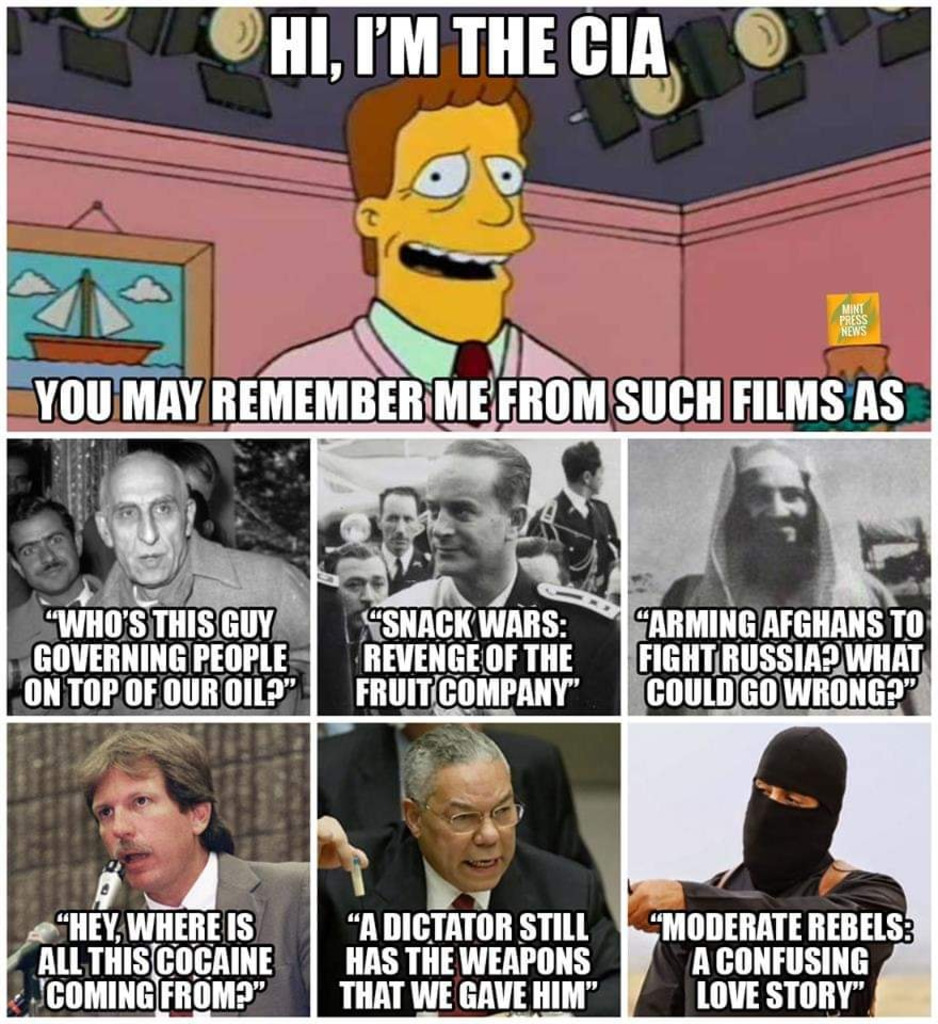
From Above. If the targeted leader has been democratically elected and enjoys popular support, the CIA has worked with elite groups, such as the military, to overthrow him (sometimes through assassination). Among several examples is the first CIA-backed coup d’état, on March 30, 1949, just 18 months after the agency’s founding, when Syrian Army Colonel Husni al-Za’im overthrew the elected president, Shukri al-Quwatli.
The CIA in 1954 toppled the elected President Jacobo Árbenz of Guatemala, who was replaced with a military dictator. In 1961, just three days before the inauguration of President John F. Kennedy, who favored his release, Congolese President Patrice Lumumba was assassinated with CIA assistance, bringing military strongman Mobutu Sese Seko to power. In 1973, the US backed Chilean General Augusto Pinochet to overthrow and kill the democratically-elected, socialist President Salvador Allende, setting up a military dictatorship, one of many U.S.-installed military dictatorships of that era in Latin America under Operation Condor.
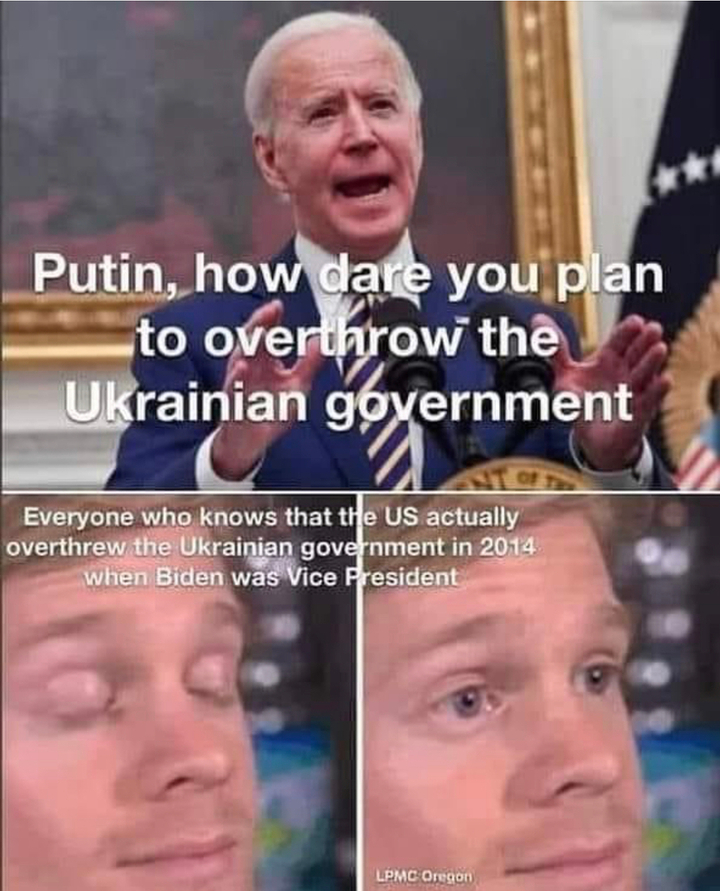
From Below. If the targeted government faces genuine popular unrest, the U.S. will foment and organize it to topple the leader, elected or otherwise. 1958-59 anti-communist protests in Kerala, India, locally supported by the Congress Party and the Catholic Church, were funded by the CIA, leading to the removal of the elected communist government. The 1953 coup in Iran that overthrew the democratically-elected Prime Minister Mohammad Mosaddegh was a combination of bottom-up CIA (and MI-6)-backed street protests, and top-down conservative clergy and military to destroy democracy and return a monarch to the throne. The US-backed Ukrainian coup of 2014 is the latest example of the US working with genuine popular dissent to help organize and steer the overthrow, in this case, of an OSCE-certified elected president.
Through Military Intervention. If a coup is not feasible, the US turns to indirect or direct military intervention. One of earliest examples was the US expeditionary force that invaded Russia in 1918 during the civil war in an attempt to help overthrow the new Bolshevik government. More recently, in 1983 the U.S. military invaded Grenada to overthrow a Marxist president; in 1989 the U.S. invaded Panama to overthrow former CIA asset Manuela Noriega.
Another hybrid operation was the US bombing of Serbia in 1999 and the State Department funding of the opposition group Otpor!, which led to the ouster of Slobodan Milosevic. The most prominent recent examples of direct military invasion to overthrow governments are the U.S.-led invasions of Afghanistan in 2001 and Iraq in 2003. Indirect military intervention through proxies to overthrow governments happened in the 1980s Contra war against Nicaragua; and the 2011 to present jihadist war to overthrow the Syrian government.
The New York Times reported that, “in the 67 years since the CIA was founded, few presidents have had as close a bond with their intelligence chiefs as Mr. Obama forged with Mr. [John] Brennan,”[5] an architect of the CIA’s extraordinary rendition program and former CIA station chief in Saudi Arabia.
Obama’s worldview meshed so closely with this “unsentimental intel warrior” and “terrorist hunter” that Obama “found himself finishing Brennan’s sentences.”
An anonymous Cabinet member explained that “presidents tend to be smitten with the instruments of the intelligence community [but] Obama was more smitten than most—this has been an intelligence presidency in a way we haven’t seen maybe since Eisenhower.”[6]
The consequences could be seen in Obama’s boosting funding for the National Endowment for Democracy (NED), which promotes regime change in countries defiant of the New World Order, and his drastic expansion of the use of drones—for both surveillance and targeted killings.
The Obama administration further; a) backed coups in Ukraine and Honduras; b) pivoted the U.S. military to Asia, ramped up arms sales to Saudi Arabia and expanded military bases in Africa; c) helped suppress evidence about CIA torture, d) refused to pursue a criminal case against the CIA’s money laundering bank, HSBC, e) eavesdropped on U.S. allies and a U.S. congressman (Dennis Kucinich) who opposed his administration’s illegal invasion of Libya that devastated that country, f) stepped up surveillance and efforts to destroy Wikileaks and its founder Julian Assange, and g) presided over the prosecution of a record number of whistleblowers under the Espionage Act of 1917.


You must be logged in to post a comment.