George Carlin on homelessness…


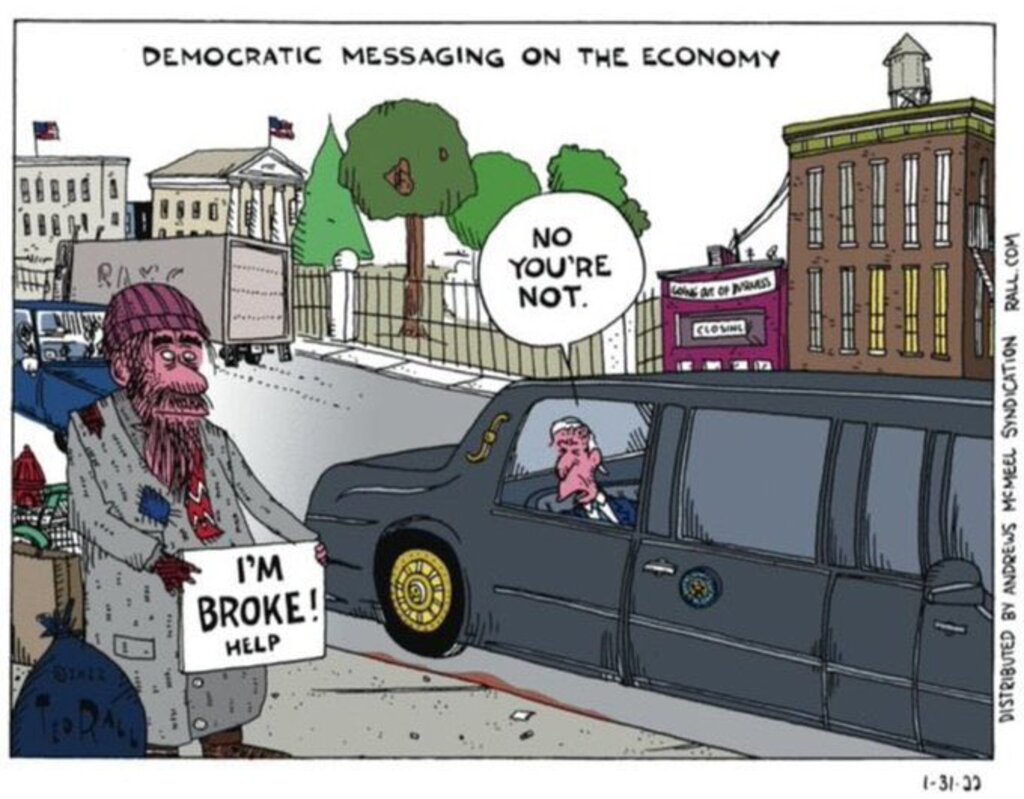
Critics absolutely roasted Energy Secretary Jennifer Granholm after she suggested that lower to middle class Americans could fight the rising cost of living by investing thousands in solar panels and other green energy initiatives.
Granholm made an appearance on “Fox News Sunday” to explain how the recently-passed Inflation Reduction Act — which has since been touted as a tax, energy, and health care bill — would impact everyday Americans who are struggling with record-high inflation, food, gasoline, and energy costs.
“If you are low income, you can get your home entirely weatherized through the expansion from the bipartisan infrastructure laws, a significant expansion — you don’t have to pay for anything,” she said, adding, “”If you want heat pumps, insulation, new windows, that is covered,” she said. “If you are moderate income, today you can get 30% off the price of solar panels. Those solar panels can be financed, so you don’t have to have the big outlay at the front … If you don’t qualify for the weatherization program, you will be able to, starting next year, get rebates on the appliances and equipment that will help you reduce your monthly energy bill by up to 30%. That is all about reducing costs for people.”
But as critics quickly pointed out, people who were struggling to feed their kids or wondering how they’d afford the gas to get to work were not just waiting on a 30%-off sale to make the jump to solar — they were just doing what they could to get by.
“GOP just needs to run ad after ad of Granholm telling the poors to buy solar panels and electric cars to save money,” Erick Ericksen tweeted.

Miami may relocate some of the city’s homeless population out of the streets and into city-sponsored encampments on an island housing a wastewater treatment plant.
Earlier this year, Miami-Dade’s Board of County Commissioners asked city officials to come up with ideas to mitigate its homeless population in the city, according to the Daily Mail.
City Manager Art Noriega called for an encampment to be established on the northern region of the Virginia Key island, one of five locations being discussed, beside a sewage treatment plant and a biking trail. The other four possible locations as options include three parking lots, two of which are located near residential buildings.
The city is considering the proposal that would relocate homeless people, which was recently recorded at 1,525 people, who live on the street in heavily populated tourist areas, like downtown, Overtown, and Little Havana.
The proposal details a plan to establish as many as nine large tents, which can hold up to 22 people, and a parking lot in the northernmost region of the Virginia Key.
Twenty-two states are suing President Joe Biden’s administration for threatening to zap school-meal program funding unless the states comply with new rules surrounding gender identity and sexual orientation in schools.
The lawsuit represents the latest volley fired in the ongoing battles between state officials and Biden, who they accuse of usurping their authority through his executive orders.
The states complain that a federal nondiscrimination rule, set to take effect Aug. 15, seeks to impose “obligations that apparently stretch as far as ending sex-separated living facilities and athletics and mandating the use of biologically inaccurate preferred pronouns,” said the lawsuit, filed in U.S. District Court, Tennessee, on July 26.
“The Biden administration’s sweeping rhetoric treats normal practices, such as sex-separated bathrooms and athletics, as ‘discriminatory’ even though DOJ and the Department of Education treated those as legal, nondiscriminatory practices as recently as last year,” the suit says.
A fact sheet about the proposed policy cited examples of discriminatory acts, as interpreted by bureaucrats, under the new rule: “Preventing a transgender high school girl [a biological male] from using the girls’ restroom” and “preventing a transgender high school girl [a biological male] from “try[ing] out for the girls’ cheerleading team,” the lawsuit says.

If Congress won’t ban AR-15s, Democratic Rep. Don Beyer (VA) wants to slap a 1,000% tax on them – which would of course mean only people with lots of money, such as drug dealers and rich people, could afford them, while punishing lower-income Americans.
Introduced last week, Beyer’s Assault Weapons Excise Act has 36 Democratic co-sponsors, according to the Washington Post. The group hopes the idea might bypass the Senate filibuster, which would require the support of at least 10 Republicans.
According to Beyer, the idea is to increase the price to such a degree that it significantly limits who’s able to buy them. The tax would also apply to high-capacity magazines.
“It’s trying to hit the sweet spot, where it’s not an all-out ban, but people’s independent purchasing decisions would be much more ‘no’ than ‘yes,’” Beyer told the Post, adding. “You want to shift the demand curve pretty significantly.”
Beyer said part of the thinking behind the 1,000 percent figure was to have a high-enough fiscal impact that the Senate parliamentarian would find it qualifies for inclusion in a reconciliation package, meaning it could pass the Senate with a simple majority. -WaPo
“In a nation crying out for progress on gun safety, we would present a plausible way forward in this Senate,” he said.
The tax would only apply to newly purchased guns, and would not apply to government buyers. The proceeds would go into the general fund.
Columbus civic leaders continued to seek answers Thursday about how AEP decided which neighborhoods to cut power to this week and whether appropriate steps were taken to notify customers in advance of the outages.
The NAACP Columbus chapter again questioned AEP Thursday, calling for additional answers as to how the utility determines areas that will be without service, and whether AEP notified residents, governments and social service agencies prior to the shutdown. The questions followed statements from NAACP leaders Wednesday raising concerns that areas in Columbus affected by the outage included many low-income and minority neighborhoods.
“The NAACP’s concern is that these outages will add to the growing list of health, environmental and crime rates in these communities,” the NAACP said in a statement Thursday. “We also need to know what this community can expect moving forward in these dog days of summer.”
City of Columbus officials also contacted AEP about the outages and the direct impact on those poorer neighborhoods, city spokeswoman Melanie Crabill said Thursday.
“We asked AEP the same question because we were being asked by residents,” Crabill said. “AEP assured us that they based load shedding on circuit locations, not neighborhoods.”
Ohio Democratic lawmakers from the Columbus area also sought answers from AEP Thursday, writing in a letter that the utility has an obligation to provide customers access to services and to communicate planned outages “to limit the human and financial costs shouldered by families, cities and people with medical needs.”
The letter included a list of questions for AEP and was signed by Democratic state representatives from Franklin County, including Kristin Boggs, Rich Brown, Latyna Humphrey, Dontavius Jarrells, David Leland, Mary Lightbody, Beth Liston, Adam Miller, and Allison Russo.
“We find it troubling that AEP has no issue with customer notifications when bills are due, but when customers are faced with historic heat, limited resources and great needs, there seems to be limited or no communication about planned outages that impact the health, safety and welfare of customers,” the lawmakers wrote.

You must be logged in to post a comment.