California law may backfire terribly as 70,000 independent truckers could be forced out of work, unleashing ‘devastating’ supply chain misery

California law threatens to unleash more supply chain misery and inflation on residents of the Golden State by forcing independent truckers out of the workforce.

California Assembly Bill 5 was introduced by former state Assemblywoman Lorena Gonzalez, a Democrat, and signed into law in September 2019 by California Gov. Gavin Newsom.

AB5 called for “a person providing labor or services for remuneration shall be considered an employee rather than an independent contractor unless the hiring entity demonstrates that the person is free from the control and direction of the hiring entity in connection with the performance of the work, the person performs work that is outside the usual course of the hiring entity’s business, and the person is customarily engaged in an independently established trade, occupation, or business.”

Certain professions were exempt from AB5, including insurance agents, health care professionals, investment advisers, realtors, barbers, and fishermen. However, truckers were not exempt from AB5.

Keep reading

Confusion swirls as Colorado imposes new retail delivery fee, catching businesses by surprise

Colorado consumers will start noticing a 27-cent fee on receipts for almost everything that gets delivered to them, including restaurant food, after Colorado’s new “retail delivery fee” took effect July 1.

The fee must be collected and paid to the state by retailers “on all deliveries by motor vehicle to a location in Colorado with at least one item of tangible personal property subject to state sales or use tax,” according to the new law.

The new fee is occurring at a time of record-setting inflation, spiking home prices, and a general sense of how unaffordable living in Colorado has become, particularly in metro Denver. It’s also occurring even as elected officials promise to do everything in their power to lift the economic burden on residents.   

Keep reading

Officials Demand Mom Pay Them $5,000 for the Privilege of Selling Homemade Cookies

In the land of the free, attempting to earn money in certain professions without first paying the state for the privilege of doing so can and will get you kidnapped and extorted. These laws are applied to children behind lemonade stands as well as adults selling flowers. The state callously and with extreme prejudice has been documented arresting people, or even beating up women to enforce these licensing laws. As the following case illustrates, even mom’s trying to have a bake sale to raise money for their children’s college fund will be subject to the government’s tyranny.

Recently, the state of New Jersey passed an ordinance that allows folks to sell their home-baked goods for commercial purposes. For $100, citizens of New Jersey can obtain a permit to sell their cookies with a yearly gross income maximum of $50,000. This permit is good for two years.

While this price may seem steep to sell cookies from your home, Maria Winter, a fourth grade teacher in Somerville, just found out that $100 is just the beginning.

When Winter applied for a home-baked license in the city of Somerville, she was told that she had to shell out $5,000 — to sell cookies for her son’s college fund.

Keep reading

While Trying to Kill a Dog, A Cop Missed and Shot His Partner Instead

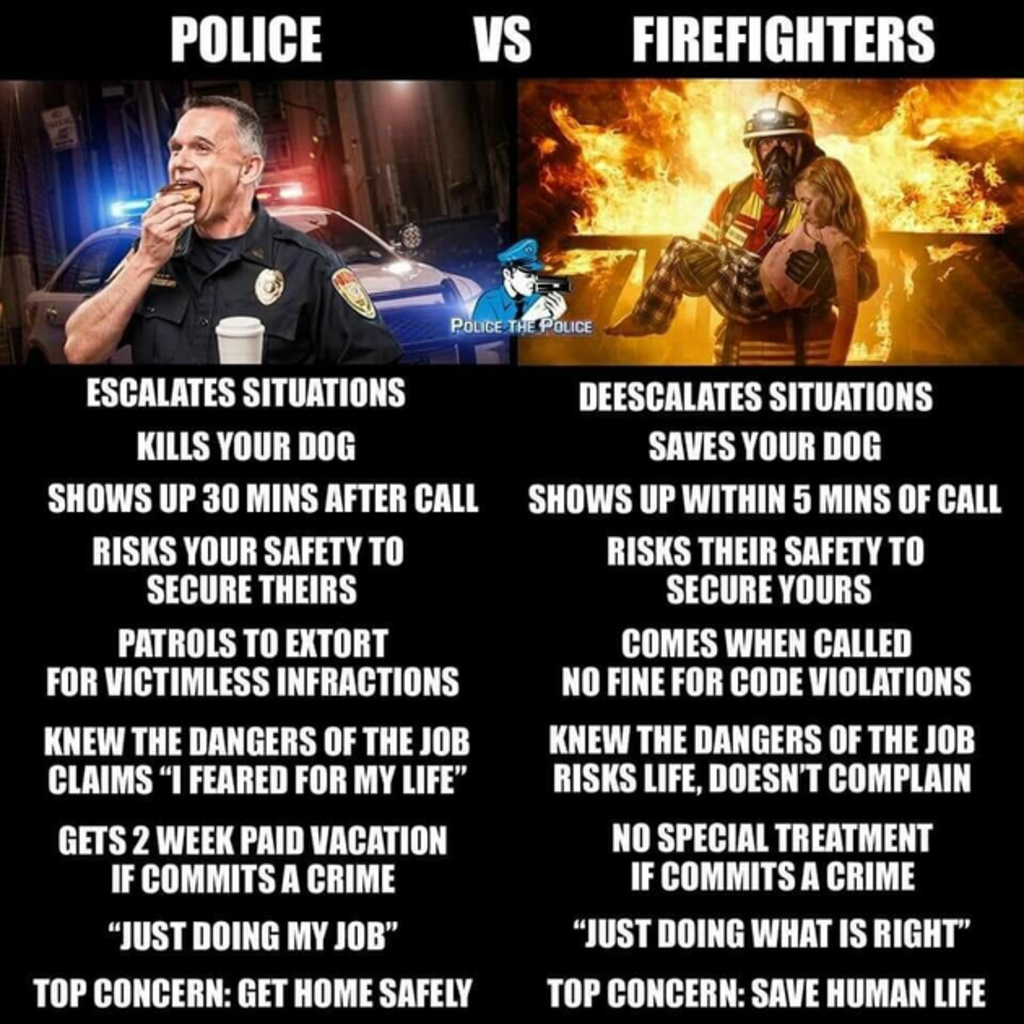
It is no secret that cops shoot dogs — a lot. Frequent readers of TFTP know too well how many beloved family pets are gunned down every year by public servants in the U.S. It happens so much that there is a term for it called “puppycide.” We have an endless archive of stories in which dogs meet their untimely ends at the end of a cop’s gun.

According to an unofficial count done by an independent research group, Ozymandias Media, a dog is shot by law enforcement every 98 minutes. That number could be higher too as many of the cases never make the media reports.

When these cases do make the local media, often times, they are dismissed by apologists who claim the dogs’ owners were committing crimes or should have had better control of their dog. Unfortunately, however, it is not just people suspected of crimes who see their dogs gunned down in front of them. Cops go onto the wrong properties all the time and kill the dogs of innocent families — and they do so with impunity.

Epitomizing the problem with cops shooting dogs is the fact that even their fellow officers are not safe. According to the Knox County Sheriff’s office, two deputies were responding to a call Tuesday night when a dog came from behind the residence.

Deputy Jordan Hurst then pulled his gun and attempted to kill the dog but instead shot his partner, deputy Lydia Driver.

Driver was taken to the University of Tennessee Medical Center and is recovering from emergency surgery in the ICU. She is expected to recover and according to the sheriff, she is in good spirits.

Hurst has since been placed on paid administrative leave and no details — including the reason for the deputies walking into the yard — have been released. No arrests have been made and no suspects have been named in the response to the reported call.

Instead, the sheriff told the citizens that cops have to make tough decisions and this case is above their comprehension.

“Officers deal with people and situations the average person will never experience in their lifetime. This incident is unfortunate, but we will get through it together. We are blessed to serve a community that loves and appreciates our men and women. For that, I’m grateful,” Sheriff Tom Spangler said.

As this case, and others like it illustrate, it is no secret that police officers are unafraid to put the lives of innocent people in danger and pull their guns out to shoot at dogs. The Free Thought Project has reported on multiple instances in which cops have attempted to shoot dogs and shot men, women, and children instead.

Keep reading

Donald Trump Calls for Drug Dealers and Human Traffickers to Get Death Penalty 

Former President Donald Trump called on drug dealers, human traffickers, and those who kill police to get the death penalty during a Save America rally held in Las Vegas, Nevada, on Friday night.

Trump said:

So this is a little controversial. And I will either get a standing ovation – and I don’t care about the ovation, I care about the country – or people are going to walk out of the room for what I’m about to say. But it’s time finally to say it. If you look at countries all throughout the world…The only ones that don’t have a drug problem are those that institute the death penalty for drug dealers. They’re the only ones, they don’t have any problem.

Trump also added that human traffickers and those who kill police should face the death penalty.

“Those who kill police officers as well as those who kill through human trafficking,” he continued.

“So we can be streetwise tough and smart and end our problem or we can be politically correct, weak and frankly, extremely stupid,” Trump said. “Which is probably the way we will continue to be and lose millions and millions more people to a scourge the likes of which our country and most other countries have never seen before.”

“So do something about it. It’s The only way you’re going to win the only way you’re going to win all right,” the former president added.

Keep reading

War on churches: Pennsylvania town cracks down on feeding the homeless

A lot of powerful people in this country think it’s really important to put religion in its place. They reduce the free exercise of religion to the freedom of worship, and they argue that faith should be strictly private. They also believe that a church building must be exclusively for worship and not for any of the other aspects of people living out their faith.

Pottstown, Pennsylvania, is a working-class town of 20,000 between Philadelphia and Reading. It has more than its share of poverty, which is why Christ Episcopal Church and Mission First Church run robust aid programs, especially during and after the pandemic. The churches give out free meals to the public once a week, provide counseling and mental health support, and hand out groceries, toiletries, and other staples for free.

But the Pottstown government is having none of it. According to local law, a church building can be used only for worship and “those accessory activities as are customarily associated” with worship. In June, a zoning officer sent a violation notice instructing the churches that they must cease their good deeds or go through the zoning hearing board to seek a variance.

“Civil action will commence with the Districts Justice if these violations are not corrected,” the zoning officer wrote in a letter.

Local governments have a long and storied history of stopping religious congregations from serving the poor. Mike Bloomberg wouldn’t let a synagogue donate bagels to homeless shelters. Dozens of other cities have outlawed feeding the homeless.

Pottstown’s actions against the churches are particularly striking because they don’t even involve a safety or food regulation. Instead, the town is attempting to weaponize the very definition of what a church building is in order to prevent worshippers from using it to follow the command of Jesus Christ: “When I was hungry, you fed me.”

“It is the opinion of this office that the use of the property has changed and, by definition, is more than that of a Church,” the zoning officer wrote. He included the zoning code’s definition of a church: “A building wherein persons assemble regularly for religious worship and that is used only for such purposes and for those accessory activities as are customarily associated therewith.”

It’s a horribly crimped view of what a church is, and it’s a view the churches’ leaders reject.

Keep reading

New Jersey Bill Would Require College Students to Receive Coronavirus Vaccine

A proposed bill in New Jersey would require college students and staff at higher education institutions to receive the coronavirus vaccine.

Proposed by Democratic Assemblyman Herb Conaway Jr. and co-sponsored by Democratic Assemblyman Ralph Caputo, Bill A4334 would essentially require that all in-person students and staff be fully vaccinated while exempting only those who would work virtually.

“If the bill becomes law, it would go into effect in the 2022-2023 school year,” noted News12.

The bill will now be reviewed by the Assembly Health Committee and will have to pass the state Senate before it becomes law. A similar bill in the New Jersey Senate has not yet received a vote.

Colleges and universities have adopted their own vaccination policies without government mandates up until now. According to the National Conference of State Legislatures, no other state in the union has required coronavirus vaccinations for students in higher education.

Keep reading