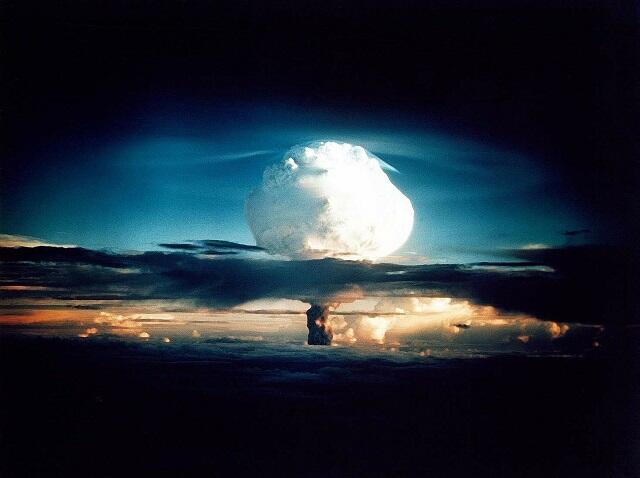
Rhetoric in Ukraine has reinforced the fallacy of limited nuclear exchange

Since the end of the Cold War, Russia, the United States, France, and China have continued to possess and develop nuclear weapons below the strategic level of land-based and submarine-launched intercontinental-range ballistic missiles. The long-touted rationale for this was simple: non-strategic (or tactical) nuclear weapons are necessary to give the decision-maker more options and provide a credible proportionate deterrence response to the use of similar weapons by an adversary.

The rationale continues by implying that such nuclear weapons use would occupy a third and separate strategic conflict space between conventional war and all-out strategic nuclear exchange. It is necessary, it has been argued, to occupy that space to deter at all levels.

The profound implication of this line of reasoning is that this “limited nuclear exchange” space is both distinct and separate from conventional war below and nuclear Armageddon above, and that transitions between the spaces can be controlled. This is at best unproven conjecture.

For many years, opponents to the continued existence of such tactical weapons in nuclear arsenals—including these authors—have argued to the contrary. Rather than being controlled, these transitions are simultaneously enabled, increased in probability, and accelerated by the very existence of such weapons.

Keep reading

The Profoundly Stupid Narrative That Nuclear Brinkmanship Is Safety And De-Escalation Is Danger

Of all the face-meltingly stupid narratives that have been circulated about the US proxy war in Ukraine, the dumbest so far has got to be the increasingly common claim that aggressively escalating nuclear brinkmanship is safety and de-escalation is danger.

We see a prime example of this self-evidently idiotic narrative in a new Business Insider article titled “Putin’s nuclear threats are pushing people like Trump and Elon Musk to press for a Ukraine peace deal. A nuclear expert warns that’s ‘dangerous.’

“An understandable desire to avoid a nuclear war could actually make the world more dangerous if it means rushing to implement a ‘peace’ in Ukraine that serves Russian interests,” writes reliable empire apologist Charles Davis.

“Such a move, which some influential figures have called for, risks setting a precedent that atomic blackmail is the way to win wars and take territory troops can’t otherwise hold, a model that could be copycatted by even the weakest nuclear-armed states, and may only succeed at delaying another war.”

Davis’ sole source for his article is the UN Institute for Disarmament Research’s Pavel Podvig, who is very openly biased against Russia.

“The West supports Ukraine with weapons and financial and moral and political support. Giving that up and saying that, ‘Well, you know, we are too afraid of nuclear threats and so we just want to make a deal’ — that would certainly set a precedent that would not be very positive,” says Podvig. “If you yield to this nuclear threat once, then what would prevent Russia in the future — or others — to do the same thing again?”

Like other empire apologists currently pushing the ridiculous “de-escalation actually causes escalation” line, Davis and Podvig argue as though nuclear weapons just showed up on the scene a few days ago, as if there haven’t been generations of western policies toward Moscow which have indeed involved backing down and making compromises at times because doing so was seen as preferable to risking a nuclear attack. We survived the Cuban Missile Crisis because Kennedy secretly acquiesced to Khrushchev’s demands that the US remove the Jupiter missiles it had placed in Turkey and Italy, which was what provoked Moscow to move nukes to Cuba in the first place.

Throughout the cold war the Soviet Union insisted on a sphere of influence that US strategists granted a wide berth to, exactly because it was a nuclear superpower. Even as recently as the Obama administration the US president maintained that “Ukraine, which is a non-NATO country, is going to be vulnerable to military domination by Russia no matter what we do.”

Nevertheless we’re seeing this new “escalation is safety and de-escalation is danger” narrative pushed with increasing forcefulness by imperial spinmeisters, because it would take a lot of force indeed to get people to accept something so self-evidently backwards and nonsensical.

Keep reading

Are We on the Verge of World War 3? Here Are Some Facts We Know for Sure.

Sometimes it is best to take a step back and look at the facts that we know without a doubt so that we can then take a look at the bigger picture. Within the context of World War 3, here is a bit of what we have seen.

Draw your own conclusions.

Does Washington’s opinion here matter?

Out of the blue, New York City recently released a PSA instructing New Yorkers on what they needed to do in order to survive a nuclear strike on American soil. This hasn’t been done since the Cold War. If you want information about nuclear survival that isn’t glossed over by the government, you should check out our live nuclear survival webinar that is coming up with Army Ranger NBC Specialist Chuck Hudson. Go here to learn more.

The United States is now stockpiling anti-radiation medicine. Washington recently ordered $290 million worth of the drug Nplate, a drug used to treat “blood cell injuries that accompany acute radiation syndrome in adult and pediatric patients (ARS).”

Biden recently said that Putin was “not joking” about a potential Russian attack with “tactical nuclear weapons or biological or chemical weapons.” Anybody who has read Soviet defector Ken Alibek’s Biohazard is well-familiar with what some of these biological weapons are.

Does the market speak?

Potassium iodide pills are out of stock just about everywhere you check now.

Sales of gas masks, Geiger counters, and dosimeters have absolutely exploded.

Keep reading

Biden: We’re Trying To Figure Out How Putin Can Exit This War

The president of the United States made headlines the other day by just casually mentioning “Armageddon” as a possible outcome of the rapidly escalating war in Ukraine.

“We have not faced the prospect of Armageddon since Kennedy and the Cuban missile crisis,” President Biden said, adding the false claim that Vladimir Putin “talks about potential use of tactical nuclear weapons or biological or chemical weapons” in this conflict.

“First time since the Cuban missile crisis, we have the threat of a nuclear weapon if in fact things continue down the path they are going,” the president said in the same speech. “We are trying to figure out what is Putin’s off-ramp? Where does he find a way out? Where does he find himself where he does not only lose face but significant power?”

As though the US government itself has not played a major role in both provoking and sustaining this extremely dangerous conflict.

Keep reading

US Buying $290M Worth Of Anti-Radiation Drugs for Use In “Nuclear Emergency”

The Biden regime is buying up $290 million in anti-radiation drugs for use in “nuclear emergencies” amid escalating tensions with Russia and heightened threats of a nuclear war.

From Health and Human Services:

FOR IMMEDIATE RELEASE
October 4, 2022

Contact HHS Press Office
202-821-9446
asprmedia@hhs.gov
www.hhs.gov/news
Twitter: @HHSgov

HHS purchases drug for use in radiological and nuclear emergencies

As part of long-standing, ongoing efforts to be better prepared to save lives following radiological and nuclear emergencies, the U.S. Department of Health and Human Services is purchasing a supply of the drug Nplate from Amgen USA Inc; Nplate is approved to treat blood cell injuries that accompany acute radiation syndrome in adult and pediatric patients (ARS).

Amgen, based in Thousands Oaks, California, developed Nplate for ARS with support from the Biomedical Advanced Research and Development Authority (BARDA), part of the HHS Administration for Strategic Preparedness and Response (ASPR), as well as the National Institute of Allergy and Infectious Diseases, part of the National Institutes of Health.

BARDA is using its authority provided under the 2004 Project Bioshield Act and $290 million in Project BioShield designated funding to purchase this supply of the drug. Amgen will maintain this supply in vendor-managed inventory. This approach decreases life-cycle management costs for taxpayers because doses that near expiration can be rotated into the commercial market for rapid use prior to expiry and new doses can be added to the government supply.

ARS, also known as radiation sickness, occurs when a person’s entire body is exposed to a high dose of penetrating radiation, reaching internal organs in a matter of seconds. Symptoms of ARS injuries include impaired blood clotting as a result of low platelet counts, which can lead to uncontrolled and life-threatening bleeding.

To reduce radiation-induced bleeding, Nplate stimulates the body’s production of platelets. The drug can be used to treat adults and children.

Nplate is also approved for adult and pediatric patients with immune thrombocytopenia, a blood disorder resulting in low platelet counts. Repurposing drugs for acute radiation syndrome that also are approved for a commercial indication helps to sustain availability of the product and improves healthcare provider familiarity with the drug.

“The US government said the procurement of Nplate was not in response to the war in Ukraine,” The Telegraph reported.

“An HSS spokesman told The Telegraph: ‘This is part of our ongoing work for preparedness and radiological security. It has not been accelerated by the situation in Ukraine.'”

Keep reading

We Survived The Last Nuclear Standoff Through Compromise And De-Escalation

Vladimir Putin has signed documents finalizing the Russian annexation of four regions in eastern Ukraine, meaning there’s now a western-backed Ukrainian counteroffensive underway to recapture what Russia officially considers parts of its homeland.

Moscow has made it clear that it will use all weapons systems at its disposal to defend against attacks on territories it claims as its own, which could include nuclear weapons. Depending on if and how that happens and what kind of day all the relevant decision makers are having when it does, there is a distinct possibility that a chain of events could follow which leads to the end of the world.

This happens as Ukraine’s President Zelensky signs a decree officially ruling out the possibility of any peace talks with Putin, who recently publicly requested such talks. The US empire, which has been driving this proxy war from the beginning, is also not currently engaged in peace talks with Moscow. Things are accelerating faster and faster toward the absolute worst thing that could possibly happen, and as far as we know nobody’s got a foot anywhere near the brake pedal.

Keep reading

Nuclear Watchdog Groups Mock NYC’s Atomic Bomb Preparedness Video As ‘Delusional’

Peace advocates on Tuesday derided a New York City public service announcement meant to prepare residents for a nuclear attack as a 21st-century version of the absurd Duck and Cover civil defense film of the early Cold War era.

“So, there’s been a nuclear attack,” the narrator of the NYC Emergency Management video begins. “Don’t ask me how or why, just know the big one has hit.”… “So what do we do?” she continues before instructing viewers to “get inside, fast,” “stay inside… and get clean immediately,” and “stay tuned; follow media for more information.”

“All right? You’ve got this,” the woman assures viewers.

While New York City Mayor Eric Adams called the PSA a “great idea,” some critics accused officials of unwarranted fearmongering amid increased nuclear tensions with Russia over its invasion of Ukraine and NATO’s response.

Others lambasted the PSA as latest in a line of nuclear war informationals like the U.S. Civil Defense Administration’s Duck and Cover and the British government’s Protect and Survive films that offer little more than delusive contentment for millions of people who likely would not survive a full-scale thermonuclear attack.

“The reality is, if this comes to pass, you don’t ‘got this,'” tweeted the International Campaign to Ban Nuclear Weapons (ICAN), which was awarded the 2017 Nobel Peace Prize for its work leading to a landmark treaty outlawing nukes.

Calling the PSA “outrageously misguided,” ICAN said it’s difficult to get inside fast during a nuclear explosion “when, in a matter of seconds, houses up to 175 kilometers away from the epicenter crumble like they are made of cards.”

Keep reading

A Brief History of Pundits Encouraging Nuclear War

There is an active, influential, and well-paid minority of pundits and politicians in America who apparently believe that escalating conflict between nuclear powers—and even nuclear war itself—is not really that big a deal. 

These, of course, are the sorts of people who fancy themselves “the adults in the room,” while people who proceed with prudence, caution, and regard for the rule of law are to be regarded as traitors, cowards, or Russian agents. 

Consider, for example, Sean Hannity’s March 2 suggestion that the North Atlantic Treaty Organization—which really means the United States—should attack a Russian tank column with “some of [NATO’s] fighter jets, or maybe they can use some drone strikes and take out the whole damn convoy.” For Hannity, this would not count as escalation because NATO could elect to not tell the Russians who carried out the attack, and then Moscow “won’t know who to hit back.” 

Meanwhile, support for a “no-fly zone” has been one of the more dangerous avenues to escalation, since a no-fly zone would be a de facto declaration of war on Russia. Sen. Roger Wicker, for example, has said the US should “seriously consider” a no-fly zone. Florida congresswoman Maria Salazar supports a no-fly zone for the very profound reason that “freedom isn’t free.” (Fortunately, most members of Congress appear to recognize that a no-fly zone would mean World War III.) 

And then there are the pundits who have outright treated the gravity of nuclear war with a lot of hand-waving. NBC’s chief foreign correspondent, Richard Engel, in an apparent reference to nuclear war, implied the US should risk everything in order to destroy a Russian convoy.

Keep reading

A FEMA document about nuclear explosions reveals the utter fatuousness of our bureaucracy

No matter the purpose for which they’re established, bureaucracies often become ends in themselves, self-perpetuating entities that generate paper to justify their existence.  That seems to be the case with FEMA, at least insofar as its rules for nuclear disasters go.  Some poor desk drone was given the task of updating FEMA documents to reflect the CDC’s ridiculous COVID requirements.  That drone worked hard, with the result being that the FEMA guidelines for a nuclear explosion now include masks and social distancing in bomb shelters.

Once again, Libs of Tik Tok has the news on her irreplaceable Twitter account.  She (or someone with whom she communicates) felt that, with Putin threatening to start a nuclear war, it might be useful to check out the government’s guidance for responding to the fallout from a nuclear attack.  That’s how we learn that someone at FEMA laboriously updated FEMA guidelines with CDC requirements about social distancing and masks.

Keep reading