
Truth.

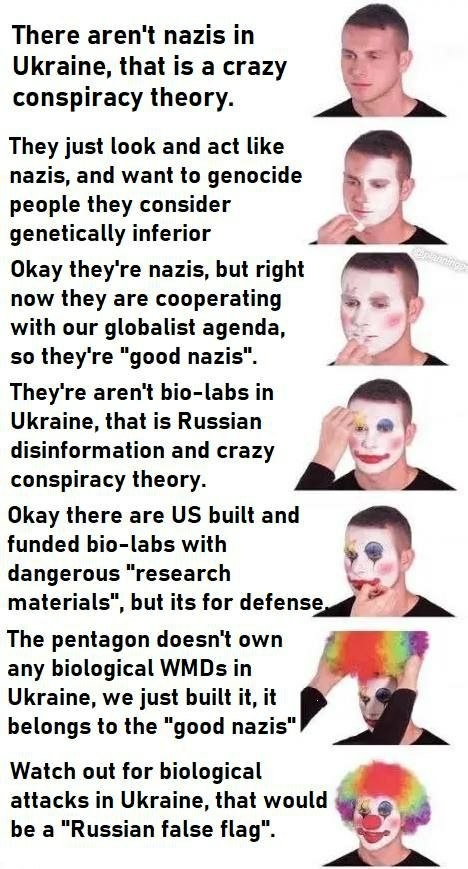
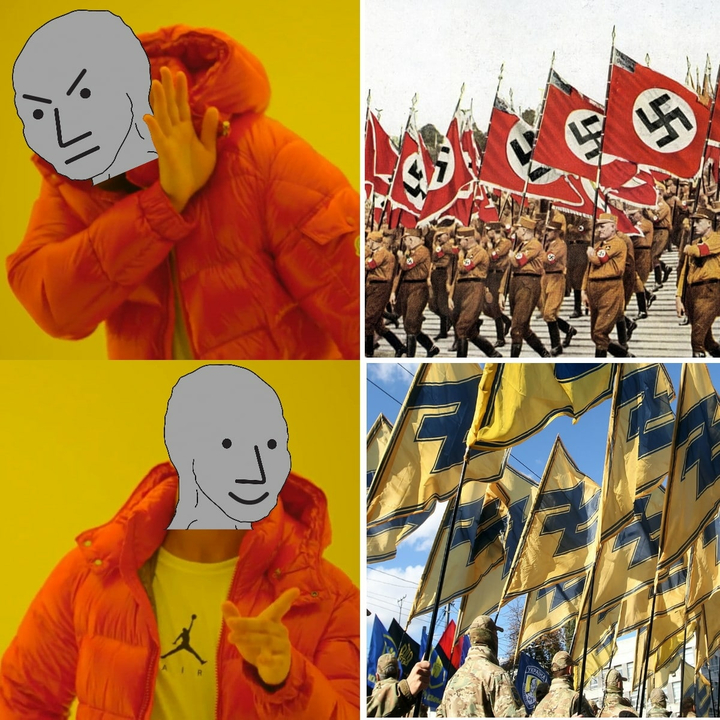
Putin claimed one of the reasons that Russia invaded Ukraine was to eliminate the Nazis in that country. Many in the media wondered what he was talking about. We identified the Azov battalion some time ago and even reported that some elements of that group showed up on Jan 6 at the Capitol. This group was shown on American TV and the announcers had no idea who they were, claiming these guys were getting ready for the Russian invasion.
We also recently reported that the Azov Battalion is a Nazi group in Ukraine. We acknowledged that many Americans had never heard of the Azov Battalion but it was indeed a group in Ukraine. Let’s also acknowledge that the Nazis and the Russians hated each other in World War II.
In 2019, forty House Democrats signed a letter to the State Department requesting that the Ukrainian army’s Azov Battalion be designated as a Neo-Nazi terrorist organization.
Three years later, House Democrats have approved a massive spending package for Ukraine, which will wind up in the hands of the same people that they themselves admitted to being Neo-Nazis and terrorists.
The Senate approved the massive package late Thursday night, sending it to President Biden for signature. It includes $1.5 trillion in funds to keep the federal government operating as well as $13.6 billion in emergency help for Ukraine.
In 2019 they questioned why certain “white supremacist groups,” notably the Ukrainian Azov Battalion, were not put on the Foreign Terrorist Organizations (FTO) list in a letter signed by 40 US House Democrats and addressed to then-Secretary of State Mike Pompeo.
Since then, the battalion has been portrayed as ultranationalists, Ukraine’s finest weapon, and everything in between by western journalists. The Neo-Nazi battalion, on the other hand, is praised in Ukraine for its discipline, strong motivation, and efficacy in defending Mariupol from Russian-backed terrorists from the puppet “republics” in the east.
The involvement of Neo-Nazi foreigners in the unit has also sparked criticism. This element of Ukraine’s army is “linked to recent terrorist attacks across the world, as well as recruiting and influencing American people,” according to House Democrats in 2019.
Recently, western political leaders and mainstream media have begun injecting a new talking point into their anti-Russian and wartime discourse: that Russia is planning an endless series of ‘false flag attacks.’
Never mind the fact that, historically speaking, Russia has no visible track record of false flag operations.
Unfortunately, the same cannot be said for either the US and Britain – both have an extremely long list of military and political deceptions which they’ve used to start and prolong various wars around the world.
Currently, in the Donbass region, formerly in eastern Ukraine, the Ukrainian Armed Forces are firing indiscriminately into civilian towns and villages – and then attempting to blame their own violent actions on Russia. The shelling of civilian areas has been going on continuous there since the civil war began in 2014. This is extremely worrying, because in the current anti-Russian western media ecosystem, any accusations leveled at Russia are never questioned, before being beamed across all western global news networks. And that is exactly what is happening right now with mainstream media coverage in Ukraine.
Independent journalist Patrick Lancaster is on the ground in Donbass region in the Luhansk and Donetsk People’s Republics, and has recently interviewed local witnesses who have confirmed these very war crimes, carried out by NATO-backed Ukrainian Army and their Nazi-Azov Battalions.
America’s Public Broadcasting Service (PBS) has published and promoted an interview with a renowed Neo-Nazi Ukrainian mayor, without disclosing the politician’s allegiances to World War II German leader Adolf Hitler and Ukraine’s own Nazi sympathizer Stepan Bandera.
The interview comes just days after PBS published an article downplaying the links between Neo-Nazi politicians and Ukraine’s current political situation.
On Thursday, March 4th, PBS hosted Mayor Artem Semenikhin of Konotop in the country’s North East.
Semenikhin described the Russian military as “cockroaches” before going on to thank the United States for supplying his people with weapons.
“My weapon is American, and I feel like our occupiers will be pleased that we are killing them with American weapons,” he concluded.
But Semenikhin is scarcely the liberty-minded freedom fighter PBS would have him seem. In 2015 the Jerusalem Post reported:
Two months after local elections were held across Ukraine, residents of the small northern city of Konotop are expressing shock and dismay over the behavior of newly chosen Mayor Artem Semenikhin of the neo-Nazi Svoboda party.
According to reports, Semenikhin drives around in a car bearing the number 14/88, a numerological reference to the phrases “we must secure the existence of our people and a future for white children” and “Heil Hitler”; replaced the picture of President Petro Poroshenko in his office with a portrait of Ukrainian national leader and Nazi collaborator Stepan Bandera; and refused to fly the city’s official flag at the opening meeting of the city council because he objected to the star of David emblazoned on it. The flag also features a Muslim crescent and a cross.
In fact, during the PBS interview Semenikhin posed with a Bandera portrait behind him, albeit blurred out by the network in their attempts to obscure their work with Ukrainian Neo-Nazis.
Emmanuel Macron said in a speech Wednesday it’s a lie that Russia is fighting Nazis in Ukraine. But in 2014, the BBC, the NYT, the Daily Telegraph and CNN — not just CN — reported on the Nazi threat.
Throughout the Ukraine crisis, the U.S. State Department and mainstream media have downplayed the role of neo-Nazis in the U.S.-backed Kiev regime, an inconvenient truth that is surfacing again as right-wing storm troopers fly neo-Nazi banners as they attack in the east, Robert Parry reports.
The New York Times reported almost in passing on Sunday (Aug. 10) that the Ukrainian government’s offensive against ethnic Russian rebels in the east has unleashed far-right paramilitary militias that have even raised a neo-Nazi banner over the conquered town of Marinka, just west of the rebel stronghold of Donetsk.
That might seem like a big story a U.S.-backed military operation, which has inflicted thousands of mostly civilian casualties, is being spearheaded by neo-Nazis. But the consistent pattern of the mainstream U.S. news media has been since the start of the Ukraine crisis to white-out the role of Ukraine’s brown-shirts.
Only occasionally is the word “neo-Nazi” mentioned and usually in the context of dismissing this inconvenient truth as “Russian propaganda.” Yet the reality has been that neo-Nazis played a key role in the violent overthrow of elected President Viktor Yanukovych last February as well as in the subsequent coup regime holding power in Kiev and now in the eastern offensive.
Prescott Bush was a partner of Brown Brothers Harriman & Co and director of Union Banking Corporation which had close relations with German corporate interests including Thyssen Steel, a major company involved in the Third Reich’s weapons industry.
“…[N]ew documents, declassified [in 2003], show that even after America had entered the war [December 8, 1941] and when there was already significant information about the Nazis’ plans and policies, he [Prescott Bush] worked for and profited from companies closely involved with the very German businesses that financed Hitler’s rise to power. It has also been suggested that the money he made from these dealings helped to establish the Bush family fortune and set up its political dynasty” (The Guardian, September 25, 2004)
.****
Without US support to Nazi Germany, the Third Reich would not have been able to wage war on the Soviet Union. Germany’s oil production was insufficient to wage a major military campaign. Throughout the war, the Third Reich relied on regular shipments of crude oil from US Standard Oil owned by the Rockefeller family.
The main producing countries in the early 1940s were: the United States (50% of global oil production), the Soviet Union, Venezuela, Iran, Indonesia, and Romania.
Without a steady supply of oil, Germany would not have been able to conduct Operation Barbarossa which was launched on June 22, 1941. The invasion of the Soviet Union was intent upon reaching and taking control of the oil resources of the Soviet Union in the Caucasus and Caspian sea regions: the oil of Baku.
In the early 1930s, there was a concerted effort on the part of Adolf Hitler and his Nazi Party to consolidate power. The back end methods of this consolidation are well taught and well known, fear, intimidation, and street violence. However, the front part, the legitimate part, is less studied by the majority of the public.
Knowing that his radical Nazi party was in a precarious position electorally, Hitler set out to bring centrist parties into the fold. One such party was the Centre Party which had long been a bastion for political German Catholics. Hitler aimed to reduce the political power of the Catholic Church while receiving an international agreement with the Holy See. He achieved both brilliantly.
On their faces, it does not seem like the Pope and the Nazis would have much in common, and in many cases, they did not. There was one binding similarity between the two that brought them close together in the early 1930s: hatred for communism.
Both the new Nazi government in Germany as well as the Vatican in Italy were both publicly and diametrically opposed to communism. The Nazis were opposed to it for political reasons while the Catholics were opposed for religious reasons. Communism was a completely atheist system which had cracked down on Christianity in Russia and elsewhere leading to alarm in Vatican City.
(As a side note, the Papacy would remain staunchly anti-communist all the way through the Cold War.)
In 1933, Pius XI and one of his top advisors, Eugenio Pacelli who would succeed Pius XI as Pius XII, signed the Reichskonkordat with Germany. This sweeping document paved the way for Hitler to sweep the Catholic influence in Germany aside while giving him an international political victory on the world stage.
 Hellbound and Down
You must be logged in to post a comment.