Grandma Left Unrecognizable After Calling 911 for Paramedics and Getting Cops Instead

“I wanted help,” McCabe said in a recent interview with KTVU. “We called for help. This was not the kind of help we wanted.”

According to KTVU, in their report, Fremont police described her as “combative,” “assaultive,” “hostile” and “uncooperative.” When she got to jail, she was listed as a “priority booking” inmate.

McCabe admits that she talked back to police when they showed up but says that was only because she didn’t want police there at all. She called for paramedics — not cops.

“Why am I in the back of a cop car when I called for help?” she remembers thinking.

Keep reading

HOW THE CRIMINAL JUSTICE SYSTEM FAILS PEOPLE WITH MENTAL ILLNESS

How those with mental illness are treated in the system has become a focus in the ongoing calls for criminal justice reform that have increased in volume since the killing of George Floyd by a Minneapolis police officer in May. At least 25 percent of fatal police encounters involve a person with mental illness, and individuals with untreated mental illness are 16 times more likely to be killed during an encounter with police, according to a report from the Treatment Advocacy Center.

Keep reading

Gender Activists Are Trying to Cancel My Book. Why is Silicon Valley Helping Them?

The day after I tweeted about the ongoing attempts to block sales of my book, Irreversible Damage: The Transgender Craze Seducing Our Daughters, I was stuck on the phone with my parents’ real estate agent. “How’s your book going?” she wanted to know. “Is there a lot of controversy?”

I know it’s fashionable these days to claim to be an introvert—something to do with an unwarranted assumption of depth, maybe—but I actually am an introvert. Small talk exhausts me, not because I believe it’s beneath me, but because it feels like being handed a socket wrench. I have no idea what to do with it.

“Well, you had to expect that, right?” she added casually. “When you write a book like that, that’s what you’re expecting.”

This is, more or less, most people’s reaction to the efforts to suppress my book. It isn’t that they agree with censorship per se. But you also can’t go setting fires without expecting Big Tech’s cops to shut them down. “If you’re going to talk about the trans thing, I mean, what did you expect?” I think the agent may have said those very words.

Except that I didn’t write about “the trans thing.” I wrote specifically about the sudden, severe spike in transgender identification among adolescent girls. I fully support medical transition for mature adults. And I have no desire to be a provocateur. (I dislike pointless provocation, in part because I think provocateurs often have a good argument—one they’re too lazy or inept to make). Nor do I have any prurient interest in others’ social lives.

What I aim to do, as a journalist, is to investigate cultural phenomena, and here was one worth investigating: Between 2016 and 2017, the number of females seeking gender surgery quadrupled in the United States. Thousands of teen girls across the Western world are not only self-diagnosing with a real dysphoric condition they likely do not have; in many cases, they are obtaining hormones and surgeries following the most cursory diagnostic processes. Schoolteachers, therapists, doctors, surgeons, and medical-accreditation organizations are all rubber-stamping these transitions, often out of fear that doing otherwise will be reported as a sign of “transphobia”—despite growing evidence that most young people who present as trans will eventually desist, and so these interventions will do more harm than good.

The notion that this sudden wave of transitioning among teens is a worrying, ideologically driven phenomenon is hardly a fringe view. Indeed, outside of Twitter, Reddit, Tumblr, and college campuses, it is a view held by a majority of Americans. There is nothing hateful in suggesting that most teenagers are not in a good position to approve irreversible alterations to their bodies, particularly if they are suffering from trauma, OCD, depression, or any of the other mental-health problems that are comorbid with expressions of dysphoria. And yet, here we are.

The efforts to block my reporting have been legion, starting with staff threats at a publishing house, which quickly reversed its original intention to publish my book. Once I obtained a stalwart publisher, Regnery, Amazon refused to allow that company’s sales team to sponsor ads on its site. (Amazon allows sponsored ads for books that uncritically celebrate medical transition for teenagers).

Because the book tackles an interesting phenomenon, a number of established journalists wanted to review it. The issue of trans-identification has seemed to come out of nowhere with Gen Z, the generation begun in 1995 whose large-scale mental-health crisis already has us so on edge. And the issue has created surprising bedfellows. Religious conservatives are concerned about the trend—but so are lesbians, who look upon the shocking numbers of teen girls transitioning with abject alarm. Many suspect that all this transitioning of girls is effectively euthanizing a generation of young lesbians.

Keep reading

Lockdown has caused a mental-health crisis

What’s strange is that a mental-health lobby that has spent years redefining mental illness to include more and more people, and spent years discussing the potential social causes of this supposed ‘crisis’, is strangely hesitant to criticise lockdown. This is despite the fact that lockdown forces us into circumstances pretty much guaranteed to increase anxiety, depression and debilitating mental illnesses

major survey by Mind, the mental-health charity, has found that two thirds of adults and three quarters of young people with existing mental-health problems have experienced worsening mental health over the course of the pandemic. In addition, more than one in five adults with no previous experience of such problems described their mental health as poor or very poor. One in four of those who tried to access support was unable to get it from the NHS.

Keep reading

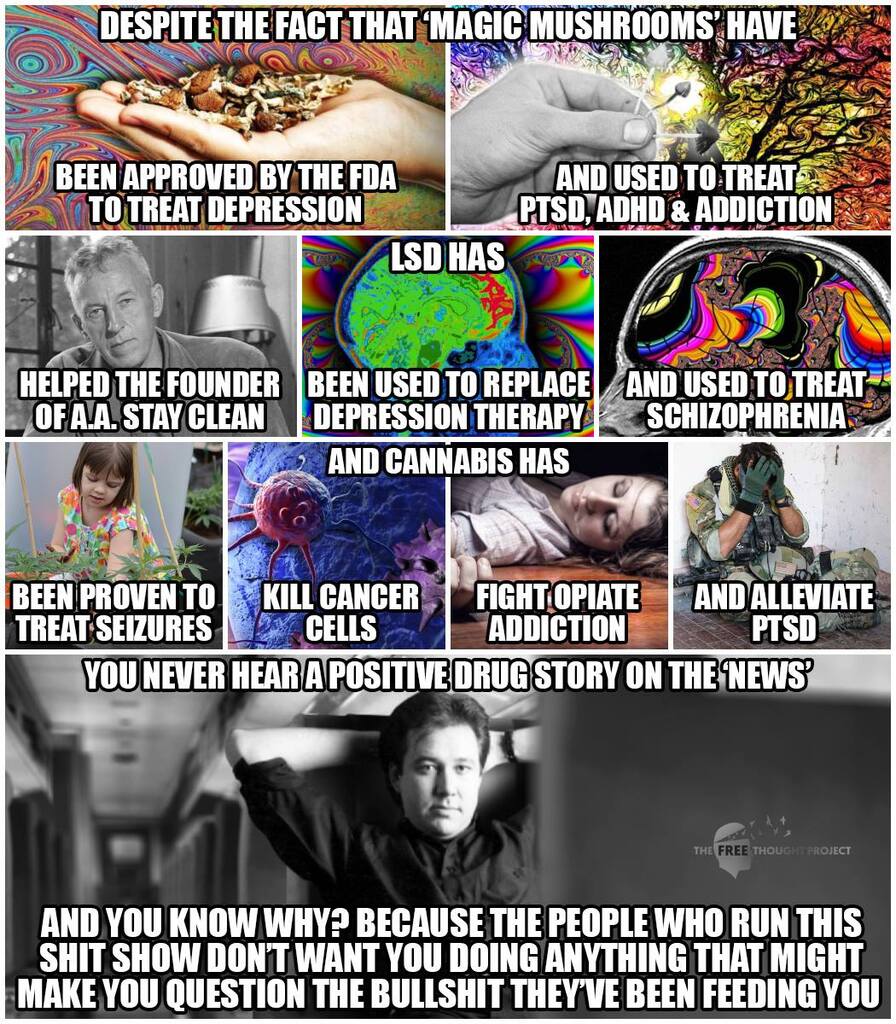
Ease restrictions on medical psychedelics to aid research, experts say

Potential treatments for severe depression, addiction and other mental health disorders are being held up by excessive restrictions on psilocybin, the active ingredient in magic mushrooms, scientists and politicians have said.

Clinical trials suggest that psilocybin may be a safe and effective medicine for patients with certain psychiatric illnesses who do not respond to talking therapies, antidepressants and other drugs. But researchers say their work is being stymied by the government placing the strictest possible controls on the chemical compound.

In a report published on Monday, the Adam Smith Institute, a free market thinktank, and the Conservative drug policy reform group, urge ministers to order a review of psilocybin and remove the obstacles faced by researchers.

Under Home Office regulations, psilocybin is classified as a schedule 1 drug, along with raw opium, LSD, ecstasy and cannabis, and is not considered a medicinal compound. While clinical trials are allowed under licence, obtaining one takes more time and money than many researchers can afford, the authors say.

Robin Carhart-Harris Read more

The report calls on government to make psilocybin a schedule 2 drug, a move that would dramatically cut the cost and time taken to obtain a licence and remove the stigma surrounding research into the drug.

Keep reading