Shock Reports Allege CIA ‘Exploiting Loopholes’ to Cast Secret Dragnet on American Citizens

Call it Snowden 2: Electric Boogaloo.

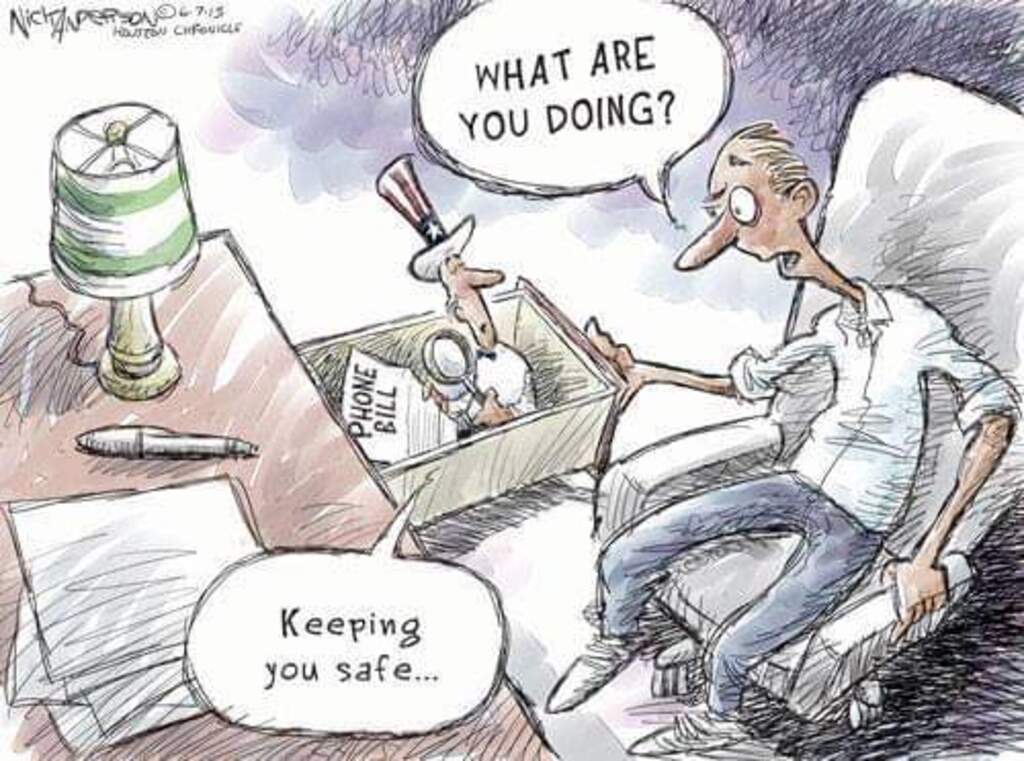
Nine years after National Security Administration whistleblower Edward Snowden disclosed that the United States was keeping a massive trove of information on its own citizens obtained via a secret digital dragnet, two Democrat senators are alleging the CIA has assembled a similar clandestine stockpile of our data.

According to The Hill, the late-Friday release of the reports is suddenly grabbing attention, if just because concerns over privacy have become widespread of late — targeting everyday Americans, as well as presidential candidates.

The reports were sent on the same day special counsel John Durham alleged in a court filing that lawyers for Hillary Clinton’s 2016 campaign paid techs to “infiltrate” servers in both Trump Tower and the White House to intercept data on Donald Trump during the election and its aftermath.

According to the Associated Press, a heavily redacted letter was sent by Democratic Sens. Ron Wyden of Oregon and Martin Heinrich of New Mexico.

They asked intelligence officials to detail a program which allegedly collected bulk data on American citizens in secret and operated “outside the statutory framework that Congress and the public believe govern this collection.”

“There have long been concerns about what information the intelligence community collects domestically, driven in part by previous violations of Americans’ civil liberties,” the AP’s Nomaan Merchant noted.

Keep reading

CIA Collecting Data on Americans

Two Democrat senators say the CIA has been operating a secret program that collects data on Americans.

Sens. Ron Wyden of Oregon and Martin Heinrich of New Mexico sent a letter to intelligence officials looking for additional details about the undisclosed data repository. The letter, sent April 2021, was declassified on Thursday with portions of it blacked out.

Both Wyden and Heinrich are members of the Senate Intelligence Committee.

In the letter, Wyden and Heinrich requested the declassification of a report by the Privacy and Civil Liberties Oversight Board [PCLOB] on a CIA bulk collection program.

statement released on Thursday by the two Senators said: “The letter, which was declassified and made public today reveals that “the CIA has secretly conducted its own bulk program,” authorized under Executive Order 12333, rather than the laws passed by Congress.

“The letter notes that the program was ‘entirely outside the statutory framework that Congress and the public believe govern this collection, and without any of the judicial, congressional or even executive branch oversight that comes from [Foreign Intelligence Surveillance Act] collection.'”

“What these documents demonstrate is that many of the same concerns that Americans have about their privacy and civil liberties also apply to how the CIA collects and handles information under executive order and outside the FISA law. In particular, these documents reveal serious problems associated with warrantless backdoor searches of Americans, the same issue that has generated bipartisan concern in the FISA context,” Wyden and Heinrich said in the statement.

Keep reading

Senate Bill Creates Massive Surveillance Program to Scan All of Your Online Messages

 People don’t want outsiders reading their private messages —not their physical mail, not their texts, not their DMs, nothing. It’s a clear and obvious point, but one place it doesn’t seem to have reached is the U.S. Senate.

A group of lawmakers led by Sen. Richard Blumenthal (D-CT) and Sen. Lindsey Graham (R-SC) have re-introduced the EARN IT Act, an incredibly unpopular bill from 2020 that was dropped in the face of overwhelming opposition. Let’s be clear: the new EARN IT Act would pave the way for a massive new surveillance system, run by private companies, that would roll back some of the most important privacy and security features in technology used by people around the globe. It’s a framework for private actors to scan every message sent online and report violations to law enforcement. And it might not stop there. The EARN IT Act could ensure that anything hosted online—backups, websites, cloud photos, and more—is scanned.

Keep reading

Post Office’s Law Enforcement Arm Is Expanding Its Surveillance Powers

The U.S. Postal Service (USPS) has announced plans to provide its law enforcement branch with access to its vast trove of customer data, raising concerns among privacy activists about the organization’s expanding surveillance powers.

The USPS came under scrutiny in 2021 when it was revealed that its law enforcement arm, the U.S. Postal Inspection Service (USPIS), was monitoring both left- and right-wing protest groups on social media. Multiple nonprofit organizations sued the USPS, seeking internal records about its surveillance program and questioning the legality of such activities.

Those lawsuits haven’t stopped the Postal Service from seeking additional surveillance powers. On Dec. 17, 2021, the USPS announced that it intended to provide customer data to USPIS investigators.

“USPIS will collect and aggregate eight data elements—Name, Address, 11-Digit Delivery Point ZIP Code (ZIP 11), Phone Number, Email Address, Tracking Number, IP Address, and Moniker,” the Postal Service stated.

According to the USPS, the influx of new data will allow postal inspectors to conduct “link analysis,” using data analytics to discover patterns and trends in criminal activity.

Keep reading

Israel insists it only ‘legally’ spies on citizens

An Israeli minister has denied reports that police illegally used Pegasus surveillance software to spy on the country’s own citizens, calling the “central claim” – that the practice was illegal – “not true.”

Several government investigations were launched this past week after the Israeli newspaper Calcalist reported that law enforcement had been using NSO Group’s infamous Pegasus spyware to illegally intercept the calls of citizens.

The newspaper claimed that police had been using the spyware since 2013 to carry out surveillance on citizens “who were not criminals or suspects.”

Omer Bar-Lev, Israel’s Minister of Public Security, told Channel 12 on Saturday that the allegations were not true, “except for the fact that the Israel Police used advanced technology.”

“The central claim that the police are illegally spying is not true,” he declared, citing the assurances of Police Commissioner Kobi Shabtai, before claiming to be “very happy that the Israel Police has advanced technological tools to help deal with serious crime organizations that are using advanced technology.”

Commissioner Shabtai vowed on Friday that the police’s “legal use of technological tools” would “continue,” and said the force would carry on “developing and improving these tools.”

Keep reading

The FBI’s Honeypot Phones Were More Widely Distributed in the U.S. Than Previously Thought

One of the weirder stories from last year involved a gargantuan FBI honeypot operation designed to catch crooks all over the world. According to Motherboard, that operation had a bigger imprint in the U.S. than originally believed.

During “Operation Trojan Shield,” the feds used a secret relationship with an encrypted phone company, called Anom, which sold devices exclusively to career criminals looking for a secure way to communicate with one another. The product’s developer, who had previously been busted for drug trafficking, agreed to act as a high-level federal informant and for at least two years sold devices to criminals while also secretly cooperating with authorities. Meanwhile the FBI, along with its international partners, intercepted all of the communications, which allowed them to capture evidence of widespread criminal malfeasance on a global scale.

It made for one helluva weird story when the bureau finally revealed what it had been up to last June, and “Shield” led to the arrest of hundreds of alleged criminals in countries all around the world—many of which are accused of using the phones to organize drug trafficking and other forms of organized crime. The arrests continue to this day.

Keep reading

Police Caught Stealing Money from Innocent People To Secretly Buy Tech to Spy on Citizens’ Cellphones

The Boston Police department has been robbing citizens of their cash — many of whom were never accused of a crime — to buy surveillance technology off the books, to spy on citizens.

As their report points out, an August investigation by WBUR and ProPublica found that even if no criminal charges are brought, law enforcement almost always keeps the money and has few limitations on how it’s spent. Some departments benefit from both state and federal civil asset forfeiture. The police chiefs in Massachusetts have discretion over the money, and the public has virtually no way of knowing how the funds are used.

Boston cops have stolen so much money that they are secretly buying more expensive gear to seemingly get better at stealing money. According to the report:

[I]n 2019 the Boston Police Department bought the device known as a cell site simulator — and tapped a hidden pot of money that kept the purchase out of the public eye.

A WBUR investigation with ProPublica found elected officials and the public were largely kept in the dark when Boston police spent $627,000 on this equipment by dipping into money seized in connection with alleged crimes.

Because this spy equipment was bought with funds stolen from citizens, not even the Boston city council knew police had it.

Boston city councilors interviewed by WBUR said they weren’t aware that the police had bought a cell site simulator. Councilor Ricardo Arroyo, who represents Mattapan, Hyde Park and Roslindale, said, “I couldn’t even tell you, and I don’t think anybody on the council can necessarily tell you … how these individual purchases are made.”

Only because ProPublica obtained the documents, does anyone know the department is using stingray devices to spy on citizens. So much for transparency.

Keep reading

Despotism Is The New Normal: Looming Threats to Freedom in 2022

“Looking at the present, I see a more probable future: a new despotism creeping slowly across America. Faceless oligarchs sit at command posts of a corporate-government complex that has been slowly evolving over many decades. In efforts to enlarge their own powers and privileges, they are willing to have others suffer the intended or unintended consequences of their institutional or personal greed. For Americans, these consequences include chronic inflation, recurring recession, open and hidden unemployment, the poisoning of air, water, soil and bodies, and, more important, the subversion of our constitution.”—Bertram Gross, Friendly Fascism: The New Face of Power in America

Despotism has become our new normal.

Digital tyranny, surveillance. Intolerance, cancel culture, censorship. Lockdowns, mandates, government overreach. Supply chain shortages, inflation. Police brutality, home invasions, martial law. The loss of bodily integrity, privacy, autonomy.

These acts of tyranny by an authoritarian government have long since ceased to alarm or unnerve us. We have become desensitized to government brutality, accustomed to government corruption, and unfazed by the government’s assaults on our freedoms.

This present trajectory is unsustainable. The center cannot hold.

The following danger points pose some of the greatest threats to our collective and individual freedoms now and in the year to come.

Keep reading

UK Government Greases Skids For Fleets of Surveillance Drones Over Cities

In what appears to be a cynical PR stunt, the UK government is considering plans to allow women who feel threatened on the street to call upon surveillance drones that would arrive in minutes and shine a bright light on any potential attacker.

What could possibly go wrong?

“Women in fear of an attack will be able to use a phone app to summon a drone, which could arrive within minutes armed with a powerful spotlight and thermal cameras to frighten off any potential assailant,” reports the Telegraph.

Trials will take place on campus at Nottingham University at a cost of £500,000 during which the tech will be used to “protect students and staff.”

The scheme will be submitted to the UK government’s Innovate research program, and could eventually see helicopters being replaced by drones as a front line tool of law enforcement.

“It is a high capability drone that costs just £100 an hour but can do 80 percent of what a police helicopter can do,” said Richard Gill, the founder of Drone Defence. “It cannot do high speed pursuits but it can do the other tasks such as searching for people and ground surveillance.”

Gill noted that 25 drones could do the job of one police helicopter in London for the same price, with the drones being housed at five base locations across the city.

The idea of countless government drones whizzing around a city keeping tabs on people is garishly dystopian.

Keep reading

In 2021, the Police Took a Page Out of the NSA’s Playbook: 2021 in Review

With increasing frequency, law enforcement has been using unconstitutional, suspicionless digital dragnet searches in an attempt to identify unknown suspects in criminal cases. Whether these searches are for everyone who was near a building where a crime occurred or who searched for a keyword like “bomb” or who shares genetic data with a crime scene DNA sample, 2021 saw more and more of these searches—and more attempts to push back and rein in unconstitutional law enforcement behavior.

While dragnet searches were once thought to be just the province of the NSA, they are now easier than ever for domestic law enforcement to conduct as well. This is because of the massive amounts of digital information we share—knowingly or not—with companies and third parties. This data, including information on where we’ve been, what we’ve searched for, and even our genetic makeup, is stored in vast databases of consumer-generated information, and law enforcement has ready access to it—frequently without any legal process. All of this consumer data allows police to, essentially, pluck a suspect out of thin air.

EFF has been challenging unconstitutional dragnet searches for years, and we’re now seeing greater awareness and pushback from other organizations, judges, legislators, and even some companies. This post will summarize developments in 2021 on one type of dragnet suspicionless search—reverse location data searches.

Keep reading