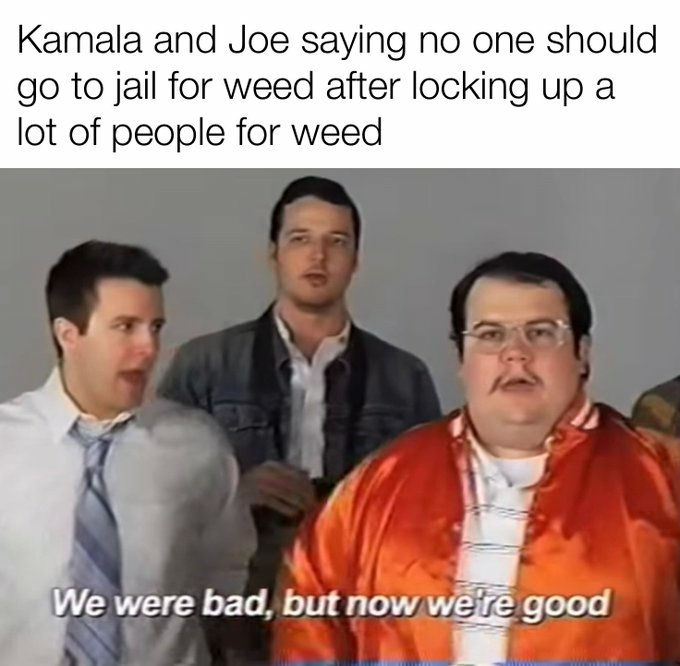
Thanks, Joe, so kind…


GOP officials’ takes on President Joe Biden’s surprise weed announcement Thursday ranged from moral outrage to begrudging praise to complete and utter silence.
Biden, a longtime opponent of legalizing weed, which he called a “gateway drug” as recently as 2019, announced Thursday—after nearly two years of pressure from cannabis and criminal justice reform advocates—that he would pardon all federal simple cannabis-possession convictions.
Biden also called on governors to pardon simple possession offenses at the state level and said he’d directed Cabinet officials, including Attorney General Merrick Garland, to begin reviewing cannabis’ Schedule 1 status under federal law, which puts it on the same level as heroin.
“I’m calling on governors to pardon simple state marijuana possession offenses,” Biden said Thursday. “Just as no one should be in a federal prison solely for possessing marijuana, no one should be in a local jail or state prison for that reason either.”
But despite the fact that 19 states and Washington, D.C., have already legalized recreational use of the drug, some Republicans criticized Biden’s announcement.
“In the midst of a crime wave and on the brink of a recession, Joe Biden is giving blanket pardons to drug offenders—many of whom pled down from more serious charges,” said Sen. Tom Cotton, an Arkansas Republican who has repeatedly said he thinks the U.S. has an “under-incarceration problem” despite the fact that the U.S. imprisons more people per capita than any nation on Earth.
The cannabis advocacy group NORML responded on Twitter: “LOL look at this loser.”
U.S. President Joe Biden is set to pardon all federal offenses of marijuana possession, the White House announced.
The pardons apply to all federal cases of simple marijuana possession as well as convictions in the District of Columbia. At least 6,500 individuals will be immediately impacted by Biden’s pardons.
“President Biden pardons all prior federal convictions for simple marijuana possession – including under DC law – also directs states to do the same, and asks HHS & AG to review how marijuana is scheduled under federal law,” reported Fox News’ White House correspondent Jacqui Heinrich.
“Senior admin official says 6500 people w/ federal convictions + thousands more under DC law will benefit… but no individuals are currently in federal prison solely for simple possession of marijuana. Most are @ state level,” Heinrich’s report continued.
The pardons will not affect anyone convicted of simple marijuana possession in state jurisdictions.
In 2018, after a wildfire destroyed their Southern California home, Corrine and Doug Thomas did their best to find a silver lining and turn that nightmare into a dream: They packed up their remaining possessions, and—along with one of their two autistic adult sons—bought a modest home nestled in Northern California’s fabled redwood forests. The home, which is perched on a hill over the Avenue of the Giants highway in Humboldt County, was a perfect fit for their family and included a large barn out back for Doug’s workshop.
Unfortunately, the Thomases’ dream quickly turned into a terrible new nightmare.
Just six days after moving in, they received a notice from the county fining them $12,000 per day because the previous owners had used the barn to grow cannabis over two years before the Thomases bought it. The county, which requires a lengthy permit process for demolitions, gave them just ten days to tear it down. Panicked, they hired a building engineer, who estimated that the demolition would cost more than $180,000—which was money they don’t have. As of today, they have accrued more than $1 million in fines.
By the county’s reasoning, anyone with a greenhouse, cleared garden, barn or any other structure that could be used to grow cannabis is assumed to be growing cannabis and fined at least $10,000 per day. Humboldt accuses property owners of cannabis-related offenses without any proof or process. The county rarely bothers to conduct even the most cursory investigation. If the inspector had visited the Thomases’, for instance, he would have found an empty barn with a few tools. But Humboldt’s inspectors have admitted that they frequently rely on satellite images alone to issue fines.
The Thomases, like more than 1,200 other Humboldt property owners, are victims of the county’s so-called “abatement” program, which levies crippling fines based on unfounded, scattershot allegations that property owners are growing cannabis without paying the county for a permit. Once fined, owners face a legal labyrinth to prove their innocence. In the Thomases’ case, for instance, they’ve waited more than a year for the county to schedule a simple hearing to plead their case. Even as the Thomases waited for a hearing, the daily fines continued to accrue.
That is why, today, the Thomases—along with a group of other Humboldt property owners—have partnered with the Institute for Justice (IJ) to file a class-action lawsuit to put an end to the county’s unconstitutional practice of levying outrageous fines against innocent individuals.
Several pervading stereotypes about cannabis users have been investigated by a new study, including the notion that they are “lazy” and lack motivation – and the results make these stereotypes go up in a puff of smoke.
Participants who used cannabis three to four times a week showed no differences compared to non-users in terms of motivation, also scoring better in terms of their ability to feel pleasure. They also showed no reduced want of rewards, nor reduced willingness to put in the effort to gain those rewards.
Scientists from University College London; the University of Cambridge; and the Institute of Psychiatry, Psychology & Neuroscience at King’s College London looked at teenagers (aged 16-17 years) and adults (26-29 years) who use cannabis regularly and compared them to controls who do not use the drug.
In a survey, the 274 participants were asked questions to assess their levels of apathy, anhedonia (inability to feel pleasure), and effort-based decision-making for rewards using pre-established scales. They were also set tests, such as button pressing tasks with chocolate and sweet rewards, to measure motivation, with participants rating their rewards to assess their levels of enjoyment.
“Cannabis use has historically been linked with amotivation, which is reflected in prevalent, pejorative ‘lazy stoner’ stereotypes,” the authors wrote in their paper. “In this study, we counter this cliché by showing that a relatively large group of adult and adolescent cannabis users and controls did not differ on several measures of reward and motivation.”
“We were surprised to see that there was really very little difference between cannabis users and non-users when it came to lack of motivation or lack of enjoyment, even among those who used cannabis every day,” Lead author, PhD candidate Martine Skumlien from University College London said in a statement.
“This is contrary to the stereotypical portrayal we see on TV and in movies.”
Even in states with legal marijuana, law enforcement’s addiction to the drug war still lingers like a dark cloud over over the land of the ostensibly free. Even in California, who has paved the way in legalization of cannabis, police officers still violently, and with extreme prejudice, lay waste to the rights of innocent people who dare grow, use, or sell this most beneficial plant.
Because of their addiction to the war on drugs, cops in Riverside County have just cost the taxpayers of their town $136,000. The money was paid to Chen-Chen Hwang, 67, and her husband, Jiun-Tsong Wu, 75, to settle a federal civil rights lawsuit alleging that their two homes were broken into by armed agents of the state and ransacked as officers looked for non-existent marijuana plants.
According to Alex Coolman, the attorney who filed the suit on behalf of the elderly couple, police were monitoring power bills of town residents and used the low amount of the couple’s bill as reason to believe they were growing marijuana.
“This was a very strange and frightening incident,” Hwang said in a release from Coolman’s office. “We did nothing to deserve this, and it made us feel unsafe in our own homes.”
The raid unfolded on August 5, 2021 and caused thousands in damage to the couple’s home.
Apparently police in Riverside County monitor power consumption and when they see low power usage, they automatically assume that people are stealing power to grow marijuana.
“The deputies believed the defendants were stealing power to grow marijuana because their power consumption was low, and they said as much,” Coolman told the Press-Enterprise.
But the couple was not growing marijuana and their power consumption was low because they used solar power and were “thrifty,” according to Coolman.
Although the medical use of marijuana has been legalized in 37 states, its recreational use is legal only in 19 states. (South Dakota voters approved a recreational marijuana initiative in the 2020 election, but it was overturned by a state circuit judge and upheld by the state supreme court.)
That is still a lot of states with legal weed considering that it was not until 2012 that the first two states (Colorado and Washington) legalized the recreational use of marijuana. In just the last two years, eight states have legalized recreational marijuana use.
What is even more amazing is that the states have done this while the federal government still classifies marijuana as a Schedule I controlled substance under the Controlled Substances Act (CSA) with “a high potential for abuse,” “no currently accepted medical use,” and “a lack of accepted safety for use of the drug under medical supervision.”
But the problem with marijuana legalization on the state level is not that it is still illegal under federal law. The problem is that there are so many government rules and regulations on the state and local level that the marijuana market can hardly be considered free at all.

Florida’s Agriculture Commissioner took issue with a recent Department of Justice memo attached to a move to dismiss a lawsuit that challenges disqualifying the state’s medical cannabis patients from legally owning firearms. The memo characterized marijuana users as “dangerous.”
“The DOJ’s argument is as offensive as it is inaccurate,” Florida Agriculture Commissioner Nikki Fried, a Democrat, said in an Aug. 8 written statement. “We were disappointed not only with the motion but with the memo attached to the motion, calling marijuana users dangerous.”
“DOJ’s argument is … inaccurate, utilizing centuries-old case law and making false claims demonizing medical marijuana patients—including perpetuating prejudicial stereotypes that cannabis users are dangerous or mentally ill.”
However, the Justice Department argues in their request for dismissal that it would be “dangerous to trust regular marijuana users to exercise sound judgment” with firearms because marijuana “causes significant mental and physical impairments that make it dangerous for a person to possess (a) firearm.”
On Aug. 9, Fried responded to a motion from the DOJ to dismiss her April lawsuit challenging the disqualification of the state’s nearly 741,000 medical cannabis patients with active identification cards from owning firearms. According to Fried’s office, Florida has 2.5 million concealed weapons permit holders on record.

You must be logged in to post a comment.