
George Carlin on divide and conquer…


In another example of the establishment left’s obsessive grift with race and social segregation, publicly funded NPR published a story claiming that if you use the wrong colour emoji in text messages in relation to your own skin colour, you are probably a racist.
In the article titled “Which skin color emoji should you use? The answer can be more complex than you think”, writers Alejandra Marquez, Janse Patrick Jarenwattananon, and Asma Khalid (it took three of them to take on this weighty subject) argue that choosing to use a yellow emoji, rather than a white, brown or black one is “the neutral option” that will leave the respondent free to “focus on the message” rather than race.
Of course, any rational person wouldn’t immediately see an emoji in a text and start thinking about race. Not these taxpayer funded hacks though.
They even went around interviewing people for the piece.
One interviewee said “I present as very pale, very light skinned. And if I use the white emoji, I feel like I’m betraying the part of myself that’s Filipino.”
The interviewee continued, “But if I use a darker color emoji, which maybe more closely matches what I see when I look at my whole family, it’s not what the world sees, and people tend to judge that.”
OMG, what a terrible dilemma to be in.
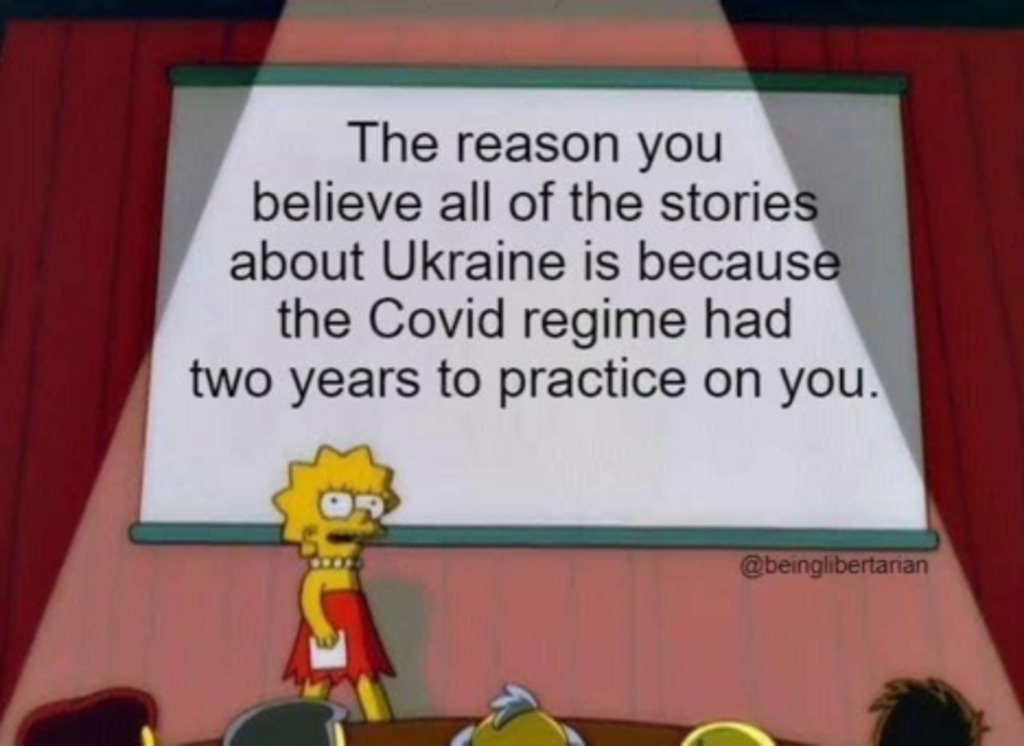
Back in November The Military Times published a Ukrainian intelligence claim, which was picked up and repeated by numerous other mainstream publications, alleging that Russia was going to invade Ukraine by the end of January.
Then in late January when the calendar debunked the Military Times incendiary headline “Russia preparing to attack Ukraine by late January”, that same outlet ran a much less viral story with the headline “Russia not yet ready for full-scale attack says Ukraine“.
Now here in early February, the Murdoch press has put out a spin piece of a sort we’re likely to see more of in coming days claiming that Russia has not invaded because the US and its allies have “ruined” Moscow’s plans by telling everyone the invasion is coming. In an article titled “Ukraine-Russia tensions: Moscow’s plans ‘ruined’ after US and Britain call out possible invasion“, Ukraine’s defense minister Hanna Maliar tells Sky News that Putin has not yet invaded because his murderous plot was thwarted by a plucky band of imperial states who would not be prevented from speaking their truth.
“It’s important to understand that when we or our western partners name the date of the possible invasion, we are ruining their plans,” Maliar told Sky News. “And the dates that were already told in public – it’s ruined plans, nothing will happen in these days. But the danger still exists.”
In the same piece Ukraine’s information minister Oleksandr Tkachenko was asked if he believed Russia would already have invaded if not for all the western talk of an imminent attack, to which he replied, “As a typical robber, if he does not see defence or at least does not see talking, he will act.”
At no time in the article is any consideration given to the possibility of a far simpler explanation for the missing Russian invasion: that Russia never intended to invade. That possibility is just skimmed right over in favor of the seemingly far less likely scenario that the Russian government thought it could orchestrate a massive invasion without anybody saying anything about it and was forced to abandon its plans in disappointment when that nonsensical gamble failed to pay off.
And now we’ve already got western media publishing other Ukrainian military claims that the real invasion will be coming on February 20th.
“February 20 is noted as a potential start date for the invasion: that is when the Winter Olympics ends in Beijing, and President Putin, 69, eager to woo the Chinese, may not wish to tarnish the event,” The Times wrote in late January.
As February 20th comes and goes without an invasion and predictions of false flag operations and Kremlin-backed coups fail to pan out, we will likely be seeing more such spin jobs from the western media claiming that those things did not happen because of measures that were taken by the US and its allies to prevent it. It may be used to score political points by claiming Biden “prevented” a Ukraine invasion with his willingness to stand up to Putin by pouring weapons into Ukraine and sending troops to Eastern Europe.
These claims will be built entirely on specious reasoning.
Bloomberg made a blunder.
The financial news site accidentally reported that Russia had invaded Ukraine Friday afternoon with a headline on its homepage.
“Live: Russia invades Ukraine,” read a jarring headline on Bloomberg’s homepage at around 4 p.m.
It stayed up for about 30 minutes, according to Olga Lautman, a Russian analyst who posted the message on social media.
Users who clicked on the eye-popping story — which comes as Russian troops mass on the Ukrainian border and US officials warn of a potential invasion — were shown an error page.
“I went on the site and saw the breaking news but knew it wasn’t real because I deal with Ukraine and will be one of the first to know,” Lautman told The Post. “It is bizarre and a pretty big mistake to make considering this is a potential large scale invasion and everyone is on edge.”
In February of 2010, the New York Times released a front page story entitled, “Research Ties Diabetes Drug to Heart Woes.” The lede read:
Hundreds of people taking Avandia, a controversial diabetes medicine, needlessly suffer heart attacks and heart failure each month, according to confidential government reports that recommend the drug be removed from the market.
The Times piece quoted an internal F.D.A. report that said the GlaxoSmithKline diabetes drug Avandia, also known as Rosiglitazone, was “linked” to 304 deaths in 2009, adding the conclusion of the two doctors who authored the report: “Rosiglitazone should be removed from the market.” The story was released in advance of a Senate Finance Committee study that produced a series of damning internal documents, including one in which an FDA safety officer expressed concern that Avandia presented such serious cardiovascular risks that “the safety of the study itself cannot be assured, and is not acceptable.”
One of the chief investigators on that study was Paul Thacker, at the time a committee aide under Iowa Republican Chuck Grassley. Multi-year document hauls like the Avandia report were Thacker’s stock in trade. I first met him around then because his committee frequently dealt with financial crisis issues I covered. Thacker, who went on to contribute to a number of commercial and academic journals, was trained in a tradition of bipartisan committee reporting that relies heavily on documents and on-the-record testimony, i.e. the indisputable stuff both sides are comfortable backing.
Thacker has an in-your-face style and a dark sense of humor, and talking to him can feel like being lost in a Bill Hicks routine, but his information is good. In his years in the Senate, his job was publicizing damaging information about the world’s most litigious companies. Certain Washington jobs require a healthy fear of the $1000-an-hour lawyers that every Fortune 500 company has on speed dial, and Thacker has always retained the Beltway investigator’s usefully paranoid approach to publishing.
“I know how to do these things,” he says. “I know how to work with whistleblowers.”
It was more than a little surprising, then, when Thacker’s name appeared in the middle of a bizarre international fact-checking controversy. In an article for one of the world’s oldest academic outlets, the British Medical Journal, Thacker wrote a piece entitled, “Covid-19: Researcher blows the whistle on data integrity issues in Pfizer’s vaccine trial.” He did what he’d done countless times, shepherding into print the tale of an apparent whistleblower with an unsettling story. Brook Jackson worked for a Texas firm called Ventavia that conducted a portion of the research trials for Pfizer’s Covid-19 vaccine. This is the same vaccine that Thacker himself, who now lives in Spain and is married to a physician, had taken.
After going through both legal and peer review, but without contacting Ventavia — apparently, they feared an injunction — the BMJ published Thacker’s piece on November 2nd, 2021. The money passage read:
A regional director who was employed at the research organization Ventavia Research Group has told The BMJ that the company falsified data, unblinded patients, employed inadequately trained vaccinators, and was slow to follow up on adverse events reported in Pfizer’s pivotal phase III trial.
Beginning on November 10th, 2021, the editors began receiving complaints from readers, who said they were having difficulty sharing it. As editors Fiona Godlee and Kamran Abbassi later wrote in an open letter to Facebook CEO Mark Zuckerberg:
Some reported being unable to share it. Many others reported having their posts flagged with a warning about “Missing context … Independent fact-checkers say this information could mislead people.” Those trying to post the article were informed by Facebook that people who repeatedly share “false information” might have their posts moved lower in Facebook’s News Feed. Group administrators where the article was shared received messages from Facebook informing them that such posts were “partly false.”
Facebook has yet to respond to queries about this piece. Meanwhile, the site that conducted Facebook’s “fact check,” Lead Stories, ran a piece dated November 10th whose URL used the term “hoax alert” (Lead Stories denies they called the BMJ piece a hoax). Moreover, they deployed a rhetorical device that such “checking” sites now use with regularity, repeatedly correcting assertions Thacker and the British Medical Journal never made. This began with the title: “The British Medical Journal Did NOT Reveal Disqualifying And Ignored Reports Of Flaws In Pfizer COVID-19 Vaccine Trials.”
The British Medical Journal never said Jackson’s story revealed “disqualifying flaws” in the vaccine. Nor did it claim the negative information “calls into question the results of the Pfizer clinical trial.” It also didn’t claim that the story is “serious enough to discredit data from the clinical trials.” The BMJ’s actual language said Jackson’s story could “raise questions about data integrity and regulatory oversight,” which is true.
The real issue with Thacker’s piece is that it went viral and was retweeted by the wrong people. As Lead Stories noted with marked disapproval, some of those sharers included the likes of Dr. Robert Malone and Robert F. Kennedy. To them, this clearly showed that the article was bad somehow, but the problem was, there was nothing to say the story was untrue.
Chris Cuomo isn’t likely to get much more than half of the $18 million he’s seeking as a settlement in his feud with CNN now that Jeff Zucker has resigned, The Post has learned.
Zucker fell on his sword in an effort to keep a possible Cuomo lawsuit against CNN from seeing the light of day, sources told The Post. The ex-CNN chief was named multiple times in a draft of a suit, which hasn’t been filed, sources said.
Zucker’s resignation came as part of an agreement hammered out with AT&T chief John Stankey, sources say. Under the agreement, Zucker would leave CNN without a fight and Stankey would settle with Cuomo, the sources said.
That way, Cuomo’s potentially damaging additional accusations about Zucker would be kept from the public, these sources say.
The western media are blaring headlines today about a “revelation” by the US government which does not actually reveal anything because it contains nothing but empty narrative fluff.
“U.S. reveals Russian plot to use fake video as pretense for Ukraine invasion,” reads a headline from CBS News.
“US reveals Russia may plan to create fake pretext for Ukraine invasion,” claims another from The Hill.
The claim is that the Russian government is plotting to fabricate a false flag operation using a graphic video with crisis actors in order to manufacture a pretense for a full-scale military invasion. State Department Spokesman Ned Price and AP reporter Matt Lee had an exchange about this claim at a Thursday press conference that you simply must watch if you haven’t already.
Lee pointed out that claims about false flags and crisis actors were “getting into Alex Jones territory” and asked for the evidence for these extraordinary claims, which one would think is reasonable since extraordinary claims are generally considered to require extraordinary evidence. Price said that the evidence is “intelligence information that we have declassified,” and when Lee asked where the declassified information was Price looked at him like he just asked the stupidest question in the world and said “I just delivered it.”
The exchange goes on to reveal that Price really did mean that the completely unverified government assertion he’d just regurgitated is the evidence for the claim being made, meaning the evidence of the government assertion is that assertion itself.
Refusing to relent, Lee kept hammering the point that a completely unsubstantiated assertion is not the same as evidence especially given all the government assertions that have proved not to be true over the years.
“Matt, you said yourself you’ve been in this business for quite a long time,” Price replied. “You know that when we make information, intelligence information public, we do so in a way that protects sensitive sources and methods.”
Ahh, so the evidence is secret. It’s top secret evidence, to protect “sensitive sources and methods”. It sure is convenient how all the evidence of immensely consequential claims made by a government with an extensive history of lying is always far too sensitive for the public to be permitted to scrutinize.
This is the kind of evidence you can’t see. The evidence is invisible.


You must be logged in to post a comment.