
There Is No Such Thing as “Settled Law”

Much of the debate over so-called “birthright citizenship” is over interpretations of the Fourteenth Amendment to the US constitution. Most of the people currently in power claim that the text means every baby born to every foreign national on American soil is an automatic US citizen. Others—like myself—believe that this interpretation is dubious and has always been a matter of debate.

In commentary on this topic, however, one often encounters assertions to the effect that rulings by the US Supreme Court provide the “definitive” or “final” interpretation. Or, put another way, there is an idea that once SCOTUS makes a ruling on something, then the ruling is “settled law.” Even worse, some people think that once the Supreme Court has ruled on something, there is no point discussing it or challenging the currently popular interpretation of the law.

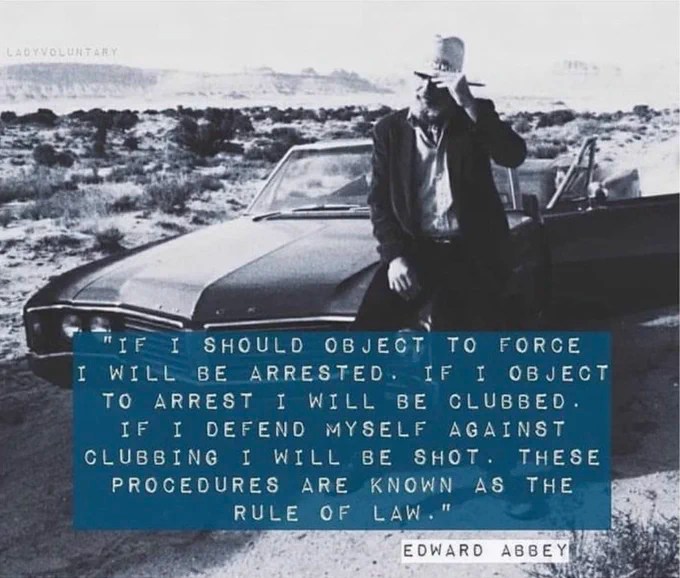
In truth, there is no such thing as settled law and the US Supreme court’s interpretations are hardly definitive. In politics nothing is ever settled or permanent. No cause is ever won or lost permanently. Beyond the short term, everything is up for grabs.

Keep reading

Get Ready to Spend Two Years in Prison

Hunter Biden most likely isn’t going to jail any time soon despite an obvious track record of fraud and criminality. But if you happen to be a small business owner in the Land of the Free, you are looking at potentially two years in prison if you don’t comply with a new law that just took effect yesterday.

It started nearly five years ago, in the spring of 2019.

Back then, a member of Congress from the state of New York– a career politician with five decades of experience named Carolyn Maloney– introduced a new bill to the House of Representatives called the Corporate Transparency Act, or CTA.

At first her bill didn’t go anywhere.

But the following summer, during the peak Covid insanity of 2020, the CTA was jammed into the nearly 1,500-page National Defense Authorization Act (NDAA), i.e. the military budget that Congress is required to pass each year.

The NDAA (and hence the CTA along with it) were passed on January 1, 2021. And now, three years later, the CTA has formally taken effect.

Now, the whole premise behind the Corporate Transparency Act is the classic bogeyman premise that evil criminals and terrorists use US corporations and LLCs to conduct their illicit activities, so therefore the government wants more rules, regulations, and reporting for US companies.

This is the same simple-minded hysteria that we always hear about cryptocurrency, i.e. criminals and terrorists use Bitcoin, therefore it should be tightly regulated by hapless government bureaucrats.

Obviously, it’s true that criminals can and do use crypto– or US business entities like Delaware LLCs– to commit their crimes.

Criminals also use iPhones, Facebook, Gmail, Dell laptops, JP Morgan Chase bank accounts, Ford F-150 pickup trucks, Amazon gift cards, and Verizon Wireless to commit their crimes.

But in this case, in the infinite wisdom of Congress, it’s business entities that are being singled out for additional scrutiny.

So, because criminals sometimes use US business entities to launder money, every law-abiding US citizen with a completely legitimate business now must jump through all sorts of hoops and reporting requirements.

And if you fail to report, you’re looking at two years in prison.

Keep reading

These are the most controversial laws that went into effect across the U.S. today

A raft of new laws that have immediate — and possibly fundamental — impact on the lives of Americans went into effect Monday.

Among them was state legislation that dealt with guns, marijuana, voting rights, minimum wage and a controversial Texas law that bans diversity programming at public colleges.

The New York Times gave a rundown of the New Year’s Day changes across the country.

Gun Ownership

In California, a law that went into effect on January 1 bars the carrying of guns in most public places. It lists more than two dozen locations where the weapons can’t be carried, including libraries and sports venues.

In Minnesota, a new law gives officials the power to take firearms away from people deemed dangerous. A similar law will take effect in Michigan next month.

Washington State will require all gun buyers to have a 10-day waiting period and to have passed a safety training program, while in Illinois high-powered semiautomatic rifles have been banned.

Keep reading

NYC law banning discrimination based on height and weight goes into effect

A new city law that bans discriminating against someone because of their height or weight went into effect last week, six months after Mayor Eric Adams first signed the legislation.

The law adds those two categories to the list of characteristics that are protected from housing, job and public discrimination — alongside things like age, gender, race, religion and sexual orientation, according to the New York Times.

“All New Yorkers, regardless of their body shape or size, deserve to be protected from discrimination under the law,” NYC City Council Speaker Adrienne Adams and Councilman Shaun Abreu said in a joint statement Sunday.

“Body size discrimination affects millions of people every year, contributing to harmful disparities in medical treatment and outcomes, blocking people from access to opportunities in employment, housing and public accommodations, and deepening existing injustices that people face,” the statement added.

“New York City is leading the nation with this groundbreaking anti-discrimination law.”

Keep reading

Biden Judicial Nominee Appears Stumped by Basic Legal Terms at Nomination Hearing

A nominee for a district judgeship in Oklahoma struggled during her nomination hearing on Wednesday to define basic terms for orders issued regularly by judges.

Sara E. Hill, who is nominated by President Biden to be the district judge for the Northern District of Oklahoma, was grilled by Sen. John Kennedy, R-La., on the Senate Judiciary Committee about basic legal and Constitutional terms and definitions — a practice that’s become usual for him in recent months after several nominees have struggled to pass his tests.

When Kennedy asked Hill the difference between a “stay” order and an “injunction” order — two orders frequently issued by federal courts — Hill stumbled through her answers.

“A stay order would prohibit, um, sorry. An injunction would restrain the parties from taking action. A stay order … I’m not sure I can, actually can, can give you that,” she said.

Keep reading