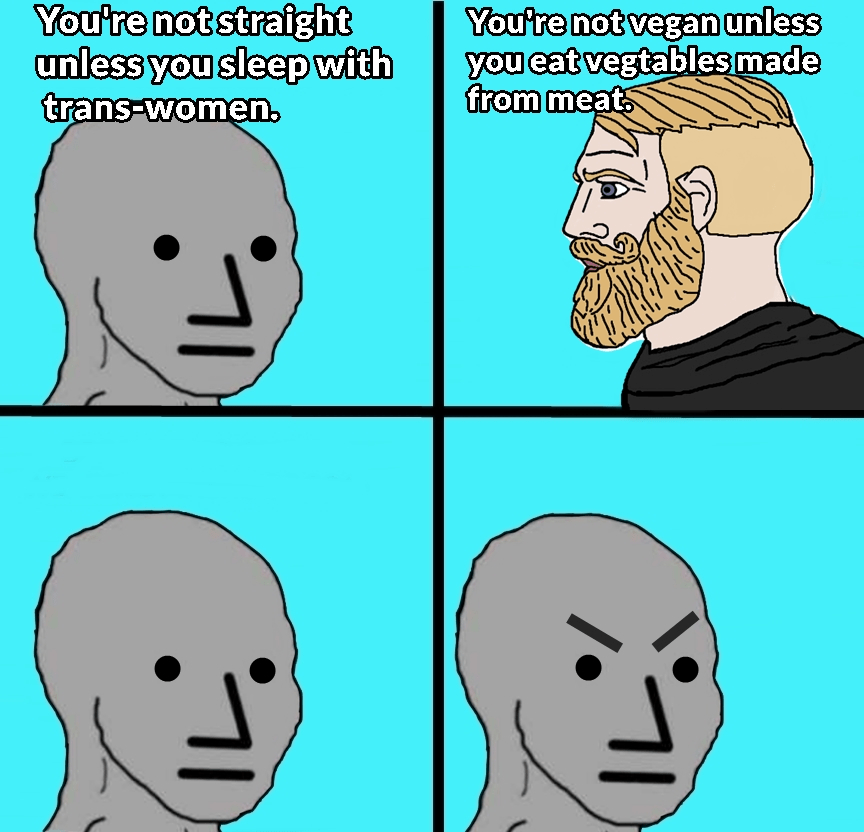
Is that how it works?

Speedy Gonzalez, along with several other cartoon characters, came under scrutiny on Wednesday after Charles Blow, a columnist for The New York Times, wrote a defense of those businesses and groups that have canceled six books by Theodor Seuss Geisel, known as Dr. Seuss, over allegations of racism. Blow included in his column a handful of cartoons and other shows that he claimed pushed toxic culture. As Blow writes:
Some of the first cartoons I can remember included Pepé Le Pew, who normalized rape culture; Speedy Gonzales, whose friends helped popularize the corrosive stereotype of the drunk and lethargic Mexicans; and Mammy Two Shoes, a heavyset Black maid who spoke in a heavy accent.
Reruns were a fixture in the pre-cable days, so I watched children’s shows like Tarzan, about a half-naked white man in the middle of an African jungle who conquers and tames it and outwits the Black people there, who are all portrayed as primitive, if not savage. I watched the old “Our Gang” (“Little Rascals”) shorts in which the Buckwheat character summoned all the stereotypes of the pickaninny.
And of course, I watched westerns that regularly depicted Native Americans as aggressive, bloodthirsty savages against whom valiant white men were forced to fight.
Blow’s column sparked backlash in defense of the cartoons that millions of Americans grew up watching. Many spoke out in defense of Pepé Le Pew, a cartoon skunk famous for his numerous failed attempts to woo a black and white cat.
“[Right wing] blogs are mad [because] I said Pepe Le Pew added to rape culture,” Blow tweeted on Saturday. “Let’s see. 1. He grabs/kisses a girl/stranger, repeatedly, [without] consent and against her will. 2. She struggles mightily to get away from him, but he won’t release her 3. He locks a door to prevent her from escaping.”
“This helped teach boys that ‘no’ didn’t really mean no, that it was a part of ‘the game’, the starting line of a power struggle,” argued Blow. “It taught overcoming a woman’s strenuous, even physical objections, was normal, adorable, funny. They didn’t even give the woman the ability to SPEAK.”
Mathematics allowed a young Sergiu, who came of age in Ceausescu’s Romania, to escape to a world where right and wrong couldn’t be fudged, and, ultimately, to a life of freedom in the United States. Without math, his life quite literally would not have been possible.
In the piece below he explains how activists are destroying his discipline in the name of progress. Worse, they are robbing poor children of the opportunity to raise themselves up by mastering it — with untold effects on all of us.
Math, with its seemingly unbiased tools — 2 + 2 always equals 4 — has presented a problem for an ideological movement that sees any inequality of outcome as evidence of systemic bias. The problem cannot be that some kids are better at math, or that some teachers are better at teaching it. Like so much else, the basic woke argument against math is that it is inherently racist and needs to be made antiracist. That is accomplished by undermining the notion of right and wrong answers, by getting rid of the expectation that students show their work, by referring to mathematical testing tools as racist, and by doing away with accelerated math classes.
If that sounds like a caricature, I urge you to read this whole document, funded by the Bill and Melinda Gates Foundation, which Sergiu writes about below. As the linguist John McWhorter put it in a powerful piece published yesterday: “to distrust this document is not to be against social justice, but against racism.”
Sergiu wrote me in an email that the situation in his field reminds him of this line from Thomas Sowell: “Ours may become the first civilization destroyed, not by the power of enemies, but by the ignorance of our teachers and the dangerous nonsense they are teaching our children. In an age of artificial intelligence, they are creating artificial stupidity.”
The critical race theorists are feeling the heat. Over the past decade, they have had remarkable success in perpetuating the concepts of systemic racism, unconscious bias, white privilege, and white fragility in American institutions, beginning with universities and moving on to schools, government agencies, and multinational corporations. Their campaign began mostly without opposition, as most conservatives were either ignorant of what was happening or dismissed it as a campus fad.
That changed last year. The intellectual movements around the so-called Intellectual Dark Web, Quillette magazine, and the 1776 Unites coalition of dissident black scholars had laid down a theoretical case against critical race theory (CRT). President Trump elevated the debate into the mainstream, denouncing CRT by name at the National Archives, signing an executive order banning CRT-based training programs from the federal government, and sparring on the topic during a televised presidential debate. Since then, investigative journalists, including me, have reported on the negative impact of CRT in government, schools, and corporations; states such as New Hampshire, Arkansas, Iowa, West Virginia, and Oklahoma have introduced legislation seeking to ban CRT programs that promote the concepts of race essentialism, collective guilt, and race-based harassment in public institutions.
This shift in momentum against the new racial orthodoxy, which has now grown beyond America’s borders to England, France, Italy, Hungary, and Brazil, has rattled the American Left. Their first argument against this change is that conservatives are using state power to “cancel wokeness.” New York Times columnist Michelle Goldberg recently followed this line, attacking my work “leading the conservative charge against critical race theory,” declaring that the Right wants to ban critical race theory because it is afraid to debate it. This is false, of course. For more than a year, prominent black intellectuals, including John McWhorter, Glenn Loury, Wilfred Reilly, and Coleman Hughes have challenged the critical race theorists to debate—and none has accepted. After Goldberg published her column, I called her bluff even further, challenging to “debate any prominent critical race theorist on the floor of the New York Times.” Predictably, none responded, catching the New York Times in a fib and further exposing the critical race theorists’ refusal to submit their ideas to public scrutiny.
The second line of attack, advanced by Goldberg and Acadia University professor Jeffrey Sachs, is that the attempt to regulate critical race theory-based programs is an “attack on free speech.” Goldberg and Sachs are attempting to reclaim the mantle of free speech, but on closer inspection, their case is legally and morally groundless. First, as legal writer Hans Bader points out, the Supreme Court has ruled that states and public schools have the ability to control curricular speech without violating free speech. Furthermore, under the Fourteenth Amendment, states and school districts have an obligation to prevent the creation of a learning environment that promotes hostility toward a certain race or sex. The courts have repeatedly ruled that the Fourteenth Amendment outweighs and limits the First Amendment when it comes to government entities adopting policies and programs that perpetuate racial stereotyping, discrimination, and harassment. Despite Sachs’s hyperventilation about threats to academia (i.e., the public-employment program for new racialist ideology), many legislatures have explicitly allowed the teaching of CRT in university classrooms; it is only forbidden to turn these principles into compelled speech, employee-indoctrination programs, and official state curricula for primary and secondary school students.
The most telling limitation in their argument, however, is that Goldberg and Sachs both refuse to deal with specifics. They present critical race theory as a benign academic discipline that seeks “social justice,” while ignoring the avalanche of reporting, including my own, that suggests that, in practice, CRT-based programs are often hateful, divisive, and filled with falsehoods; they traffic in racial stereotypes, collective guilt, racial segregation, and race-based harassment. The real test for intellectuals on the left is not to defend their ideas as abstractions but to defend the real-world consequences of their ideas.

Opponents of our new social justice dispensation often find themselves at a rhetorical disadvantage. Social justice advocates desire to replace oppressive “cultural, structural, and personal norms” with a new, more “welcoming culture.” Anyone who opposes this transformation is, by definition, unwelcoming. Who wants to be defined as unwelcoming? The rhetorical disadvantage of dissidents is only compounded by the development of new code words for social justice (like diversity or inclusion). Social justice warriors win battles simply through deploying certain terms, since this language cows and confuses their opponents.
Americans, after all, value diversity, inclusion, and equity. Diversity of faculties and talents produces inequalities—and protecting such diversity was, as Madison writes in Federalist 10, “the first purpose of government.” Inclusion reflects the universality of the rights of man, though certain people would enjoy them sooner and others later as enlightenment spread. Equity is a characteristic of impartial laws, derived from English common law, that protects and recognizes all equally before them; it provides predictable rules and doctrines for settling disputes. Diversity, inclusion, and equity produce inequalities that serve the public good: they reward productivity, expand opportunities for individuals, and provide a basis for stable common life under equal laws.
Our regnant social justice ideology redefines these words, taking advantage of their sweet sounding civic bent. This co-option represents a thoroughly new civic education. Social justice advocates have won no small ground in American political debate by seeming to adhere to the words and ideas of the old civic education, while importing a new, pernicious vision. We must re-train our ears to hear what social justice ideology peddles.
Opponents of this movement can best grasp social justice newspeak through an analysis of its public documents. What follows is based on my analysis of the state of Washington’s 2020 Office of Equity Task Force’s Final Proposal. The same word salad is served everywhere critical race theory is taught—in university task forces (like Boise State’s), in corporate trainings, even in K-12 curriculum.


 Hellbound and Down
You must be logged in to post a comment.