Talcum X: grifters gonna grift…

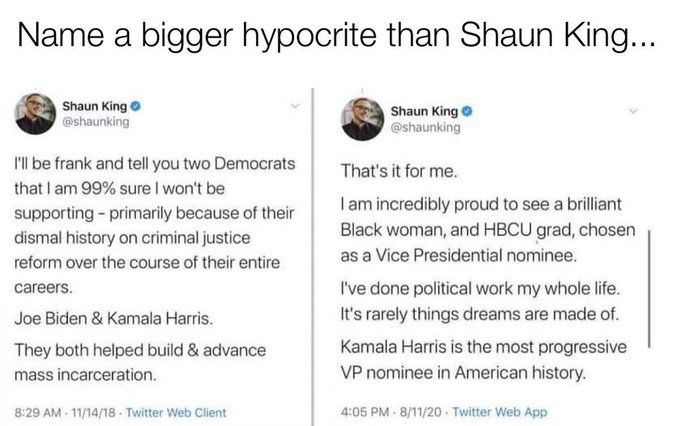
Someone intuitive once said that insanity can be defined by doing the same thing over and over again, and expecting a different result. This pretty much describes the United States political process in 2020 perfectly. Every four years, most Americans rally at the polls, get behind their political football team and claim that if their person wins, all we be good. If their person does not win, it will be four years of hell. In reality, however, no matter who wins, the police state grows, wars continue, and your rights are diminished. Nothing highlights this scenario quite like the Democratic nomination of Kamala Harris — whose made her career cheerleading the police state — in the middle of a police brutality epidemic.
In short, Harris’ entire political career can be summed up in five simple words: Kamala Harris is a cop.
Unless you have been under a rock for the last three months, you have probably noticed the nightly clashes across the country between protesters and police. While there are certainly a handful of violent agitators among the protesters, the majority of them are peaceful. However, the fact that they are peaceful has been no deterrent from more police brutality.
As Americans take to the street to protest police brutality that unfolds across the country on a daily basis, they are being met with even more of it. There is no end in sight and the situation keeps escalating. One would think that the Democratic party would see this and seek to nominate someone who has a track record of fighting for civil rights and not the police state. However, as Harris’ nomination for Vice President illustrates, one would be wrong.
Harris has catapulted herself into political stardom by stepping on the backs of those she locked away, some under false pretense, and countless others for victimless crimes. Though she claims to be against the drug war now, Harris spent over a decade ruining lives by systematically kidnapping and caging nonviolent people for possessing substances deemed illegal by the state.
She not only bragged about it, but she mocked those who sought to reform the system suggesting they are naive sloganeers who do not understand crime prevention.



The laws strengthening criminal penalties drove a surge in the state’s prison population over 30 years, beginning in the 1970s. Under both Republicans and Democrats — including Kamala Harris, who became a prosecutor in 1990 — a tough-on-crime political culture flourished in California, and African Americans were hit hardest: Their incarceration rate remains more than five times their share of California’s population.
The crackdown on crime swept most of the country, but California stood out as one of the most aggressive states. Only recently has it begun shedding its lock-’em-up mind-set.

Harris, like the rest of the Democratic field, is trying to posture as a progressive alternative to Trump, while, in her case, seeking to split the difference between Biden, the “moderate” frontrunner, and his two main challengers from the “left” wing of the party, Bernie Sanders and Elizabeth Warren. Harris has tried to have it both ways, combining the “electability” argument of Biden with the suggestion that, as a former prosecutor, she would aggressively challenge Trump.
At the heart of Harris’s candidacy—as far as her credentials with the ruling class are concerned—is her record as a ruthless operative in the fields of criminal justice and national security. She was district attorney in San Francisco for six years, then California state attorney-general for the same length of time, before winning a Senate seat in 2016.
Senate Democratic leaders promoted Harris from the start, giving her plum committee assignments, including Budget, Homeland Security and Judiciary, where she was heavily publicized for her role in the questioning of Supreme Court nominee, now justice, Brett Kavanaugh.
Most revealing was her appointment to the Intelligence Committee in 2017—the only newly elected Democrat to be given such a critical position, and an indication that, as far as the Democratic Party establishment and the military-intelligence apparatus were concerned, Harris is a “safe pair of hands.”
Harris has repaid this confidence by acting as the point woman, among the Democratic presidential candidates, for the bogus anti-Russian campaign, demanding Trump’s impeachment, not for his flagrant violations of the US Constitution or his persecution of immigrants, but based on the McCarthyite smear that he is a stooge of Moscow.
Fighting on behalf of victims of sexual abuse, particularly children, has been central to Harris’s political identity for the better part of three decades. Harris specialized in prosecuting sex crimes and child exploitation as a young prosecutor just out of law school. She later touted her record on child sexual abuse cases and prosecuting pedophiles in television advertisements, splashy profiles, and on the trail as she campaigned for public office.
But when it came to taking on the Catholic Church, survivors of clergy sexual abuse say that Harris turned a blind eye, refusing to take action against clergy members accused of sexually abusing children when it meant confronting one of the city’s most powerful political institutions.
When Harris became San Francisco district attorney in 2004, she took over an office that had been working closely with survivors of sexual abuse to pursue cases against the Catholic Church. The office and the survivors were in the middle of a legal battle to hold predatory priests accountable, and Harris inherited a collection of personnel files involving allegations of sexual abuse by priests and employees of the San Francisco Archdiocese, which oversees church operations in San Francisco, and Marin and San Mateo counties
The files had been compiled by investigators working under the direction of Terence Hallinan, the radical district attorney who Harris ousted in a contentious election campaign. Hallinan’s team had prosecuted cases of abuse that had occurred decades earlier and had gathered evidence as part of a probe into widespread clergy sexual misconduct.
Just six months before Harris took office, a U.S. Supreme Court decision overturned a California law that had retroactively eliminated the statute of limitations for criminal prosecution of child molestation cases. That shifted the focus to holding predators among the clergy accountable through civil cases and through a broader effort to bring attention to predators who had been shielded by the church.
Hallinan believed that the clergy abuse files were a matter of public record; Harris refused to release them to the public.
In her seven years as district attorney, Harris’s office did not proactively assist in civil cases against clergy sex abuse and ignored requests by activists and survivors to access the cache of investigative files that could have helped them secure justice, according to several victims of clergy sex abuse living in California who spoke to The Intercept.
“It went from Terence Hallinan going hundred miles an hour, full speed ahead, after the Catholic Church to Kamala Harris doing absolutely nothing and taking it backwards hundred miles an hour,” said Joey Piscitelli, a sexual assault survivor, who a jury found had been molested as a student while attending Salesian College Preparatory, a Catholic high school in Richmond, California.

 Hellbound and Down
You must be logged in to post a comment.