First-graders in New Jersey will be given sex education lessons dubbed ‘Pink, Blue and Purple’ that will include discussions on gender identity: Ex-Gov. Chris Christie slams Phil Murphy for embracing ‘crazy liberal policies’

First-graders in New Jersey will be learning about gender identity in new sex education curriculum which includes a lesson that teaches the children that they can have ‘boy parts’ but ‘feel like’ a girl. 

The new lessons, which are part of a broader, K-12 health and sex education curriculum adopted by the New Jersey Board of Education, are alarming some parents. 

One of the 30-minute lesson plans, called ‘Pink, Blue and Purple‘ teaches the students to define ‘gender, gender identity and gender role stereotypes,’ Fox News reported. 

Another lesson plan, this one for second graders, called ‘Understanding Our Bodies,’ tells teachers to instruct students that ‘being a boy or a girl doesn’t have to mean you have those parts, there are some body parts that mostly just girls have and some parts that mostly just boys have.’ 

‘Most people have a vulva and a vagina or a penis and testicles, but some people’s bodies can be different,’ the plan states. ‘Your body is exactly what is right for you.’ 

The new state sex education guidelines, which go into effect in September, were handed out to parents at the Westfield Board of Education meeting in February, and included instructions for teachers to tell students that their gender identity is up to them.   

‘You might feel like you’re a boy even if you have body parts that some people might tell you are ‘girl’ parts,’ the lesson plan states.

‘You might feel like you’re a girl even if you have body parts that some people might tell you are ‘boy’ parts. And you might not feel like you’re a boy or a girl, but you’re a little bit of both. No matter how you feel, you’re perfectly normal!’ 

Keep reading

Census Bureau will Spend $10 Mil to Study How to Best Add Gender Identity Questions on Surveys

In a fierce governmentwide effort to provide special accommodations to less than one percent of the American population, key federal agencies are implementing significant—and costly—measures to support residents who identify as transgender. This includes the U.S. Census Bureau spending $10 million to research how to best add questions about sexual orientation and gender identity on surveys. The Biden administration calls it “critical research” in a recent announcement issued by the White House on Transgender Day of Visibility. It is essential to invest in the research because the data collected by the Census Bureau will help the federal government “better serve the LGBTQI+ community by providing valuable information on their jobs, educational attainment, home ownership, and more,” the White House statement reads.

The administration took the opportunity on Transgender Day of Visibility to also reveal additional measures that other federal agencies will implement to accommodate transgender people, those whose gender identity differs from the sex assigned at birth. For instance, the State Department will allow all American citizens to select an X as their gender marker on U.S. passport applications. This will deliver on the president’s commitment to expand access to accurate identification documents for transgender and non-binary Americans, according to the announcement. The Department of Homeland Security (DHS) is strong-arming air carriers to “promote the use and acceptance of the X gender marker to ensure more efficient and accurate passenger processing.” The DHS agency created after 9/11 to protect the nation’s transportation system, the Transportation Security Administration (TSA), will update its Standard Operating Procedures to remove gender considerations when validating a traveler’s identification at airport security checkpoints. TSA PreCheck and Customs and Border Protection (CBP) Trusted Traveler Programs will also get updated to include X gender markers to “enhance access for transgender, non-binary, and gender non-conforming travelers.”

Keep reading

School Nurse Suspended For Revealing Connecticut Public School Was Secretly Giving Children Puberty Blockers Behind Their Parents’ Backs

A school nurse was suspended after revealing the school worked at was secretly giving children puberty blockers behind their parents’ backs.

77-year-old Kathleen Cataford was suspended by Hartford Public Schools this week after she revealed the school secretly put an 11-year-old student on puberty blockers in a public comment on Facebook.

“Investigate the school system curriculum…CT is a very socially liberal, gender confused state,” the Facebook post read. “As a public school nurse, I have an 11yo female student on puberty blockers and a dozen identifying as non-binary, all but two keeping this as a secret from their parents with the help of teachers, SSW [social workers] and school administration.”

She continued, “Teachers and SSW are spending 37.5 hours a week influencing our children, not necessarily teaching our children what YOU think is being taught.”

Keep reading

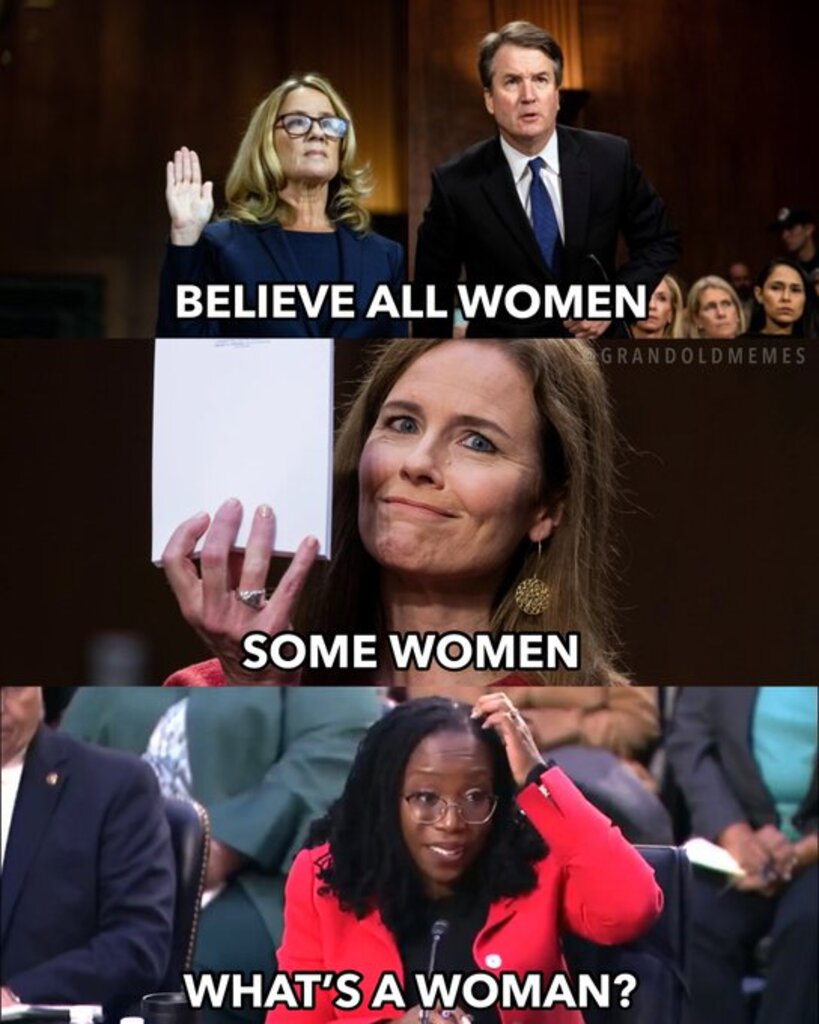
How Can Ketanji Brown Jackson Rule In Sex Discrimination Cases If She Can’t Define ‘Woman’?

Judicial confirmation hearings are rarely illuminating. Since the introduction of television cameras, they mostly serve as a way for senators to say what they want their constituents to hear and for judicial nominees to say as little as possible. Nothing is learned, at least not on purpose.

But occasionally, we learn something by accident. At Judge Ketanji Brown Jackson’s confirmation hearing on Tuesday, Sen. Marsha Blackburn of Tennessee asked a seemingly innocuous question: “Can you provide a definition of the word ‘woman’?”

The nominee was unable to do so.

It might seem like a question that goes more to politics than to the job of a judge, but when sex discrimination is frequently before the court — including as recently as last year in Bostock v. Clayton County — it behooves a judge to have some inkling about what “sex” means.

Blackburn’s questioning began with a reference to the 1996 case of United States v. Virginiain which the Supreme Court struck down the Virginia Military Institute’s policy of only admitting men by a 7-1 vote, with Justice Ruth Bader Ginsburg writing the opinion of the court. (You can watch the testimony here, beginning at about 13:10:00.) Blackburn quoted from that opinion, specifically to Ginsburg’s point that “[p]hysical differences between men and women, however, are enduring: ‘[T]he two sexes are not fungible; a community made up exclusively of one [sex] is different from a community composed of both.’”

“Do you agree with Justice Ginsburg,” Blackburn asked, “that there are physical differences between men and women that are enduring?”

It sounds like a softball — even young children know that there are physical differences between men and women. Jackson knows it, too. Everyone in that room knows it. But she declined to admit it.

“I am not familiar with that particular quote or case,” she said, which strains credulity. Had she committed that line to memory? Probably not. But to be unfamiliar with a landmark case, the most consequential majority opinion Justice Ginsburg ever authored? United States v. Virginia was surely a topic of discussion in 1996, Jackson’s third year of law school, where she was an editor of the Harvard Law Review. It beggars belief to say she was unfamiliar with it entirely.

The senator pressed on: “Do you interpret Justice Ginsburg’s meaning of ‘men and women’ as ‘male and female’?”

Judge Jackson demurred. “Again, because I don’t know the case, I don’t know how I interpret it.”

So Blackburn made it even simpler: “Can you provide a definition of the word ‘woman’?”

Again, Jackson pretended to not understand something that people have understood since the beginning of time.

“I can’t,” she said. “Not in this context, I’m not a biologist.”

Keep reading

If Ketanji Brown Jackson Doesn’t Know What A ‘Woman’ Is, Why Does She Use The Word So Much?

Joe Biden’s recent Supreme Court nominee Judge Ketanji Brown Jackson, whom the president has admitted was nominated in part because she is a woman, stunned listeners on Tuesday when she refused to give a definition of what a woman is.

“I can’t. … I’m not a biologist,” Jackson said after Republican Sen. Marsha Blackburn asked her to provide a definition of the word “woman.”

But for not knowing what a “woman” is, Jackson loves to use the word. Here are 14 times she invokes the fairer sex in just the first two days of her confirmation hearings, plus 34 times she’s used the word in her legal opinions as a judge

Keep reading