Tax Comparisons Show ‘Free’ Stuff is Very Expensive

People who want a larger, more active state frequently point to their favorite European country (usually a small Scandinavian nation) and ask why America doesn’t provide lots of “free” services like that alleged utopia. The answer is that it could but that wouldn’t necessarily make people happier. The U.S. is a large and diverse country where people don’t nearly agree with each other on what they want, and it’s difficult for government to provide more services without fueling arguments over what and how much should be provided. Importantly, too, those services aren’t free—they carry a very high price tag.

Paying Half Your Salary for Government Services

“Governments with higher taxes generally tout that they provide more services, and while this is often true, the cost of these services can be more than half of an average worker’s salary, and for most, at least a third of their salary,” Cristina Enache wrote last week for the Tax Foundation. “Belgium has the highest tax burden on labor at 52.6 percent (also the highest of all OECD countries), followed by Germany and France at 47.9 percent and 47.2 percent, respectively. Switzerland had the lowest tax burden at 22.9 percent.”

The U.S. government’s tax bite comes in at 29.9 percent, according to the Organization for Economic Cooperation and Development (OECD). The average across the OECD as of 2023 was 34.8 percent.

That cited tax percentage isn’t a formal rate set by any government, but a “tax wedge” created for the purpose of comparisons across diverse tax systems. The OECD defines the tax wedge “as the ratio between the amount of taxes paid by an average single worker (a single person at 100% of average earnings) without children and the corresponding total labour cost for the employer.” It doesn’t account for adjustments such as tax breaks offered to families with children. It also doesn’t allow for wild variations in tax compliance that can turn nominal tax rates into suggestions when you’re discussing the difference between 83 percent compliance in the U.S., 62 percent compliance in Italy, and 70 percent in Belgium, where tax evasion is something of a national sport. But the tax wedge allows us to roughly contrast the cost of government in Belgium with that in Spain or the U.S.

It turns out governments offering lots of “free” stuff to the public, like health care and higher education, charge dearly for such services. You won’t have to pay for that appointment or a degree, but you’ll also never see somewhere between one-third and half of what you should be taking home in pay.

And the price keeps going up.

Keep reading

Local Media Laments Lack of Free-To-Buyer Cars As EV Incentive Program Goes Bust

It’s not surprising — the climate cult has forced EV’s on the public so hard, with both carrots and sticks, and the incoming President campaigned on righting the electric ship and its mandates. 

Then there is the matter of charging stations, which the American people fully funded, albeit against their will, which were never fully realized under current leadership. 

But the real story here is the example CPR raises of a customer that feels “defeated” and “betrayed.”

The customer is Lisa Levad, a small business owner who figured out that she could get a used BMW EV for free by stacking rebates. She traded in her truck and chose a dealership that maxed out EV credits. She nearly got it done, too, except Xcel ran out of money before her rebate passed through, so she was left paying $2500 for a BMW electric vehicle. 

The CPR article paints her as a victim. She is apparently a victim because she failed to get a free car. 

Also, hilariously, she says the quiet part about EVs out loud: 

“While the car only offers 60 miles of range, she said it works for city driving and taking her granddaughter to school. ‘It is a very deluxe golf cart. I love it, though,’ Levad said.”

Keep reading

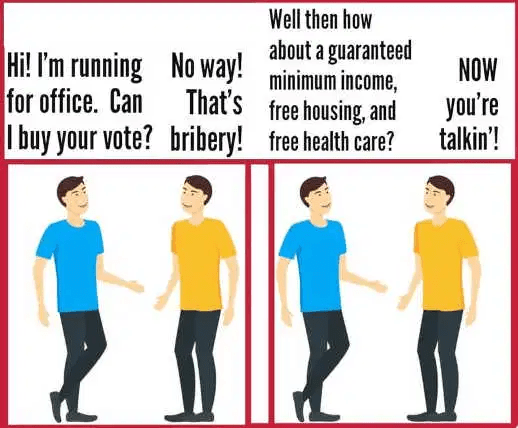
EVERYONE LOVES A GENEROUS GOVERNMENT UNTIL THEY HAVE TO PAY FOR IT

Governments, like individuals, can spend liberally with great generosity, or they can be frugal. Everyone receiving government money loves the state’s free-spending generosity, as it is “free money” to the recipients.

But there is no such thing as truly “free money,” a reality discussed by Niccolo Machiavelli in his classic work on leadership and statecraft, The Prince, published in 1516. In Machiavelli’s terminology, leaders could either pursue the positive reputation of being liberal in their spending (not “liberal” in a political sense) or suffer the negative reputation of being mean, i.e. miserly, tight-fisted and frugal.

Machiavelli pointed out that the spending demanded to maintain the reputation for free-spending liberality soon exhausted the funds of the state and required the leader to levy increasingly heavy taxes on the citizenry to pay for the state’s largesse.

Once we examine this necessary consequence of liberal spending, it turns out the generous government is anything but generous, as it is eventually forced to impoverish its people to support its spending.

It is the miserly leader and state that is actually generous, for it is the miserly leader / state that places a light burden on the earnings and livelihoods of the citizenry.

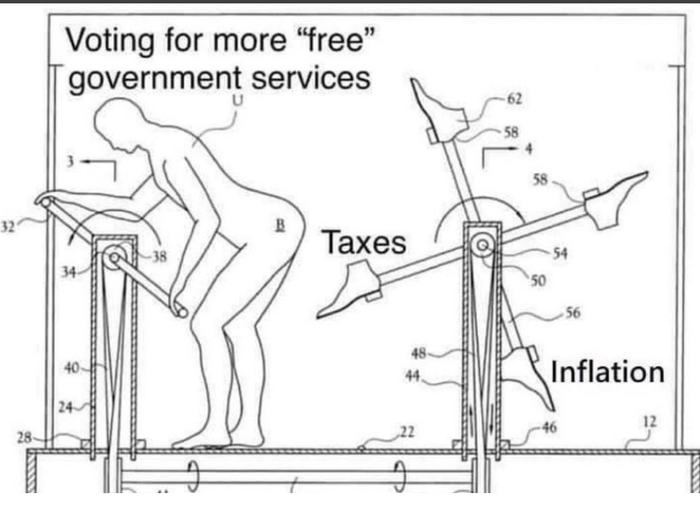
As Machiavelli explained, taxes and the inflation that comes with free spending both rob everyone, while the state’s generosity is a political process that necessarily distributes the largesse asymmetrically:

If he is wise he ought not to fear the reputation of being mean, for in time he will come to be more considered than if liberal, seeing that with his economy his revenues are enough, that he can defend himself against all attacks, and is able to engage in enterprises without burdening his people; thus it comes to pass that he exercises liberality towards all from whom he does not take, who are numberless, and meanness towards those to whom he does not give, who are few.

The profligate state and leader fail, for their resources are squandered.

We have not seen great things done in our time except by those who have been considered mean; the rest have failed. A prince, therefore, provided that he has not to rob his subjects, that he can defend himself, that he does not become poor and abject, that he is not forced to become rapacious, ought to hold of little account a reputation for being mean, for it is one of those vices which will enable him to govern.

Machiavelli understood that the positive reputation generated by profligacy decays as quickly as solvency. Everyone loves getting “free money” from the state until the bill comes due: the decay of purchasing power (i.e. inflation), higher taxes and fees, and the ever-increasing burdens of interest to be paid on soaring state debts that squeezes out all other spending.

And there is nothing wastes so rapidly as liberality, for even whilst you exercise it you lose the power to do so, and so become either poor or despised, or else, in avoiding poverty, rapacious and hated. And a prince should guard himself, above all things, against being despised and hated; and liberality leads you to both. Therefore it is wiser to have a reputation for meanness which brings reproach without hatred, than to be compelled through seeking a reputation for liberality to incur a name for rapacity which begets reproach with hatred.

Keep reading