Joe Biden’s BLM Nominee Pushed Population Control, Defined American Children as ‘Environmental Hazard’

Tracy Stone-Manning, President Joe Biden’s nominee to be director of the Bureau of Land Management (BLM), described American children as an “environmental hazard” while advocating for slowing U.S. population growth in her 1992 graduate thesis.

The Daily Caller reported on Stone-Manning’s thesis, titled “Into the Heart of the Beast| A case for environmental advertising,” after which she was awarded a master of science degree in environmental studies. Her thesis, however, amounted to public policy recommendations for the University of Montana described as “environmental education.”

Stone-Manning called for an advertising campaign to lessen procreation among Americans, ostensibly towards “environmental” ends. She produced a sample poster deriding a shirtless child as an “environmental hazard.”

Her political advertisement asked in its header, “Can you spot the environmental hazard in this photo?” It included the following response:

That’s right, it’s the cute baby. Americans believe that overpopulation is only a problem somewhere else in the world. But it’s a problem here too.”

The earth is only so big, and we can tap into it only so often. In America, we tap in often and hard.

We breed more than any other industrialized nation. At the same time, we suck up one-third of the world’s energy.

On average, each of us gobbles the same energy as 3 Japanese, 13 Chinese, and 499 Ethiopians. When we overpopulate, the earth notices it more. Stop at two. It could be the best thing you do for the planet.

Biden’s nominee to head the BLM also composed a script for a 30-second video commercial to discourage American families from having more than “one or two” children. A female voiceover for the advertisement reads, “When we [Americans] have children, the planet feels it more. Do the truly smart thing. Stop at one or two kids.”

Her thesis claimed, “The origin of our abuses is us. If there were fewer of us, we would have less impact.”

Keep reading

Biden’s $2 Trillion Infrastructure Bill Will Hurt the Environment

President Joe Biden’s administration has made the fight against climate change a central part of its $2 trillion infrastructure plan. This legislation, if it ever sees the light of day, would shovel more than $100 billion of subsidies toward boosting the market for electric vehicles, as well as updating the country’s electric grid to make it allegedly more resilient to climate disasters.

All of these “investments” sound well and good on paper, but if you genuinely care about the environment, don’t hold your breath for any real progress. For one thing, Biden’s plan is mostly a giant handout to corporations that are already heavily investing in infrastructure. It’s also a gift to unions, most of which will do nothing to encourage the type of activities the president claims to support, and they’ll make the cost of producing infrastructure more expensive, so we’ll probably see less of it.

Keep reading

Wow! Such BS Caught on Video: Pete Buttigieg Has Gas-Guzzling Suburban Drop Him Off a Couple Blocks from Work So He Can Ride His Bike in for the Cameras

More liberal BS caught on video.

The media went gaga after news broke that Transportation Secretary Pete Buttigieg was riding his bike to work.
What a guy!
What a great example!

Now we know it was all a dog and pony show like everything the Democrats do and say.

Pete Buttigieg used an armored gas-guzzling Suburban to bring a bike within a short distance of the destination. Then he was caught on video unloading the bike and riding in with a security detail in tow, pretending to save energy.

Keep reading

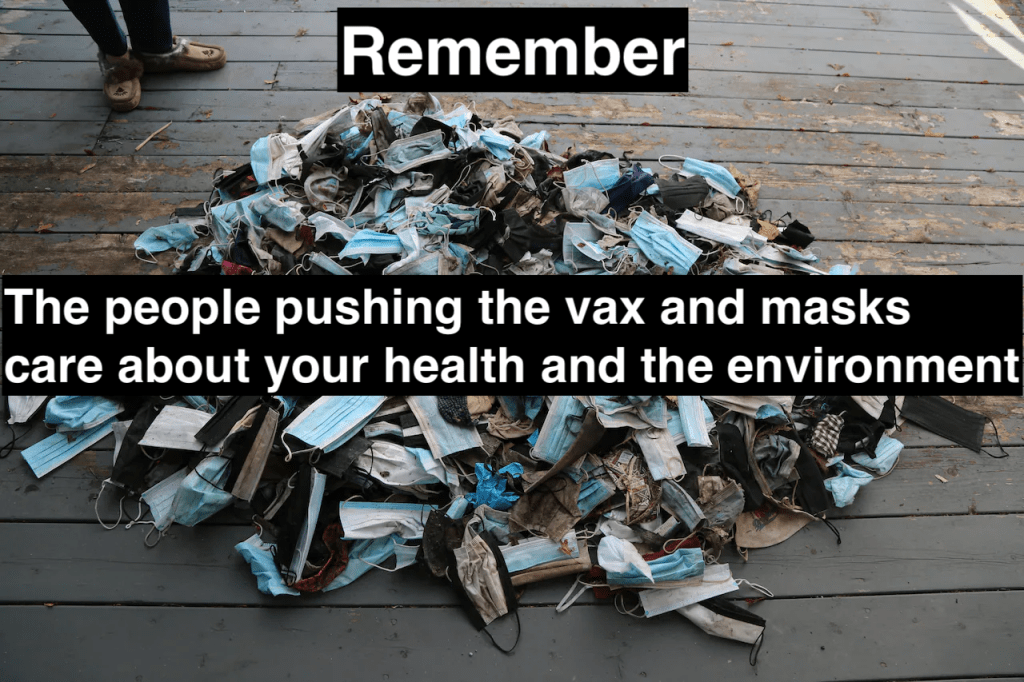
Researchers Say 4 Billion Masks Tossed Out Daily Could Cause Environmental Catastrophe

Around the world, every minute of every day, three million masks are tossed out. Let that sink in. THREE million masks are tossed out every MINUTE.

Every single day, on average, a little over four billion — with a “b” — masks are thrown out.

Every single month, 129 billion — again with a “b” — masks are tossed out.

And this does not include all the other protective equipment.

“Preventing masks from becoming the next plastic problem,” is the name of a research paper published this year and here’s the takeaway:

Recent studies estimated an astounding 129 billion face masks being used globally every month (3 million / minute) and most are disposable face masks made from plastic microfibers (Prata et al., 2020). With increasing reports on inappropriate disposal of masks, it is urgent to recognize this potential environmental threat and prevent it from becoming the next plastic problem.

Yes, there is a layer of plastic in all those disposable masks, and here’s a collection of photographs that bring the problem to life.

Keep reading

Covid Face Masks Killing Wildlife, Study Says

Researchers are blaming “corona waste,” including disposable face masks and latex gloves, for a recent increase in wildlife deaths.

The researchers in the Netherlands say wildlife across the world is getting entangled in discarded face masks and other safety gear.

“Researchers note incidents of foxes in the United Kingdom and birds in Canada all becoming entangled in discarded face masks,” according to studyfinds.org. “Hedgehogs, seagulls, crabs, and even bats are all encountering the disposable plastics in the environment.”

“In some cases, study authors say animals are eating this debris.”

Informed readers will see the irony in that the very people pushing face mask mandates also claim to be concerned with “global warming” and the environment in general.

Keep reading

More than 50 new environmental chemicals detected in people

Researchers have detected more than 50 new environmental chemicals lurking in people’s bodies, the vast majority of which are little known or unknown compounds.

These chemicals — which have never been observed in people before — were discovered in a study of pregnant women and their newborns.

The findings are concerning given that very little is known about these chemicals and their potential health effects, researchers from the new study say. What’s more, pregnant women and their newborns are a particularly vulnerable population.

Keep reading

‘More Masks Than Jellyfish’: Covid Mask Pollution Is Destroying Ocean Ecosystems, Wildlife

While Covid face mask mandates have proved lucrative for governments, the pharmaceutical and PPE industries, and health officials, they have taken a devastating toll on the world’s oceans and wildlife according to ecological and environmental experts.

An extensive study from marine preservation group OceansAsia found that “the number of masks entering the environment on a monthly basis as a result of the COVID-19 pandemic is staggering.”

“From a global production projection of 52 billion masks for 2020, we estimate that 1.56 billion masks will enter our oceans in 2020, amounting to between 4,680 and 6,240 metric tonnes of plastic pollution,” OceansAsia reported. “These masks will take as long as 450 years to break down and all the while serve as a source of micro plastic and negatively impact marine wildlife and ecosystems.”

“Every single visit we find more masks,” OceansAsia’ Teale Phelps Bondaroff said, noting that since many masks are shredded and covered in algae, they may be consumed by fish and ocean creatures that mistakes the masks as food.

The global face masks market value was roughly $790 million in 2019, but exploded to over $166 billion by the end of 2020.

In a Facebook post from early in the mask and lockdown cycle, Operation Clean Sea nonprofit founder Laurent Lombard warned, “Knowing that over 2 billion disposable masks have been ordered, soon there are likely to be more masks than jellyfish in the waters of the Mediterranean…!”

Keep reading