
On September 7th, 2001 I was on a business trip to New York as an employee of Sprint. It was a beautiful blue-sky day, and I recall standing in a skyscraper on Times Square and looking down Broadway towards Lower Manhattan and the Twin Towers. Four days later I was hiking in Zion National Park when the world exploded into madness.
For years I had no reason to question the official narrative of that day, and accepted it without question. I was aware of “conspiracy theories” and alternative views, but I saw them as fringe and unimportant. My life revolved around professional advancement, small children, and personal dislocations.
The illegal and illegitimate wars in Iraq and Afghanistan gave me pause for thought. I remember giving Tony Blair the benefit of the doubt over the Iraq war, and dismissing the case made by peace protestors that the WMD pretext was fabricated. Clearly, I was wrong, and had been fooled.
Around the year 2010 I returned to the story of 9/11, and began to dig into these challenges to the widely accepted account. The more I looked, the greater was my concern. I could not be sure what had happened, or who really was behind the attacks, or what the real motive was. But I could not reconcile the hard data with the standard explanation given.
To believe the official version, you had to overlook a lot of very hard-to-ignore anomalies. The Twin Towers had free-fall collapsed, turning to dust on the way down, and leaving minimal piles of rubble (compared to their size) heaped upon molten rock that took months to cool. The suggested progressive collapse process breaks the law of conservation of momentum.
WTC7 also implausibly collapsed on itself due to “office fires”, with it being announced by the BBC before it happened. A secret engineering model was used to justify this unlikely and unique event. WTC6 had its core disappear, but that can be overlooked as unimportant. All the crime scene debris was hauled off to China for disposal rather than kept.
There was evidence of pre-planted explosives, and you could even see some going off prematurely on floors below the one that was failing. Multiple eyewitness reports also gave evidence of explosions before the collapse. The alleged aircraft flew implausible flight paths only to leave negligible debris. The towers were explicitly designed to withstand such an impact, yet both failed in exactly the same way.
Meanwhile at the Pentagon, another “aircraft” magically skimmed the grass only to disappear into a hold in the wall smaller than its fuselage, with no trace of impact of wings or engines. That wall just happened to have the audit team for the theft of trillions of dollars that had been announced the day before. The “crash” in Pennsylvania also (coincidentally I am sure) left no visible aircraft debris.
Speaking of money, the evidence of massive insurance fraud was self-evidently irrelevant. So was all the insider dealing in the stock market that presaged what was to come. All common sense questions about money and military matters could be overlooked, especially anything to do with the Saudis. Meanwhile, all this happened while the military stood down and no planes were scrambled. And just by coincidence (again) the CCTV cameras were all turned off at the Pentagon so there was no evidence to contradict the official version. Why so?
The biased and under-resourced investigation committee ignored reams of objections from military, pilots, architects, engineers, and first responders (who perplexingly seemed to be dying from conditions more associated with radiation poisoning). The patsy offered immediately and unquestioningly at the outset was accepted as the perpetrator. No alternative theories were entertained.
Nobody should ever consider this a pre-planned event, especially given decades of foreshadowing in the mass media. Indeed, the occult symbolism all over it — George Bush reading “My Pet Goat” for instance — is of no relevance whatsoever. We should automatically agree that the two wars and millions of dead that flowed from the official story are a price worth paying for our freedom.
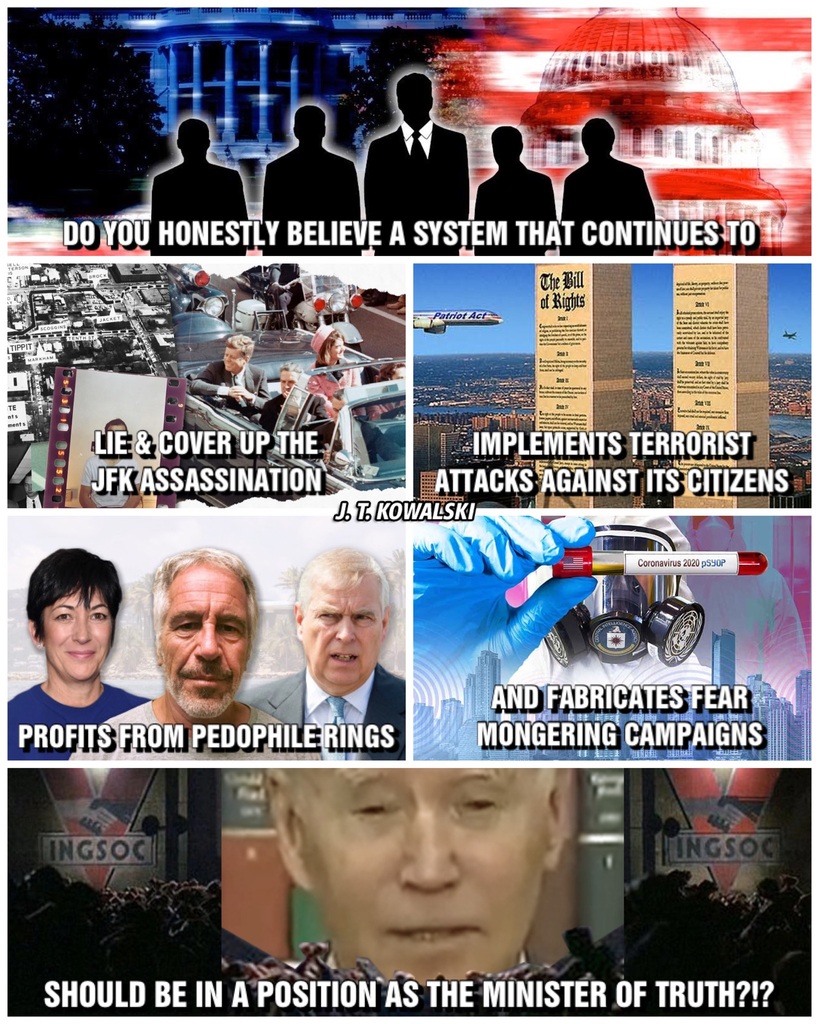
Looking back it is hard to see how anyone can believe the official story, it is so ridiculous and full of holes. But a decade ago I still doubted myself, because to reject it raised two profound issues. The first was that our collective sense of reality was wrong, and our system of government was corrupt and criminal to its core, yet most people believed in it somehow. The second was why there was no objection from honest military people and no obvious counter-movement to depose these criminals from power.
These lingering questions meant I kept my views to myself and didn’t discuss them in my professional or public spheres. In the years that followed my first accepted “conspiracy theory”, I was involved in paradigm-busting and pioneering telecoms work. My expert colleagues were well versed in seeing through the nonsense of the mainstream ideology. Yet one day I suggested that the Apollo story was a bit off, and they looked at me as if I had lost my mind.
If you want to dig into the moon landing story, I suggest the wonderful essay series “Wagging the Moondoggie” by (the sadly departed) Dave McGowan. It is fabulous writing, and exceptionally funny once you dig into it. If the 9/11 story is tragically absurd, the Apollo one is astronomically comical. I cannot imagine any reasonable and rational person coming away from reading this and still having no questions about the offered version of events.


You must be logged in to post a comment.