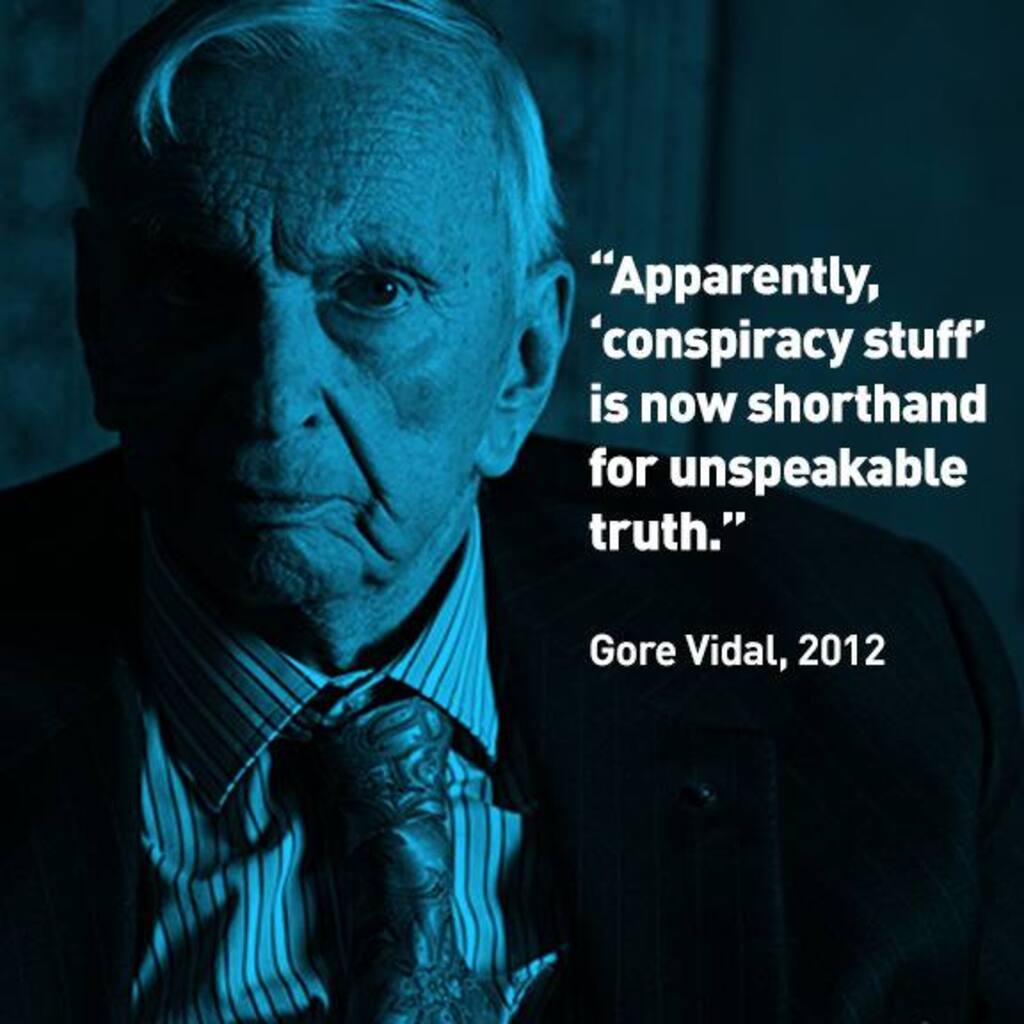
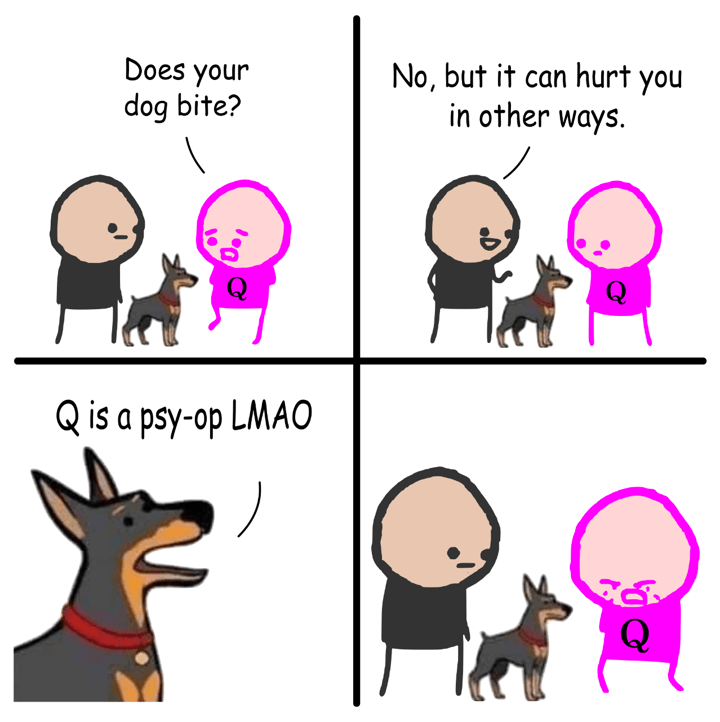
Mean little dog…


U.S. President Joe Biden discussed a “new world order” at a Business Roundtable CEO Quarterly Meeting on Monday, deploying a phrase often pilloried by corporate media outlets as “conspiracy theory.”
“You know we are in an inflection point, I believe, in the world economy” the Commander-in-Chief said, “Not just the economy, the world. It occurs every three or four generations. As one of the top military people said to me in a secure meeting the other day, 60 million people died between 1900 and 1946 and since then we established a liberal world order and that hadn’t happened in a long while. Lot of people dying [now], but nowhere near the chaos. And now’s the time when things are shifting. There’s gonna be a new world order out there, and we’ve gotta lead it. And we’ve gotta unite the rest of the world in doing it.”
– President Biden, Monday March 21st 2022
The statement leans in part on the “fourth turning” or Strauss–Howe generational theory, though in a clumsy fashion. It is not the first time Biden has appealed to such messaging.
In 1992, then Senator Biden wrote an op-ed for the Wall Street Journal entitled “How I Learned to Love the New World Order.” In the article, Biden – who was also the Senate Foreign Relations Committee’s European Affairs Subcommittee – said: “Having contained Soviet communism until it dissolved, we need a new strategy of “containment” – based, like NATO, on collective action–but directed against weapons proliferation.”
The Department of Homeland Security (DHS) published a report recommending an increased focus on scanning the social media accounts of its employees in order to detect “extremism.”
Among the examples of “extremism” cited by DHS are: a belief that fraud occurred in the 2020 election, and objections to current coronavirus policies.
From the DHS report, obtained by Reclaim The Net:
A March 2021 unclassified threat assessment prepared by the Office of the Director of National Intelligence (ODNI), Department of Justice, and DHS, noted that domestic violent extremists “who are motivated by a range of ideologies and galvanized by recent political and societal events in the United States pose an elevated threat to the Homeland in 2021.” The assessment pointed to newer “sociopolitical developments such as narratives of fraud in the recent general election, the emboldening impact of the violent breach of the U.S. Capitol, conditions related to the COVID-19 pandemic, and conspiracy theories promoting violence” that “will almost certainly spur some [domestic violent extremists] [sic] to try to engage in violence this year.”
The report shows increased DHS concern with rooting out “extremists” within its own ranks, including through monitoring the social media accounts of employees.
Last Spring, Secretary of Homeland Security Alejandro Mayorkas ordered an internal review to identify how to best detect, prevent, and respond to threats related to domestic violent extremism within the department.
A component of this was based on online activity. “DVE [domestic violent extremist] attackers often radicalize independently by consuming violent extremist material online and mobilize without direction from a violent extremist organization, making detection and disruption difficult,” the unclassified initial report stated.
The report (obtained here) said that extremists, “exploit a variety of popular social media platforms, smaller websites with targeted audiences, and encrypted chat applications to recruit new adherents, plan and rally support for in-person actions, and disseminate materials that contribute to radicalization and mobilization to violence.”
One of the recommendations is to increase “efforts to better identify and evaluate mis- dis- and mal-information (MDM) with a homeland security nexus, including false or misleading conspiracy theories spread on social media and other online platforms that endorse violence.”
While not directly stated, it was inferred that the DHS was in some way monitoring online activity. Obviously, some privacy and free speech concerns were raised.
And now, this month, the DHS has released a report with the findings of the review.
We obtained a copy of the report for you here.
“And now it’s conspiracy see, they’ve made that something that should not be even entertained for a minute, that powerful people might get together and have a plan. Doesn’t happen! You’re a kook! You’re a conspiracy buff!”
George Carlin
Bombshell evidence prepared for a recently-deceased Trump National Security Council (NSC) official explicitly reports on multiple shooters carrying out the Las Vegas terrorist shooting of October 1, 2017. The report states that Stephen Paddock did not actually commit suicide but was executed by others, pointing to Antifa and ISIS involvement and FBI foreknowledge of the attack. The report also provides evidence that an ANTIFA group claimed responsibility for the shooting with the message: “One of our comrades from our Las Vegas branch has made these fascist Trump supporting dogs pay.” The following report was prepared for Rich Higgins, who served in the National Security Council strategic planning office in 2017. Higgins died of complications at a hospital at around 3 AM on February 23, 2022. The more than 50-page report is entitled “All Source Assessment: Attack on the Route 91 Country Music Festival October 1, 2017 Mandalay Bay Hotel Las Vegas, Nevada” and was prepared for Higgins shortly after he left the National Security Council.
According to the Rich Higgins Las Vegas document: “The report fuses open source information with tactical counter terrorism analysis, cyber intelligence, and digital data mining capabilities.” The report states: “Stephen Paddock may have anticipated the arrival of a fly in team of additional shooters that would assist in the operational execution.”
The report names an Australian man named Brian A. Hodge as a “person of interest” with “possible ties to Islamic organizations and a possible Islamic State (IS) linkage.” The report states that “Mr. Hodges’ personal profile is more befitting of a left wing or Anti-Fascist Action (ANTIFA) affiliate, but recent intelligence reports point to an increased level of collaboration between groups like Antifa and Islamic State.”
On page 45, the report states: “The FBI was closely monitoring Antifa operative engagements with Islamic State and Al Qaeda (Arabian Peninsula and Islamic Maghreb) personnel in Germany…the FBI has discovered a “level of chatter” between left wing revolutionary groups and Islamic terrorist groups.” It turns out, according to the report, that “Mr. Hodge traveled to Berlin, Paris, London, and back to Berlin approximately 2 weeks prior to the attack in Las Vegas.”

Two sets of forensic linguists have published two separate papers using two different techniques to conclude that Q appears to be two people: South African tech journalist Paul Furber, 55, and 4chan internet message board moderator and computer entrepreneur Ron Watkins, 34, according to the studies.
‘While relying on two completely different technologies, both stylometric [quantitative study of literary style] analyses could establish that QAnon’s early period on the 4chan forum, from October to December 2017, was likely the result of a collaboration between Paul Furber and Ron Watkins,’ according to Claude-Alain Roten, the CEO of OrphAnalytics.
Roten, who worked with Lionel Pousaz, a partner at OrphAnalytics, took the writings of several people identified as potential Q originators and analyzed writings they had authored then cross-referenced it using computer software with early QAnon posts.
‘Open your eyes. Many in our govt worship Satan,’ was the first post on October 2017 that launched the movement, according to The New York Times, which was given exclusive access to the linguistics studies.
When reached by the Times, Furber didn’t dispute that Q’s writing resembled his own, while Watkins, who is running for Congress in Arizona, told the NYT: ‘I am not Q.’
“For deeply sourced, relentlessly reported coverage in the public interest,” the citation from the Pulitzer Prize board begins, “that dramatically furthered the nation’s understanding of Russian interference in the 2016 presidential election and its connections to the Trump campaign, the president-elect’s transition team and his eventual administration.”
Except the journalism that the Pulitzers honored — a 2018 National Reporting prize shared by The Washington Post and The New York Times for reporting on Russiagate — did no such thing.
It led to a dramatic misunderstanding, suggesting that Donald Trump colluded with Vladimir Putin to help sway the 2016 election — a grand conspiracy we now know never existed.
So there you have it.
Russiagate, the collective delusion that Donald Trump was secretly a Russian agent aided and abetted by the Kremlin, the topic of uncountable inches of Washington Post and New York Times copy and the entire primetime lineup of MSNBC, was a dirty trick by the Hillary Clinton campaign. Not just part of it. All of it. One of the most diabolical, successful misinformation campaigns ever concocted.
We already knew that the Steele dossier was garbage. Christopher Steele was paid indirectly by the Clinton campaign to dig up dirt, which he did by turning to other Clinton operatives, laundering every outlandish rumor about Trump he could find into an “investigative” document.
He shopped it to the FBI, which couldn’t verify his sources or any of his stories, but the agency dragged out the investigation to cast maximum suspicion on the new president. In the meantime, Steele found willing accomplices in the media to push his propaganda. The dupes at BuzzFeed even decided to print the whole pack of lies, with the flimsy rationale of “Well, why not?”
You must be logged in to post a comment.