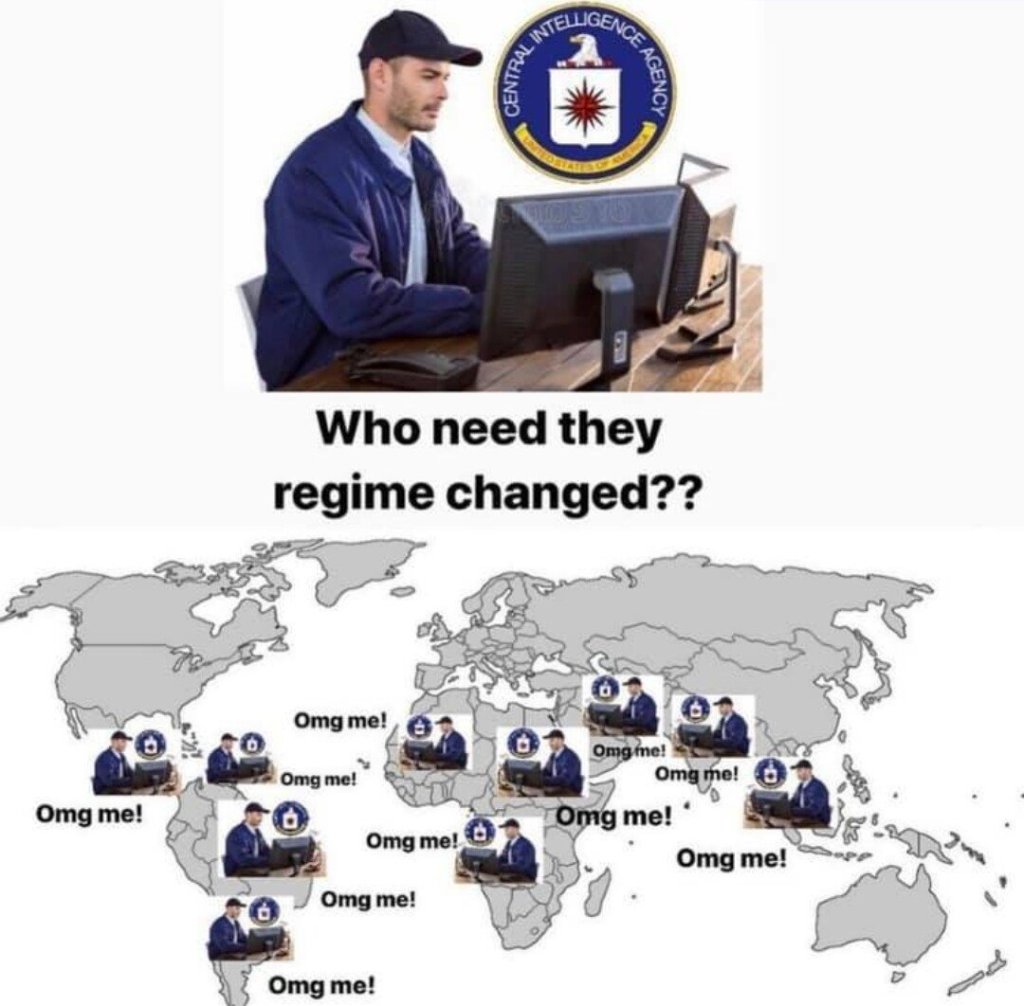
How regime change really works…

The below archive is connected with YEARS worth or research in connection with the MKULTRA CIA Collection. After years of having a 4 CD-ROM set archived, one researcher by the name of Oscar Diggs, went through and painstakingly put together a list of “missing” documents that were said to be on the CD’s, but were not.
I was given this list by Mr. Diggs in 2016. That began a near 3 year struggle with the CIA just to prove that list was accurate, let alone, getting a copy of the missing pages. Through the course of months that stretched to years, it ultimately took a 97 page fax to the CIA, with an index of every single file on the CD’s, to prove what I was asking for. The CIA had claimed they would give me the documents for FREE, since I already paid for the MKULTRA/Mind Control collection, and was told those documents were on the CD’s.
After proving it — the CIA’s story changed. They then said they were not clear, and the documents I asked for were NOT on the CD’s, and I had to pay for them. When I asked why, they said they were not on “mind control” or “MKULTRA”, but rather, were about “Behavioral Modification.” I was denied a fee waiver, and was told that I would need to purchase 4,358 pages of documents, which comprised what I had asked for of the “missing” document numbers.
Through the graciousness of the internet, I was able to secure the money, and I wrote the check. After two months of waiting, my check was returned, and the CIA said by letter that the 4,358 was actually 2,316. With this letter, was 800 pages of MKULTRA material that I was never given on the CD’s. Therefore, it appeared, that I was actually correct pushing for records, but for more than two years, the CIA would not believe me.
My check was returned, and the CIA said if I was still interested in the 2,316 remaining pages, that I had to cut a new, lesser amount, check, as if I would lose interest somehow. Of course, I cut the new check, but what happened to the page count? How did so many pages disappear and vanish? This all means that at least 1,245 pages of MKULTRA / Mind Control / Behavioral Modification documents just vanished from their original quote to me. What I can’t deduce from the CIA’s letter is if these 797 pages released were a part of that original quote, so the number of missing pages could be closer to 2,000!
Regardless of what the answer is, I finally got the remaining documents. As I know they are all digitized CIA, and I requested they be given electronically, the CIA ignored that request and printed out the thousands of pages that you will find linked below. So, I had to sit down, remove the staples and alligator clips, and begin scanning. Once completed, I went through each document and offered a date (if readable/available) file size, and a brief description. This is not meant to be a “complete” index, as the documents many times go into greater detail than my brief description. But, I do hope it offers a starting point.
Additional Note: The CIA claimed the remaining 2,316 pages were NOT related to MKULTRA, which is why I had to pay for them. However, document C00017440, was 821 pages entirely on MKULTRA. That consists of more than $80 of the fees I had to pay! Although possibly an oversight, this was the absolute icing on the frustration cake that has endured for years.

The grisly death of mega rock star Kurt Cobain in 1994 (by a shotgun blast to his head) was officially ruled a suicide by the Seattle police, but evidence quickly came to light that Cobain had actually been murdered.
However, despite serious holes in the official narrative about Cobain’s death, the verdict of suicide has held firm for 27 years.
On May 7, the FBI quietly and without fanfare declassified 10 pages of never-before-seen documents relating to Cobain’s death, which alongside a mass of accumulated evidence suggest that the agency had purposely avoided looking into the radical activist musician’s death. One potential explanation for this failure could be due to the CIA’s involvement in the murder.
The latter seems plausible given the connections to the CIA of Courtney Love, Cobain’s former wife, who is the top suspect in the murder. Love happened to be a drug distributor during the same time that the CIA was heavily involved in trafficking opium and using drugs as political weapons. The latter links call for deeper scrutiny.
About 100 CIA officers and family members are among about 200 US officials and kin sickened by “Havana syndrome”, the CIA director, William Burns, said on Thursday, referring to the mysterious set of ailments that include migraines and dizziness.
Burns, tapped by Joe Biden as the first career diplomat to serve as CIA chief, said in a National Public Radio interview that he had bolstered his agency’s efforts to determine the cause of the syndrome and what is responsible.
He confirmed that among other steps, he had tapped a senior officer who once led the hunt for Osama bin Laden to head a taskforce investigating the syndrome, and said he had tripled the size of the medical team involved in the investigation.
The agency also had shortened from eight weeks to two weeks the time that CIA-affiliated people must wait for admission to Walter Reed national military medical center, he said.
“It’s a profound obligation, I think, of any leader to take care of your people and that is what I am determined to do,” Burns told NPR in his first interview since becoming CIA director in March.
Havana syndrome, with symptoms such as dizziness, nausea, migraines and memory lapses, is so named because it first was reported by US officials based in the US embassy in Cuba in 2016.
Burns noted that a US National Academy of Sciences panel in December found that a plausible theory was that “directed energy” beams caused the syndrome.

“AStudent Group Concedes It Took Funds from C.I.A.”
That was the front page headline of the Feb. 14, 1967, edition of the New York Times. The article was one in a slew of articles published at the time in relation to something called Operation Mockingbird.
What was Operation Mockingbird?
It was an alleged large-scale project undertaken by the CIA beginning in the 1950s in which they recruited American journalists into a propaganda network. The recruited journalists were put on a payroll by the CIA and instructed to write fake stories that promoted the views of the intelligence agency. Student cultural organizations and magazines were allegedly funded as fronts for this operation.
Operation Mockingbird expanded later on in order to influence foreign media as well.
Frank Wisner, the director of the espionage and counter-intelligence branch, spearheaded the organization and was told to concentrate on “propaganda, economic warfare; preventive direct action, including sabotage, anti-sabotage, demolition and evacuation measures; subversion against hostile states, including assistance to underground resistance groups, and support of indigenous anti-Communist elements in threatened countries of the free world.”
Journalists were reportedly blackmailed and threatened into this network.
WASHINGTON — Concerning the Finders cult — the elusive Washington, D.C.-based outfit whose antics and ties we began examining in Part 1 of this series — one set of documents in particular held the most explosive allegations made against the group and against the CIA for allegedly covering the story up. Despite their contents, almost no corporate press ever quoted from these documents or addressed the concerns they raise. This article will attempt to remedy that deficit of coverage by fully exploring what the documents have to say.
I previously described the 1987 arrest of two well-dressed men in Tallahassee, Florida, on charges of child abuse relating to six children found neglected, dirty, and hungry in their care. After the men were found to be members of the Finders, a multi-state investigation sparked a national media frenzy: for a week, headlines alleged satanic ritual abuse before downshifting radically. The entire scandal was eventually explained as a “miscommunication” regarding a “misunderstood” alternative-lifestyle community. But further questions would arise regarding allegations that the Finders were linked to the CIA and that the agency had spiked the investigation.
In my initial article introducing this series of deep dives into the Finders scandal, I mentioned the allegations made by former Customs Special Agent Ramon Martinez in the Customs reports he penned in 1987. To understand the overall Finders story, we must look at exactly what evidence Martinez claims to have witnessed and what that evidence suggests. His account is crucial because, if true, it undermines the established narrative that no evidence of criminality on the part of the Finders was ever found.
It’s quite odd that “paranormal” abilities are, and have been for decades, studied and confirmed at the highest levels of government or what some would consider at levels beyond the government in black budget Special Access Programs, yet brushed off as conspiracy theories, ridiculed, and remain virtually unacknowledged within mainstream academica. These black budget programs are exempt from standard reporting requirements in the to congress in the United States, as outlined by a 1997 U.S. senate report, and based on my research there are also unacknowledged Special Access Programs that have no oversight at all from the government.
Unfortunately they’ve been studied and used for military and intelligence collection purposes, and have always remained “classified” for “national security” reasons. Developments and discoveries within this black budget world never seem to be brought to light or used for the benefit of humanity. In fact, the United States has a history of government agencies existing in secret for years. The National Security Agency (NSA) was founded in 1952, its existence was hidden until the mid 1960’s. Even more secretive is the National Reconnaissance Office, which was founded in 1960 but remained completely secret for 30 years. Our world today is drenched in secrecy.
From the declassified literature alone, there are many examples documenting people with gifted abilities able to do some extraordinary things. This declassified CIA document and this Air Force teleportation study outlines children with the ability to teleport objects in closed containers from one location to another. The containers were never touched or opened, showing that these children could transport the object through the sealed containers. These experiments were done under double-blind controlled conditions.
Another example documents the “paranormal writing” ability of a little girl, and a woman who is able to gather information about a person from simply holding and touching an object that is/was affiliated with the person in question. Then there is the remote viewing program which yielded significant and repeatable results, according to a paper published in the Journal of Scientific Exploration after the program was declassified. Remote viewing is the ability to describe a remote geographical from another location, regardless of distance and time.
This article looks into a woman by the name of Nina Kulagina. I use “real” in the title because the Defense Intelligence Agency report referenced below refers to her as an “outstanding PK (psychokinesis) psychic.”
 Hellbound and Down
You must be logged in to post a comment.