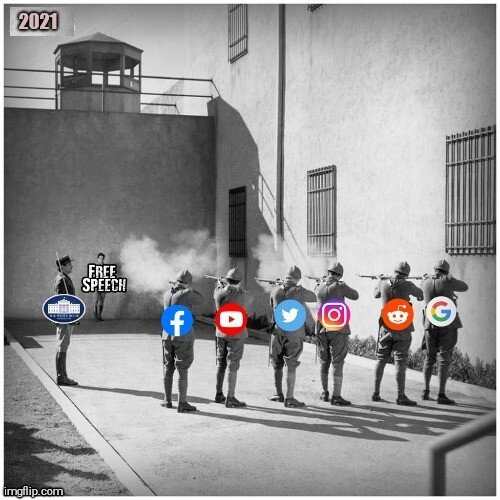
But it’s not ‘government’ censorship, eh?

If visionary writer George Orwell, author of “1984,” which gives a dystopian vision of the future, were alive today, he would be amazed at how utterly correct many of his predictions were about all-powerful central governments.
Such as the existence of a “Ministry of Truth,” whereby bureaucrats decide what the public can and cannot know in terms of ‘established facts’ — namely, no truths are permitted that run afoul of the central government’s narratives, even if they’re false.
Take what’s happening in newly authoritarian Australia as an example.
According to reports, Google officials have admitted preventing Australians from seeing certain videos because the platform’s engineers have adjusted algorithms to prevent those videos from showing up in searches.
US data analyst Justin Hart is one of the recent victims of COVID-related censorship on social networks, but he’s also one of those joining to fight back in the legal arena.
The Liberty Justice Center, a non-profit focused on constitutional rights, is suing on his behalf, with Facebook, Twitter, US President Joe Biden and the Surgeon General Vivek Murthy all named as defendants.
We obtained a copy of the complaint for you here.
Hart is alleging that his First Amendment free speech rights had been violated when his social media accounts got suspended for posting what is said to be a scientifically-based graphic under the title, “Masking Children is Impractical and Not Backed by Research or Real World Data.”
News outlets like the New York Post – who recall that their own factually correct, and occasionally bombshell stories (like the “Hunter Biden files“) got suppressed by Big Tech – suggest this claim should by now not be particularly contentious, let alone a reason for censorship.
“Study after study repeatedly shows that children are safer than vaccinated adults and that the masks people actually wear don’t do much good,” writes the Post.
But when Hart posted the infographic, Facebook reacted by locking his personal account, created in 2007, for three days. The filing indicates that the same happened to this data analyst and digital strategist on Twitter as well – but what’s particularly interesting is why top government officials, including the president himself, have been named in the lawsuit.
Namely, Hart alleges collusion between these privately owned giants and the US government, with the purpose of monitoring, flagging, suspending and deleting content that it chooses to label as misinformation.
Under current rules in the US dictated by its Constitution, the government would not be able to do this directly; but recent statements coming from Biden and some of his top collaborators have added fuel to the fire of suspicion that a form of collusion to suppress free expression on the internet might actually be taking place.
Biden recently went as far – to then be forced to walk back – as to publicly accuse Facebook of “killing people” by not getting rid of COVID content unwanted by the current administration fast enough.
This happened just after White House press secretary Jen Psaki said, “We are regularly making sure social media platforms are aware of the latest narratives dangerous to public health that we and many other Americans are seeing across all of social and traditional media,” adding, “You shouldn’t be banned from one platform and not others.”
Last week, Reuters reported based on two anonymous sources that Amazon Web Services, which controls 40 percent of web hosting in the world, “plans to take a more proactive approach to determine what types of content violate its cloud service policies.”
“Over the coming months, Amazon will hire a small group of people in its Amazon Web Services (AWS) division to develop expertise and work with outside researchers to monitor for future threats, one of the sources familiar with the matter said. It could turn Amazon, the leading cloud service provider worldwide with 40% market share according to research firm Gartner, into one of the world’s most powerful arbiters of content allowed on the internet, experts say.”
Amazon declined to comment to Reuters for the story, then after the article published sent a statement insisting the report was “wrong,” claiming, “‘AWS Trust & Safety has no plans to change its policies or processes, and the team has always existed.’”
“We’ve always reserved the right to police who is allowed to speak on our internet” is not a very comforting response to an article alleging a coming content crackdown. In addition, to this post-publication claim from Amazon, “A Reuters spokesperson said the news agency stands by its reporting.”
Don’t forget the context: The Biden administration revealed a few weeks ago that they, mafia-like, pressure big tech entities like Facebook and Twitter to remove information that contradicts their political goals. (“That’s an, um, ‘misinformed’ piece of content over there on your platform. Sure would be a shame if the super-touchy Democrats controlling the entire federal government decided it was a reason to regulate and legally harass you.”)
Facebook on Friday issued an apology after its AI software labeled Black men “primates” in a video featured on the social media network.
The New York Times first reported the story. A Facebook spokesperson told the publication that it was a “clearly unacceptable error,” and said the recommendation software involved had been disabled.
“We disabled the entire topic recommendation feature as soon as we realised this was happening so we could investigate the cause and prevent this from happening again,” the spokesperson said.
In a statement to the publication, Facebook said: “We apologize to anyone who may have seen these offensive recommendations.”
The offensive terminology related to a video, dated June 27, 2020, which was posted by The Daily Mail. The clip was titled “white man calls cops on black men at marina,” and featured Black men in disputes with white police officers and civilians.
Facebook users who watched the video received an automated prompt asking if they would like to “keep seeing videos about Primates,” according to The New York Times.
Ever keen to be seen doing more about online abuse among its users, Twitter has decided to nobble free speech with a novelty ‘Safety Mode’ button, which might reduce offence. Exactly what ‘offence’ means is up to the tech giant.
Something about Twitter has long irritated me, not so much the platform itself but the smug self-righteousness of a bunch of tech nerds adopting the moral high ground over the inalienable right to free speech.
I’m not just talking about Jack Dorsey and his Silicon Valley sidekicks who blocked Donald Trump’s social media account, but about their woke-fevered, sanctimonious, purse-lipped wowserish approach in imposing their own values in judging what should and shouldn’t be allowed to be said within their software apps.
Now, using the pretext of “Safety” –I mean, gimme a break– Twitter has announced a new “Safety Mode” which will automatically block, for seven days, “accounts that add unwanted replies, Quote Tweets and mentions to your convos.” Seven days. Smiley face with tears emoji.
Firstly, if unwanted replies or mentions on Twitter are the sort of thing that spoil your day, then might I suggest, my little snowflake friend, that social media is not the place for you. And if you believe that your life will be enhanced because you chose to switch on “Safety Mode,” then more fool you for signing up to the latest tech that implicitly denies the right to free speech.
Because Twitter has turned taking offence into a maths problem. No one is actually reading your tweets or replies to figure out if offence was caused – intentionally or otherwise – no, as a senior product manager explained, “When the feature is turned on in your Settings, our systems will assess the likelihood of a negative engagement by considering both the Tweet’s content and the relationship between the Tweet author and replier.”
Our systems, hey? What sort of systems are they? And what sort of data will they be trawling through, analysing, keeping and using in the future? Just one click on a little green button on your phone can forever change your relationship with Twitter and the way they target you with their insidious promotions. Think about that.
That fatal click could also blow a real human-to-human relationship out of the water. Twitter’s bot decides you’ve been slighted and the offender it identifies is sin-binned for seven days. While you can unblock, it’s too late, the damage is done. They were deemed ‘abusive’ before Twitter came to the rescue and they were silenced. Now you have to pick up the pieces.
It sounds petty, but it’s the prim, disapproving nanny looking over your shoulder that gets my goat. No one voted for anyone at Twitter to monitor the public discourse on social justice and that’s exactly where you know they’ll be targeting their bots. Discussions on race, gender and even climate change will most likely be judged on Twitter’s terms, the conversation manipulated by an algorithm so that those voices taking the most offence prevail in the debate and those that dissent are simply labelled ‘abusive’ and silenced.
A Facebook and Google partner that uses artificial intelligence to compile data from tracking people’s web history has put together a report that outlines ways to mentally program people to get the Coronavirus vaccine. NATIONAL FILE has obtained a copy of the cynical report from Resonate, a company based in Reston, Virginia in the Washington, D.C. area that goes out of its way to denounce “racism” and employs executives who previously worked for the Washington Post, AOL and other corporations. The report is called Moving The Needle: How To Reach The Vaccine-Hesitant And Resistant. The report gives tips on how to manipulate people’s values of “safety,” “reputation and public image,” “social clout,” and even their religion and shopping habits to coerce them to get the vaccine. The report explicitly states, “DRAW THEM TO VACCINATION SITES BASED ON THEIR SHOPPING PREFERENCES.” The report also compiles information on the children of vaccine-hesitant people and vaccine resisters.
Resonate’s listed partners include Facebook and Google. Resonate acknowledges that its data collection allows its clients to “gain a deeper understanding of every consumer who engages with your digital media presence across all platforms including Facebook, Linkedin, etc.” This Facebook and Google partner has used people’s personal information to build an extremely creepy profile of the “Vaccine-Hesitant” community. And Resonate makes it clear that they are tracking people’s “web traffic” in order to build their research. Here are some screenshots from Resonate’s website describing how they get their information from “web traffic” and how they partner with Facebook, Google, Oracle, and others.
It was never a matter of if, but when.
Science journalist Alex Berenson has been permanently suspended from Twitter, just one day after a viral series of tweets spotlighting an Israeli preprint study which showed that natural immunity from a prior Covid-19 infection is 13 times more effective than vaccines against the delta variant.
“The account you referenced has been permanently suspended for repeated violations of our COVID-19 misinformation rules,” a Twitter spokesperson told Fox News.
The last tweet he posted, meanwhile, accurately noted that the vaccine “doesn’t stop infection. Or transmission.”
“Don’t think of it as a vaccine,” he added. “Think of it – at best – as a therapeutic with a limited window of efficacy and terrible side effect profile that must be dosed IN ADVANCE OF ILLNESS.”
“And we want to mandate it? Insanity.”
“This was the tweet that did it. Entirely accurate. I can’t wait to hear what a jury will make of this,” wrote Berenson on his substack blog, Unreported Truths.
Conservatives and others across the political spectrum have been critical of the Joe Biden administration over the chaos that has resulted from the attempt to pull US troops out of Afghanistan. One of them was Jarome Bell, a candidate for Congress in Virginia’s 2nd District. “These men assisted our troops and were left behind with over 15000 Americans,” Bell wrote on Twitter, attaching a video of Taliban fighters executing men who were believed to have worked with American and Allied forces in the country. “This will be Joe Biden’s legacy and the democrats and some of you approve of this message.”
As a result, Bell’s Twitter account was locked, with the Big Tech platform seemingly determining that the video of Taliban executions violated the privacy of those involved. Specifically, Bell’s tweet allegedly violated their rules on “posting private media of an individual from a country with a recognized right to privacy law.” It is unclear how this could be the case, given that the Afghanistan government and therefore any regime that could implement such a law, has fallen to the Taliban.
Forming an “election commission” to oversee a fair and smooth election process, until recently, used to be something exclusively reserved for nation states, but now Facebook is reported to be meddling in that domain, at least semantics-wise.
The New York Times reported that the “commission” could be coming this fall, just in time to affect the way US midterm election campaigns are carried out on the giant platform.
The way these announcements are interpreted currently is that the “election commission” will play a role similar to that the Oversight Board already has in dealing with content censorship on Facebook, only clearly focused on election related content.
The Board is referred to as independent, brings together a number of academics and experts, and is ultimately seen by critics as another way for Facebook to wash its hand off the responsibility in how diverse politically and ideologically sensitive content is treated and “moderated.” Another notorious way is Facebook’s third party “fact checkers.”


You must be logged in to post a comment.