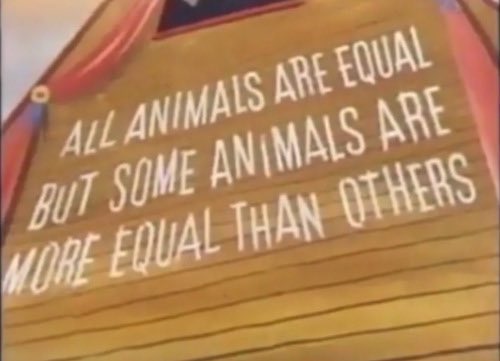
Too On Brand: School Purges 1984, Animal Farm, Lord of the Flies, and Others to Promote ‘Diversity’

You really can’t make things like this up. 

Seriously. Liberals may want to purge libraries of “wrongthink,” but you would expect that anybody with an IQ above room temperature could have figured out that tossing out more than half your books in a school library, including 1984 and Animal Farm, would be a bad look. 

But no. Not in Canada, apparently. And certainly not at the Thames Valley School District in London, Ontario. Out of a High School library of 18,000 books, 10,000 were “deselected” and tossed into the trash because they didn’t fit the vision of having an “inclusive” library. Presumably, that explains why they tossed out books by J.K. Rowling, which I assume were quite popular with the kids; she engages in wrongthink about gender, and needs to be purged. 

A London, Ontario, secondary school binned more than 10,000 library books between January and March this year under the Thames Valley District School Board’s “inclusive libraries revitalization project,” eliminating more than half of the school’s 18,000-book collection.

H.B. Beal’s library once held one of the largest collections in the board. Today, fewer than 8,300 books remain. The estimated value of the discarded materials exceeds $180,000.

Education Minister Paul Calandra moved quickly to halt further library culls while the ministry investigates the Beal revitalization project. A spokesperson for the ministry confirmed last week that “the minister has directed that all current and future library collection reviews be paused, pending further evaluation.”

According to board documentation, the project aims “to revitalize the collections of Thames Valley schools to ensure they are culturally responsive, reflect our diverse student population, and contain accurate and up-to-date information.” The project adds that it will focus on “deselecting texts with harmful images, messaging, slurs, and racial epithets to facilitate the safety and well-being of all students.”

Some of the books “deselected” blow your mind, not because it would surprise you that radical leftists would want to hide them, but because it makes their goals of purging the library of any ideological diversity so blatant. They literally purged books about…book banning. 
Keep reading

The Complex Legacy Of George Orwell

George Orwell, one of the most influential political writers of the 20th century, is widely recognized for his searing critiques of totalitarian regimes in his novels Animal Farm and 1984. Orwell’s portrayal of state control, propaganda, and the manipulation of truth has resonated with readers across the political spectrum. However, Orwell’s personal political ideology and his critiques of totalitarianism are far more complex than is often acknowledged. Rather than being a passive observer or simply an opponent of dictatorship, Orwell was deeply involved in the socialist movements of his time, aligning himself—whether accidentally or intentionally—with Trotskyist circles. Orwell was a powerful voice of the left, despite being a target in the war among socialist factions.

Orwell’s Political Ideology and Alignment with Trotskyism

While Orwell is best remembered for his criticism of authoritarianism and totalitarianism, it is essential to understand that he was, first and foremost, a committed socialist. Despite never formally joining a political party, Orwell was an active and vocal participant in the socialist movement. This may surprise those who associate Orwell solely with his critiques of state tyranny. Indeed, Orwell’s disdain for the left dictatorship did not extend to all forms of socialism, and his political writings often reflect an internal critique of socialist regimes rather than a wholesale rejection of socialist principles.

Orwell’s critique of Stalinist totalitarianism is best understood as part of a broader ideological struggle within the socialist movement itself. Specifically, Orwell’s critiques echo the views of Leon Trotsky, a key figure in early Soviet history and one of Stalin’s most prominent critics. Trotsky was a revolutionary Marxist who played a crucial role in the Russian Revolution of 1917 and the subsequent civil war. He was instrumental in founding the Red Army, which secured the Bolshevik victory over the anti-communist White Army during the Russian Civil War. However, Trotsky’s theory of “permanent revolution” set him at odds with Stalin, who favored the consolidation of socialism in one country—namely, the Soviet Union—before pursuing global revolution. Trotsky’s insistence that socialism must be spread worldwide made him a figure of suspicion within the Soviet hierarchy. In the early 1920s, Stalin consolidated power, leading to Trotsky’s exile in 1929. Despite this, Trotsky continued to oppose Stalin’s policies from abroad, particularly through his writings.

Trotsky’s critique of Stalinism included accusations that Stalin had betrayed the original goals of the Russian Revolution. According to Trotsky, Stalin had established a bureaucratic dictatorship rather than a dictatorship of the proletariat, as envisioned by Marxist theory. He argued that Stalin’s regime represented, not the rule of the working class, but the rise of a privileged bureaucratic elite, a “nomenklatura,” that dominated Soviet society. In addition, Trotsky accused Stalin of fostering a cult of personality, suppressing political opposition, and betraying the internationalist principles of socialism.

Keep reading

Orwell’s Ideas Remain Relevant 75 Years After “Animal Farm” Was Published

Seventy-five years ago, in August 1946, George Orwell’s Animal Farm was published in the United States. It was a huge success, with over a half-million copies sold in its first yearAnimal Farm was followed three years later by an even bigger success: Orwell’s dystopian novel Nineteen Eighty-Four.

In the years since, Orwell’s writing has left an indelible mark on American thought and culture. Sales of Animal Farm and Nineteen Eighty-Four jumped in 2013 after the whistleblower Edward Snowden leaked confidential National Security Agency documents. And Nineteen Eighty-Four rose to the top of Amazon’s best-sellers list after Donald Trump’s Presidential Inauguration in 2017.

As a philosophy professor, I’m interested in the continuing relevance of Orwell’s ideas, including those on totalitarianism and socialism.

Keep reading