






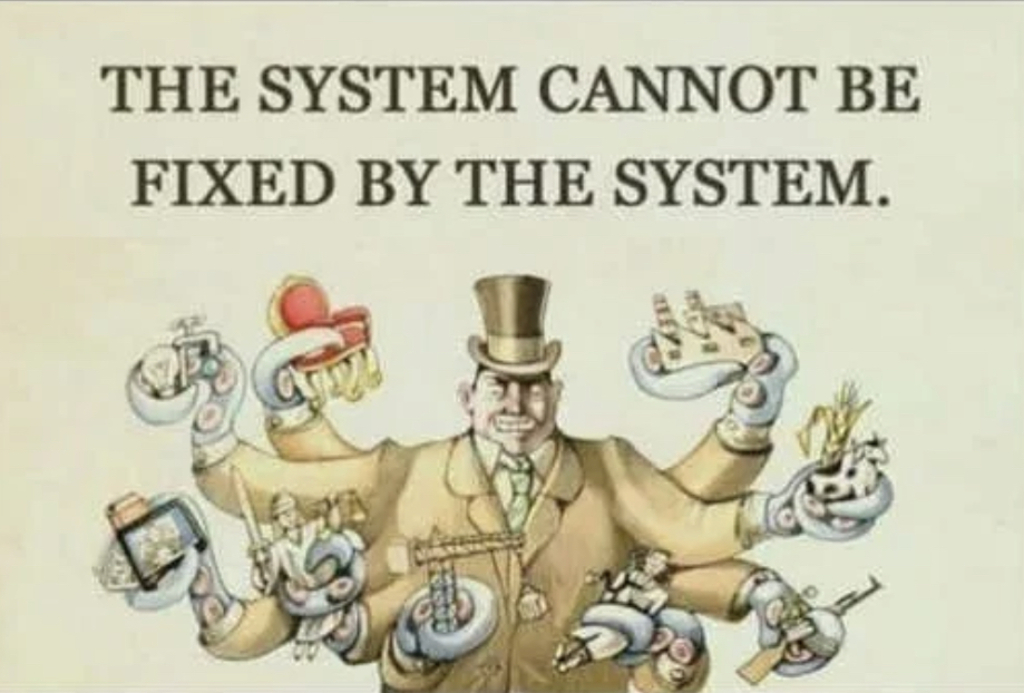
Take a guess…


“The general population doesn’t know what’s happening and it doesn’t even know that it doesn’t.”
Noam Chomsky


We first reported on Robertson in August of 2018 when the mainstream media was focused on the Trump Russia Mueller sham investigation.
John was assigned to the Anthony Weiner case, a top Democrat married to Hillary Clinton adviser Huma Abedin. During his investigation of Weiner’s computer John discovered thousands of Hillary Clinton emails and blew the whistle on the Comey-McCabe and Strzok cover-up of evidence.
“The crickets I was hearing was really making me uncomfortable because something was going to come down,” Robertson said he later told Justice Department investigators. “Why isn’t anybody here? Like if I’m the supervisor of any [counterintelligence] squad … and I hear about this, I’m getting on with headquarters and saying, ‘Hey, some agent working child porn here may have [Hillary Clinton] emails. Get your ass on the phone, call [the case agent], and get a copy of that drive,’ because that’s how it should be. And that nobody reached out to me within, like, that night, I still to this day don’t understand what the hell went wrong.” Robertson wrote a “Letter to Self” in late October after an Oct. 19, 2016, meeting, during which he implored Assistant U.S. Attorney Amanda Kramer of the Southern District of New York to push FBI leadership to look at the thousands of emails he had unearthed.
“I have very deep misgivings about the institutional response of the FBI to the congressional investigation into the Hillary Clinton email matter … Put simply: I don’t believe the handling of the material I have by the FBI is ethically or morally right. But my lawyer’s advice — that I simply put my SSA on notice should cover me — is that I have completed CYA [Cover Your Ass], and I have done so,” Robertson wrote. “Further, I was told by [Kramer] that should I ‘whistleblow,’ I will be prosecuted.”
Robertson continued: “I possess — the FBI possesses — 20 times more emails than Comey testified to. … While Comey did not know at the time about what I have, people in the FBI do now, and as far as I know, we are being silent. … If I say or do nothing more, I am falling short ethically and morally. And later, I may be accused of being a Hillary Clinton hack because of the timing of all this. … But if I say something (i.e., whistleblow), I will lose my reputation, my career, and risk prosecution. I will also be accused of being a Donald Trump hack.”

The U.S. Defense Intelligence Agency (DIA) is getting ready for the “next battlefield” and counting on the expertise of private concerns, like Booz Allen Hamilton, to implement what it calls Machine-assisted Analytic Rapid-repository System, or MARS for short. MARS is a critical data management system for “military targeting” and operation planning.
MARS is currently the DIA’s top priority, and according to DIA director Lt. Gen. Robert P. Ashley Jr., the aim is to replicate “the commercial Internet that everybody uses every day,” with the added functionality of providing a “foundational intelligence picture […] at speed and at scale.”
Terry Busch, chief of DIA’s integrated analysis and methodologies division, highlights the difference between the MARS program he manages and the old “stovepipe” data management technologies it is meant to replace: “What comes out of MARS at the end is not data, it’s analysis. It’s finished intelligence.”
Which kind of intelligence, specifically, will be assessed dynamically by the machine’s algorithms in a new kind of database management system using AI functionality. It will revolutionize the way data is received and acted-upon. As it scours and collects vast datasets and volumes of foreign intelligence that support U.S. military operations around the world, MARS will be equipped to handle both large amounts of data, like the storage-intensive images and videos collected by the National Reconnaissance Office and also analyze the information to produce actionable leads in the battlefield.
It is nothing less than the 1983 sci-fi classic “WarGames” come to life. A ‘machine’ that decides when to go to war based on the information it is fed. In the movie, a military drill of a surprise nuclear attack on the United States accidentally goes live after a hacker, played by Matthew Broderick, “unwittingly” puts the world on the brink of nuclear war.
MARS program manager Terry Busch doesn’t discount the possibility. “On the machine side,” Busch stated, “we have experienced confirmation bias in big data,” adding that it was a “real concern” given that they’ve had “the machine retrain itself to error”.
COVID-19, however, has given the top military intelligence department the opportunity to “prove [its] ability to deliver the capabilities of MARS”, as DIA chief of Staff, John Sawyer, said at a National Security Summit that concluded Friday. The “assumptions about the nature of our work,” he claims were challenged during the pandemic, were especially fruitful in regards to the MARS program, which can now benefit from a new modality of military intelligence propagation that will be “the future of how we are going to understand fighting”.
Once a COVID-19 vaccine is approved for public use, officials around the world will face the monumental challenge of vaccinating billions of people, a logistical operation rife with thorny ethical questions. What if instead of orchestrating complicated and resource-intensive campaigns to vaccinate humans against emerging infectious diseases like COVID-19, we could instead stop the zoonotic diseases that sometimes leap from animals to people at their source? A small, but growing number of scientists think it’s possible to exploit the self-propagating properties of viruses and use them to spread immunity instead of disease. Can we beat viruses like SARS-CoV-2, the novel coronavirus, at their own game?
A virus that confers immunity throughout an animal population as it spreads in the wild could theoretically stop a zoonotic spillover event from happening, snuffing out the spark that could ignite the next pandemic. If the wild rats that host the deadly Lassa virus, for example, are vaccinated, the risks of a future outbreak among humans could be reduced. For at least 20 years, scientists have been experimenting with such self-spreading vaccines, work that continues to this day, and which has gained the attention of the US military.
For obvious reasons, public and scientific interest in vaccines is incredibly high, including in self-spreading vaccines, as they could be effective against zoonotic threats. The biologists Scott Nuismer and James Bull generated fresh media attention to self-spreading vaccines over the summer after publishing an article in the journal Nature Ecology & Evolution. But the subsequent reporting on the topic gives short shrift to the potentially significant downsides to releasing self-spreading vaccines into the environment.
Self-spreading vaccines could indeed entail serious risks, and the prospect of using them raises challenging questions.
Who decides, for instance, where and when a vaccine should be released? Once released, scientists will no longer be in control of the virus. It could mutate, as viruses naturally do. It may jump species. It will cross borders. There will be unexpected outcomes and unintended consequences. There always are.
While it may turn out to be technically feasible to fight emerging infectious diseases like COVID-19, AIDS, Ebola, and Zika with self-spreading viruses, and while the benefits may be significant, how does one weigh those benefits against what may be even greater risks?

You must be logged in to post a comment.