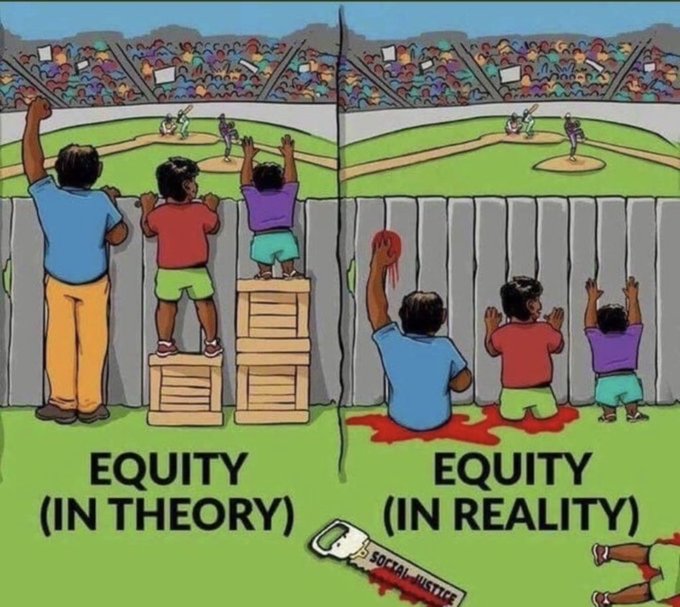
On equity…


Sam Blake, an Australian mathematician, first learned of the Zodiac Killer’s unsolved ciphers — a series of encrypted messages — from a documentary in the 1990s. His interest marginally increased in 2007 after the release of David Fincher’s “Zodiac,” but it wasn’t until last year that it completely was cemented while watching code-breaking expert David Oranchak’s “Let’s Crack Zodiac” YouTube series.
The series was dedicated to solving the codes the Northern California serial killer sent in letters to newspapers in the late 1960s and early 1970s. One of the ciphers, called the 408 cipher, was solved in 1969 by a schoolteacher and his wife, but it did not reveal the killer’s identity; the additional three puzzles remained unsolved for over 51 years, despite advances in computer technology.
Black votes in this country are worth less than white votes. Joe Biden won the Electoral College because Black voters in Atlanta, Detroit, Milwaukee, and Philadelphia turned out in significant numbers. But even with overwhelming Black support—94 percent of Detroit voted for Biden!—the outcomes in Georgia, Michigan, Wisconsin, and Pennsylvania were worryingly close.
The Argument is a column where writers and thinkers propose a provocative idea that may not be politically realizable in the short term but that pushes one to think broader about a pressing issue of public importance.
One core problem is the Electoral College. Wyoming, which has just 580,000 residents and is 93 percent white, gets three electors because of its two senators and one representative in the House. By comparison, Georgia’s Fifth Congressional District—which includes Atlanta, has 710,000 residents, and is 58 percent Black—has no dedicated electors or senators and can only occasionally overcome the mostly white and conservative votes from elsewhere in the state. This devaluation of Black votes allows our political system to ignore Black lives, and the consequences are devastating. Unequal representation has led to unequal health care outcomes, which the Covid-19 pandemic has only worsened. Without sufficient voting power, Black communities receive substandard education, and politicians are free to appoint judges who sanction mass incarceration, abusive policing, and electoral disenfranchisement.
This is all by design. The Constitution’s framers set up the Electoral College to protect the interests of slave states. Along with the Senate, the Electoral College was critical in the endurance of slavery and its continuation by other means. Abolishing this system would mean that ballots cast by Black voters—or any voters, for that matter—would count the same.
But there’s another way to undo the damage of the Electoral College and other structurally racist political institutions: We can implement vote reparations by double-counting ballots cast by all Black residents. The poisonous legacy of slavery applies to Black people regardless of when we or our ancestors arrived in this country. Vote reparations should also extend to Native Americans. Slavery is rightly called America’s original sin, but so too was the United States’ genocidal seizure of land from its original inhabitants. Various legal forms of disenfranchisement have applied to them. It wasn’t until 1962 that all Native Americans were allowed to vote, and even then they faced—and still face—electoral obstacles. These are not the only examples of American oppression; we should include in vote reparations others who have suffered similar disenfranchisement.
A study by leading education focused think tank Civitas has found that free speech at the world’s leading universities is being eroded at an alarming rate owing to the rise of “cancel culture”.
The study found that within the past three years, more than 68 per cent of universities in the UK have seen free speech severely restricted, with academics unable to meaningfully discuss the nuances of issues such as race and gender.
The report notes that universities including Oxford, Cambridge and St Andrews, three of the world’s premiere institutions are among those that have fallen into a “red” category for free speech following instances of “no platforming” of scheduled speakers.
The study warns that the situation has gotten so severe that it requires government legislation to stop campus censorship at 48 universities, the equivalent of at least 35 per cent of institutions.
The use of universal lockdowns in the event of the appearance of a new pathogen has no precedent. It has been a science experiment in real time, with most of the human population used as lab rats. The costs are legion.
The question is whether lockdowns worked to control the virus in a way that is scientifically verifiable. Based on the following studies, the answer is no and for a variety of reasons: bad data, no correlations, no causal demonstration, anomalous exceptions, and so on. There is no relationship between lockdowns (or whatever else people want to call them to mask their true nature) and virus control.
Perhaps this is a shocking revelation, given that universal social and economic controls are becoming the new orthodoxy. In a saner world, the burden of proof really should belong to the lockdowners, since it is they who overthrew 100 years of public-health wisdom and replaced it with an untested, top-down imposition on freedom and human rights. They never accepted that burden. They took it as axiomatic that a virus could be intimidated and frightened by credentials, edicts, speeches, and masked gendarmes.
The pro-lockdown evidence is shockingly thin, and based largely on comparing real-world outcomes against dire computer-generated forecasts derived from empirically untested models, and then merely positing that stringencies and “nonpharmaceutical interventions” account for the difference between the fictionalized vs. the real outcome. The anti-lockdown studies, on the other hand, are evidence-based, robust, and thorough, grappling with the data we have (with all its flaws) and looking at the results in light of controls on the population.
 Hellbound and Down
You must be logged in to post a comment.