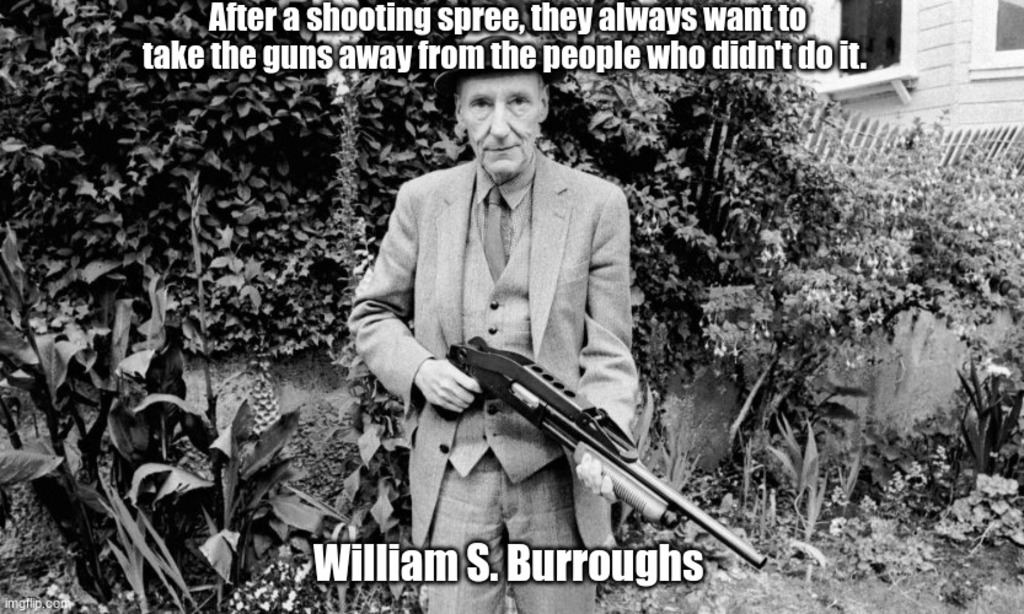
William S. Burroughs on gun control…



Most people reading this article right now likely understand the insultingly low attention span of the average American. What is today’s top story is often and quickly buried by tomorrow’s media outrage, fear mongering or sensationalist nonsense. We are bombarded 24 hours a day by our televisions, computers, and cell phones, with propaganda disguised as “news” — 99% of which is completely negative.
Thanks to the short memories of Americans this news cycle of propaganda can easily sway their attention from one story to the next, spotlighting negativity to keep citizens in a constant state of fear and obedience. We recently witnessed the nature of the easily swayed masses as the corporate press shifted from covid hysteria to Russia hysteria.
The masses temporarily switched out their masked profile pictures in exchange for Ukrainian flags almost overnight and just like that, the Branch Covidians had traded their “mask and jab” mantra for their new one, “I stand with Ukraine.”
Obviously there is nothing wrong with standing with the Ukraine as they have been invaded by a thug dictator. In fact, it is quite noble to stand against tyrants. But the selective outrage is embarrassing and the Ukraine emojis show how hollow the sentiment is considering the fact that most of these same folks have been largely silent as children have been slaughtered for 7 years in Yemen.
Essentially, they are outraged because they have been told to be outraged. And, because of short attention spans, that outrage is about to shift once more and it will most likely land back on covid.
The media and the establishment are already setting the stage for covid hysteria once more. After Americans got a much-needed vacation from chief fearmonger himself, Dr. Anthony Fauci, suddenly reappeared in the media. This time, he is telling people to prepare for the possibility of more restrictions.
Last weekend, Fauci told ABC News anchor George Stephanopoulos that Americans must be “flexible” and “prepared” to return to COVID-19 restrictions, if cases surge.
This is the last installment in a series on the nadir, or low point, of the U.S. Supreme Court. This was the period from 1937 to 1944, when the court stopped protecting the Constitution’s limits on the federal government. Our Constitution has never fully recovered.
The first, second, third, fourth, fifth and sixth installments related to how the justices initially tried to balance the demands of President Franklin D. Roosevelt’s New Deal with the Constitution’s rules. In 1937, however, Roosevelt began to replace sitting justices with New Deal enthusiasts who had no prior judicial credentials. The remodeled bench successively discarded limits on federal spending, federal property ownership, and federal economic regulation. In at least one case, it abandoned habeas corpus and the right to a trial by jury.
This final installment addresses the court’s role in what was, aside from slavery, the most egregious violation of civil rights in U.S. history. It adds some observations on how the court’s abysmal record from 1937 to 1944 continues to affect us today.

While calls to censor hate speech and violent extremist content on social media platforms are common, there’s little evidence that online incitement leads to real-world radicalization. Ironically, such calls may actually galvanize extremists, who interpret hostile media coverage, commentary, and censorship policies as confirmation of their victimhood narratives and conspiratorial thinking.
A 2018 journal article entitled “Exposure to Extremist Online Content Could Lead to Violent Radicalization: A Systematic Review of Empirical Evidence” scanned the content of more than 5,000 previous studies, but found that only 11 included “tentative evidence that exposure to radical violent online material is associated with extremist online and offline attitudes, as well as the risk of committing political violence among white supremacist, neo-Nazi, and radical Islamist groups.” The authors acknowledged that they could not conduct a systematic meta-analysis “due to the heterogeneous and at times incomparable nature of the data.” To the extent generalizations were possible, the authors reported that “active seekers of violent radical material [appear] to be at higher risk of engaging in political violence as compared to passive seekers.” If that is the case, then preventing extremist content from being published on large-scale social-media platforms is unlikely to be highly effective, as it is primarily being consumed by those who already have committed to its message.
In 2013, the RAND corporation released a study that explored how Internet usage affected the radicalization process of 15 convicted violent extremists and terrorists. The researchers examined five hypotheses generated by a review of the existing literature:
The researchers found that the Internet generally played a small role in the radicalization process of the individuals studied, though they did find support for the idea that the Internet may act as an echo chamber and enhance opportunities to become radicalized. However, the evidence did “not necessarily support the suggestion that the internet accelerates radicalization, nor that the internet allows radicalization to occur without physical contact, nor that the internet increases opportunities for self-radicalization, as in all the cases reviewed … the subjects had contact with other individuals, whether virtually or physically.”
The limited empirical evidence that exists on the role that online speech plays in the radicalization-to-violence journey suggests that people are primarily radicalized through experienced disaffection, face-to-face encounters, and offline relationships. Extremist propaganda alone does not turn individuals to violence, as other variables are at play.


You must be logged in to post a comment.