Central Bank Digital Currencies Would Let Governments Control What People Spend Money On: IMF Official

The International Monetary Fund (IMF) has said that central bank digital currencies (CBDCs) could potentially allow a government to control what people spend their hard-earned cash on.

Speaking at the IMF-World Bank annual meeting on Oct. 15, Deputy Managing Director Bo Li said that a CBDC could improve “financial inclusion” through programmability.

“A CBDC can allow government agencies and private sector players to program, to create smart contracts, to allow targeted policy functions,” Li explained. “For example, welfare payments, for example, consumption coupons, for example, food stamps.”

“By programming CBDC, that money can be precisely targeted for what kind of people can own [CBDC] and for what kind of use this money can be utilized, for example for food.”

Li, who stepped into the role of deputy managing director at the IMF on Aug. 23, 2021, added that by allowing the government to precisely target what people need, this will enable said government to “improve financial inclusion.”

However, his comments were quick to garner a reaction from experts, including Nick Anthony, a policy analyst at the Cato Institute’s Center for Monetary and Financial Alternatives.

Anthony wrote on Twitter that the IMF executive’s comments revealed how a CBDC would “allow the government to precisely control what people can and cannot spend their money on.”

Keep reading

The digital dollar will not be anonymous, Federal Reserve chair Jerome Powell says

Despite privacy being one of the main concerns citizens have about central bank digital currencies (CBDCs), the heads of the United States (US) Federal Reserve and European Central Bank (ECB) have confirmed that their respective CBDCs will not be anonymous.

During an appearance at a Banque de France (Bank of France) event, the chairman of the Federal Reserve, Jerome Powell, said if the US were to pursue a central bank digital currency (CBDC), it would be “identity verified” and “not anonymous.”

“We would be looking to balance privacy protection with identity verification, which…has to be done, of course, in today’s traditional banking system as well,” Powell added.

Keep reading

Israel begins its war on cash

Starting August 1, Israelis will not be able to make cash and bank check payments above 6,000 Shekels. According to the country’s Tax Authority, the law is meant to combat tax non-compliance, organized crime, and money laundering.

“We want the public to reduce the use of cash money,” said Tamar Bracha of Israel’s Tax Authority, speaking to The Media Line. “The goal is to reduce cash fluidity in the market, mainly because crime organizations tend to rely on cash. By limiting the use of it, criminal activity is much harder to carry out.”

But some critics have rejected the argument that the law reduces cash in the market.

“We were in the discussions about the bill. The data we brought showed that since the first phase of the law was in effect, the amount of cash on the market only increased. So clearly, something’s not working,” said Uri Goldman, a lawyer who represented plaintiffs who opposed the law in 2018.

Goldman further noted that over one million people in Israel do not have bank accounts. As such the law “would prevent them from conducting any business and would, practically, turn 10% of the population to criminals.”

The new law prevents cash and bank check payments over 6,000 Shekel to a business. Transactions between citizens (not business) are limited to 15,000 Shekel.

There are two exceptions to the law; transactions with Palestinians in the West Bank and charitable institutions.

Keep reading

Canada Freezing Bank Accounts is Child’s Play Compared to the Coming ‘Central Bank Digital Currency’

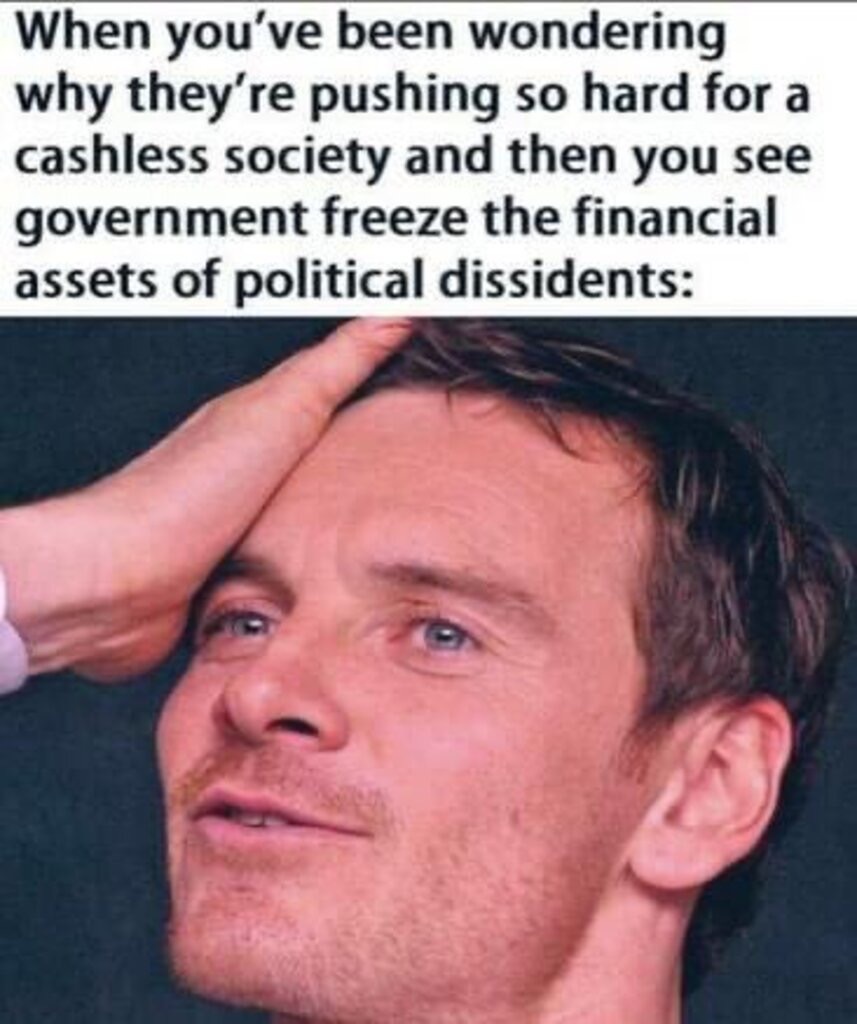
It is not a conspiracy theory. Earlier this month, Canada’s Prime Minister began freezing the bank accounts of protesters who stood against tyrannical mandates and arresting them. Not only did they go after the protesters, but the government went after the bank accounts of those who provided monetary support in the form of donations as well.

For practicing their free speech, Canadians were persecuted and driven into financial ruin by the government who claims to protect them. This was all carried out with zero due process and without any democratic input at all.

Last week, holding no punches Deputy PM Chrystia Freeland announced that “…all crowdfunding platforms and the payment service providers they use must register with Fintrac, and they must report large and suspicious transactions to Fintrac.” This, she said, is a way to “mitigate the risk” of “illicit funds” and “increase the quality and quantity of intelligence received by Fintrac and make more information available to support investigations by law enforcement.”

When the American political class watched as the Canadian government began financially persecuting individuals for their freedom of speech, it was crickets from the mainstream. This was one of the most tyrannical moves in recent Western history and instead of standing against it, the establishment actually supported it.

In fact, a poll by Trafalger Group for Convention of the States recently found that a super-majority of Democrats, 65%, actually thought Trudeau’s authoritarian move to arrest people and confiscate their life savings — for practicing their freedom of speech — was a good thing.

Just 17% of the establishment left disapproved of it.

Keep reading

Biden’s Banking Nominee Calls to Eliminate All “Private Bank Accounts”

Saule Omarova, President Joe Biden’s nominee for the Office of the Comptroller of the Currency (OCC), called during a March 2021 virtual conference to eliminate all private bank accounts and deposits.

Omarova spoke at the Law and Political Economy (LPE) Project’s “Law & Political Economy: Democracy Beyond Neoliberalism” conference in March.

Omarova discussed one of her papers, “The People’s Ledger How to Democratize Money and Finance the Economy,” which would help “redesign” the financial system and make the economy “more equitable for everyone.”

She said it would change the “private-public power balance” and democratize finance to a more systemic level.

During her explanation of her paper, she said that the Federal Reserve, the nation’s central bank, can only use “indirect levers” to “induce private banks to increase their lending.”

Her paper calls for eliminating all banks and transferring all bank deposits to “FedAccounts” at the Federal Reserve.

During her conference speech, she said, “There will be no more private bank accounts, and all of the deposit accounts will be held directly at the Fed”.

Keep reading