DOJ: Ban on mailing concealable firearms unconstitutional, can’t be enforced

A nearly 100-year-old federal ban on mailing handguns through the U.S. Postal Service is unconstitutional and cannot be enforced, according to an opinion released Thursday by the Department of Justice (DOJ).

The 15-page opinion concluded that a 1927 law, which made it illegal to use the Postal Service to mail concealable firearms, such as pistols and revolvers, infringes on the Second Amendment.

“Section 1715 makes it difficult to travel with arms for lawful purposes, including self-defense, target shooting, and hunting,” wrote T. Elliot Gaiser, the assistant attorney general for the Office of Legal Counsel.

“The statute also imposes significant barriers to shipping constitutionally protected firearms as articles of commerce, which interferes with citizens’ incidental rights to acquire and maintain arms,” the opinion continued.

Postal Service policy mandates that nonmailable firearms found in the mail stream “must be immediately reported to the United States Postal Inspection Service,” and investigations are then referred to the relevant U.S. attorney’s office for prosecution.

The agency categorizes “pistols, revolvers, and other firearms capable of being concealed on a person,” including short-barreled shotguns and rifles, as handguns. It also notes that there are no restrictions on mailing rifles and shotguns between licensed dealers, manufacturers and importers.

Major private carriers, including UPS and FedEx, also restrict the shipping of firearms to only licensed dealers, which the opinion argued effectively creates a “complete ban” for unlicensed people.

The opinion acknowledged some limitations, finding that the law was only unconstitutional related to handguns but still applied to undetectable firearms, such as pen guns.

It also found that the Postal Service should not be required to carry ammunition or gunpowder, despite those being constitutionally protected, because the existing restriction on explosives “serves legitimate postal needs to prevent injury to postal employees and property.”

Still, the DOJ determined the restrictions on handguns are unenforceable because such firearms “fall within the core of the ‘arms’ protected by the Second Amendment.”

“Consequently, so long as Congress chooses to run a parcel service, the Second Amendment precludes it from refusing to ship constitutionally protected firearms to and from law-abiding citizens, even if they are not licensed manufacturers or dealers,” the opinion stated.

Keep reading

The Postal Service’s ‘Next Generation’ Electric Delivery Vehicles Cost $22,000 More Than Other Electric Vans

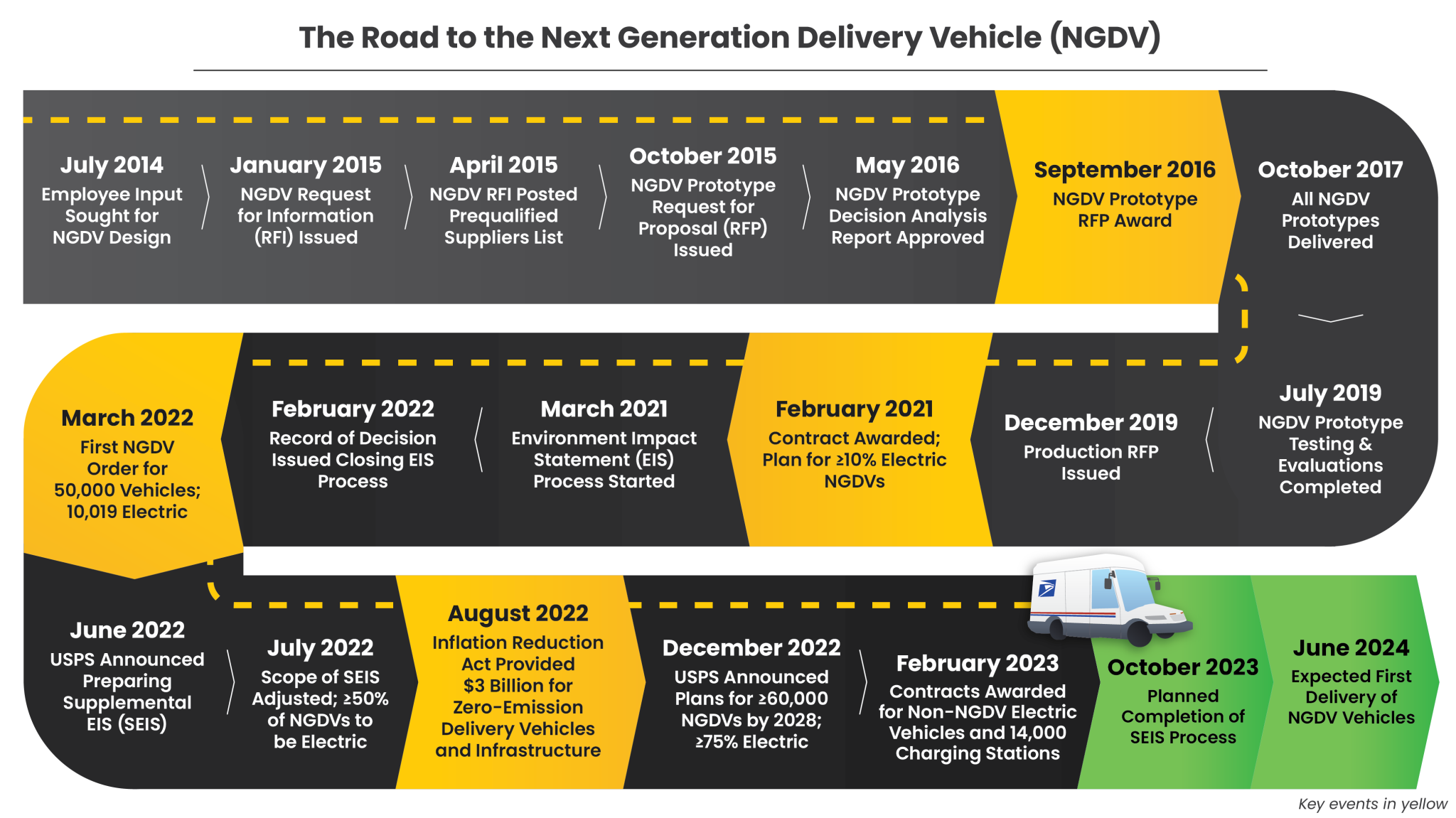
In 2014, the United States Postal Service (USPS) began replacing its fleet of delivery vehicles. In the almost 12 years since, only about 6 percent of its 51,500 custom-built delivery vehicles have been delivered. The Postal Service says the rollout will last at least two more years.

The signature USPS delivery truck is the Grumman Life Long Vehicle (LLV), which first entered service in 1986. Designed to last over 20 yearssome have now been in service for twice as long, and don’t include many modern amenities, like air conditioning and airbags. Maintaining the LLVs beyond their best-by date involved reverse-engineering the 130,000-strong fleet for discontinued parts, according to The Washington Post. In 2014, the USPS began its $9.6 billion fleet upgrade by announcing the Next Generation Delivery Vehicle (NGDV) program.

Oshkosh Defense, which produces rather mean-looking tactical vehicles for the American military (and has never before produced a delivery van), was awarded a multibillion-dollar contract in February 2021 to produce the NGDV for the Postal Service over 10 years. The Post details the production nightmare that ensued. After repeated delays, setbacks, and quadrupling the minimum number of electric NGDVs, thanks to a generous $3 billion subsidy from the Inflation Reduction Act, Oshkosh had only delivered 612 of 35,000 e-NGDVs by November 2025, and only 2,600 of the 16,500 internal combustion engine NGDVs.

The Postal Service agreed to pay Oshkosh $77,692 per e-NGDV and $54,584 per NGDV in March 2023. To put these numbers in context, FedEx’s fleet of Mercedes-Benz Sprinter vans is considerably cheaper, costing $50,830 for the baseline 2026 Sprinter and $61,180 for the 2026 eSprinter. (The Sprinter debuted in 1995 and the eSprinter rolled out in 2019, two years before the USPS awarded its Next Generation Delivery Vehicle contract to Oshkosh.)

Paying almost $80,000 per vehicle should have rung alarm bells, but what makes this situation worse is that the USPS knows cheaper alternatives exist. 21,000 of the Postal Service’s new fleet are commercial off-the-shelf vans like the Ford E-Transit (whose 2026 model starts at $54,855). In 2023, there were nearly 40,000 Mercedes-Benz Metris vans (which start at $41,495) in its fleet. It’s unclear why the agency decided to get bogged down with Oshkosh at all. Whatever the reasons may be, price is not one of them.

Keep reading

Federal Court Rules Bans on Carrying Firearms in Post Offices Are Unconstitutional, Democrats Hardest Hit

In a win for the Second Amendment and law-abiding gun owners across America, a federal court has ruled that bans on carrying firearms in U.S. Post Offices are unconstitutional.

And, yes, as I wrote in the headline, “Democrats hardest hit,” given that the gun-grabbing Democrat Party never saw a firearm it didn’t want to control, restrict, or outright ban.

As reported by RedState’s sister site, “Bearing Arms,” on Wednesday, Chief United States District Judge Reed O’Connor handed down an opinion on Firearms Policy Coalition Inc, et.al. v. Bondi. FPC was joined by the Second Amendment Foundation (SAF) in challenging the federal law.

The ruling also applies to carrying firearms on property surrounding post offices.

Here’s more, via Bearing Arms:

O’Connor wrote that the law “is unconstitutional under the Second Amendment with respect to Plaintiffs’ (and their members) possession and carrying of firearms inside of an ordinary United States Post Office or the surrounding Post Office property.” There’s nothing in the order limiting it to Texas and applies to all members of the Second Amendment Foundation and Firearms Policy Coalition.

The complaint was originally filed in June 2024 and the named defendant was then-Attorney General Garland. “So if the government seeks to restrict firearms in a particular location as a ‘sensitive place,’ it must prove that its current restriction is sufficiently analogous to a ‘well-established and representative historical analogue,’” the complaint said.

This order in Texas comes at the heels of the Department of Justice dropping a bid for an appeal in a criminal matter involving carriage on U.S. Postal Service property. U.S. v. Ayala in the U.S. District Court for the Middle District of Florida involved defendant Ayala’s possession of a firearm on postal grounds. District Court Judge Kathryn Kimball Mizelle wrote that: “The United States fails to meet its burden of pointing to a historical tradition of firearms regulation justifying Ayala’s indictment under § 930(a).”

Judge O’Connor struck down both the federal statute (18 U.S.C. § 930(a)) and USPS regulation (39 C.F.R. § 232.1(l)) that prohibited firearm possession and carry at ordinary post offices — not those situated on military bases or within multi-use federal complexes.

Such rulings, whether favorable to Second Amendment rights or against, highlight the decades-old debate between the left, which absurdly blames “gun violence” — as if firearms themselves committed crimes — and the right, which correctly asserts that “the only thing that stops a bad guy with a gun is a good guy with a gun.”

Keep reading

New Postal Rule Is An Admission That Mail Voting Is A Mess

he United States Postal Service has announced a proposed new section to its mailing standards that would have a major impact on the return of mail-in ballots, as it would shift the responsibility to the voter to confirm the exact receival date by the postal service.

USPS realizes that with their new mail processing system, the postmark is no longer proof of the date that it received a piece of mail. Their solution is to make the customer — in the case of ballots the voter — responsible for confirming the receipt date of their piece of mail. It will be up to the voter to obtain proof of date of receipt, or without it, a ballot may not be counted.

“While the presence of a postmark on a mailpiece confirms that the postal service was in possession of the mailpiece on the date of the postmark’s inscription, the postmark date does not inherently or necessarily align with the date on which USPS first accepted possession of a mailpiece,” the proposal notes.

Voters can confirm the exact date that the postal service first accepted possession of their ballot in various ways. The customer can hand the ballot or mail to a postal clerk at the post office and request a manual postmark, purchase a “Certificate of Mailing,” or pay extra for registered or certified mail.

The postal service’s postmark has been considered the mail date for payments by mail, filing taxes, and other legal documents and, in 19 states and Washington, D.C., the mail date for mail-in ballots that are to be mailed by Election Day.

Keep reading

Democrats’ All-Electric USPS Fleet Sees Each Truck Come With A $6.8 Million Price-Tag

According to a recently published New York Post report, the Biden administration played a major role in the push to massively electrify the United States Postal Service mail truck fleet. From a USPS press release in 2022:

The United States Postal Service today announced that it expects to acquire at least 66,000 battery electric delivery vehicles as part of its 106,000 vehicle acquisition plan for deliveries between now and 2028. The vehicles purchased as part of this anticipated plan will begin to replace the Postal Service’s aging delivery fleet of over 220,000 vehicles.

The Postal Service anticipates at least 60,000 Next Generation Delivery Vehicles (NGDV), of which at least 75% (45,000) will be battery electric.

But, like Buttigieg’s E.V. charging stations, which cost about a billion dollars each, or Kamala Harris’s $42 billion rural internet “flop” that connected a whopping zero rural Americans to the web, or her one-billion-dollar solar panel plan for Puerto Rico which resulted in “only a few” installations), Biden’s “green” USPS plan has been an absolute cluster.

From the Post item:

A Biden administration plan to create a ‘green’ fleet of postal vehicles has churned out a mere 250 electric mail trucks in just over two years — after shelling out taxpayer funds meant to build thousands…

The nearly $10 billion project — which called for more than 35,000 battery-powered US Postal Service (USPS) vehicles to be completed by September 2028 — was funded in part by $3 billion in funding from former President Joe Biden’s 2022 Inflation Reduction Act.

(I suspect the Post item has a typo, because as you see above, the number from the USPS is 45,000, not 35,000.)

So far, the disbursed IRA funds are around $1.7 billion, which means that if Congress is able to claw back the $1.3 billion still allocated for the project, each of these 250 trucks have cost U.S. taxpayers a minimum of $6.8 million a piece—the whole plan was a $10 billion “investment,” so who knows how much else was spent from other sources. Now, “investments” are supposed to give the investors a return on their money, haven’t these financial whizzes heard?

Keep reading

Two Former USPS Employees Indicted For Stealing $80 Million In Treasury Checks

Missing your tax return check and living near Philadelphia? We might have an idea of what’s gone wrong…

That’s because two former employees of the U.S. Postal Service in Philadelphia have been indicted for their roles in a scheme involving the theft of over $80 million in U.S. Treasury checks, the Department of Justice announced Wednesday.

According to federal prosecutors, Tauheed Tucker, 23, and Saahir Irby, 27, both previously employed as mail processing clerks at the USPS Philadelphia Processing and Distribution Center, are accused of stealing thousands of envelopes containing Treasury checks, according to NBC Philadelphia.

The indictment further alleges that Tucker and Irby sold the stolen checks to two other individuals—Cory Scott, 25, of Ardmore, and Alexander Telewoda, 25, of Clifton Heights. Scott and Telewoda are said to have advertised the checks for sale via the messaging app Telegram.

NBC Philadelphia writes that once payments were received from interested buyers, Scott and Telewoda allegedly mailed the checks out. According to prosecutors, those buyers then attempted to cash the checks, unaware they had been stolen.

Officials report that while the total face value of the stolen checks exceeded $80 million, approximately $11 million worth were successfully negotiated at banks by the buyers.

All four men—Tucker, Irby, Scott, and Telewoda—face charges including conspiracy to steal government funds, theft of government property, and mail theft. Each could face up to 20 years in prison if convicted.

In addition, Irby is facing separate charges of mail theft in connection with another incident involving stolen Treasury checks.

Keep reading

Postal Service Releases Final Report – Contract Driver Jesse Morgan Vindicated – Report CONFIRMS He Hauled Trailer of Ballots from NY to PA in Late October 2020

As The Gateway Pundit reported back in 2020, election fraud whistleblowers came forward in December following the controversial election, including one who witnessed the shipping of an estimated 144,000-288,000 completed ballots across three state lines on October 21 2020.

The information was made public at a press conference by the Amistad Project of the Thomas More Society, a national constitutional litigation organization.

The Amistad Project said at the time that they had sworn declarations that over 300,000 ballots were issued in Arizona, 548,000 in Michigan, 204,000 in Georgia, and over 121,000 in Pennsylvania.

They said that their evidence reveals multi-state illegal efforts by USPS workers to influence the election in at least three of six swing states.

The whistleblower statements included potentially hundreds of thousands of completed absentee ballots being transported across three state lines and a trailer filled with ballots disappearing in Pennsylvania.

Attorney Phil Kline said, “130,000 to 280,000 completed ballots for the 2020 general election were shipped from Bethpage, NY, to Lancaster, PA, where those ballots and the trailer in which they were shipped disappeared.”

Truck driver Jesse Morgan was present at the press conference and spoke for 9 minutes about his unbelievable ordeal. Morgan was tasked with delivering completed ballots to Pennsylvania from New York State.

This was explosive testimony.

Keep reading

Colorado Postal Worker Pleads Guilty To Fraudulently Casting Multiple Mail Ballots In 2024 Election

Aformer Mesa County, Colorado, postal worker awaits sentencing after admitting she stole and cast mail-in ballots in the 2024 general election. It is one of those election crimes we are told does not happen, despite so many opportunities for fraud in the ballot chain of custody.  

Vicki Stuart, 64, and her alleged accomplice Sally Jane Maxedon, 60, were accused of identity theft, attempt to influence a public servant, and forgery. Maxedon has not entered a plea yet and is expected in court May 8, according to Mesa County Clerk of Courts office.

According to the Mesa County District Attorney’s office which investigated the cases, in October, county elections workers started getting calls from people who said they had been notified that their ballot was rejected because of signature discrepancies, but they reported they had not yet received their mail ballot, although they had received the “Informed Mail “notification — a photo of the ballot envelope addressed to them, to let them know it was on the way.

The reports came from people who lived near each other. Some of the ballots were mailed to locked U.S. Postal Service (USPS) neighborhood mailbox clusters, leading investigators to believe someone who worked for USPS was involved.

Stuart, a mail carrier at the time, substituted for the normal mail carrier on the affected route on Oct. 12. When questioned, she confirmed she delivered many ballots that day.

 But she also compared the name on the ballot to the name printed on individual mailboxes. If there was no match she held that ballot back. Stuart told investigators she marked them “return to sender” and sent them back to the main hub. USPS told investigators mail carriers should not do this because they don’t know all the names living at an address.

She denied any involvement with ballot theft when questioned on Oct. 24.

Investigators looked at five ballot envelopes with forged signatures that had not yet been opened, and checked for fingerprints on the ballots inside.

They found Maxedon’s fingerprints on at least one bogus ballot and then interviewed her on Nov. 5.

At first Maxedon told investigators the ballots were given to her by a random man she did not know who asked her to help test the voting system. She admitted casting ballots that did not belong to her, the DA’s complaint said.

Keep reading

Non-Citizen Former USPS Worker Convicted in $1.7 Million Mail Theft and Bank Fraud Scheme, Lying on Citizenship Papers

A former U.S. Postal Service (USPS) employee, Hachikosela Muchimba, has been convicted of masterminding a $1.7 million mail theft and bank fraud scheme and falsifying his citizenship application.

Muchimba, 44, worked as a letter carrier at the Friendship Post Office in D.C.

During his tenure, Muchimba stole 98 checks, primarily from the U.S. Treasury, valued at over $1.6 million, by altering payee names or forging endorsements to deposit them into seven bank accounts he controlled.

Surveillance footage from banks showed him often making transactions in his USPS uniform.

“Muchimba used the proceeds of the stolen checks to fund a lavish lifestyle that included international travel, stays at luxury hotels, and purchases at gentlemen’s clubs,” the Department of Justice said in a press release.

The press release added, “During the scheme, Muchimba applied to become a naturalized U.S. citizen and provided false information to U.S. Citizenship and Immigration Services officers by telling them that he had not committed any crimes for which he had not been arrested. That offense carries a maximum penalty of ten years of incarceration and possible administrative denaturalization.”

In September 2023, Muchimba was arrested at Dulles International Airport. He was carrying $2,000 in cash, a Zambian passport, and a ticket to Zambia.

Keep reading

Postmaster General Agrees to Cooperate with DOGE in Reform Plan in USPS — 10,000 Workers on the Chopping Block

The United States Postal Service (USPS) is teaming up with Trump’s Department of Government Efficiency (DOGE) to implement massive reforms aimed at cutting waste, increasing efficiency, and saving taxpayer dollars.

For years, the USPS has been a bloated, inefficient, money-losing government entity, weighed down by excessive regulations and union-driven inefficiencies.

Postmaster General Louis DeJoy penned a letter to congressional leaders outlining just how broken the USPS has been for decades—racking up nearly $100 billion in losses and projected to lose another $200 billion if left unchecked.

“It has long been known that the Postal Service has a broken business model that was not financially sustainable without critically necessary and fundamental core change. Fixing a broken organization that had experienced close to $100 billion in losses and was projected to lose another $200 billion, without a bankruptcy proceeding, is a daunting task.

“Fixing a heavily legislated and overly regulated organization as massive, important, cherished, misunderstood and debated as the United States Postal Service, with such a broken business model, is even more difficult.”

DeJoy, who has helmed the USPS since 2020, touts his “Delivering for America” (DFA) plan as a miraculous turnaround for the agency.

“We’ve transformed a battered bureaucracy into a lean, mean delivery machine,” he seems to imply, citing $2.2 billion in annual transportation cuts, a 20% slash in headquarters staff (infamously dubbed the “Friday Night Massacre”), and a workforce reduction.

According to DeJoy, the USPS has already reduced 30,000 employees since 2021, saving $2.5 billion in labor costs. There will be an additional 10,000 job cuts in the next 30 days through a Voluntary Early Retirement program.

Keep reading