Human-Pig Hybrid Created in the Lab

In a remarkable—if likely controversial—feat, scientists announced that they have created the first successful human-animal hybrids. The project proves that human cells can be introduced into a non-human organism, survive, and even grow inside a host animal, in this case, pigs.

This biomedical advance has long been a dream and a quandary for scientists hoping to address a critical shortage of donor organs.

What if, rather than relying on a generous donor, you could grow a custom organ inside an animal instead?

That’s now one step closer to reality, an international team of researchers led by the Salk Institute reports in the journal Cell. The team created what’s known scientifically as a chimera: an organism that contains cells from two different species.

In the past, human-animal chimeras have been beyond reach. Such experiments are currently ineligible for public funding in the United States (so far, the Salk team has relied on private donors for the chimera project). Public opinion, too, has hampered the creation of organisms that are part human, part animal.

But for lead study author Jun Wu of the Salk Institute, we need only look to mythical chimeras—like the human-bird hybrids we know as angels—for a different perspective.

“In ancient civilisations, chimeras were associated with God,” he says, and our ancestors thought “the chimeric form can guard humans.” In a sense, that’s what the team hopes human-animal hybrids will one day do.

Keep reading

Scientists Create New Material Five Times Lighter and Four Times Stronger Than Steel

Materials that are both strong and lightweight can improve everything from cars to airplanes to medical equipment. Now, researchers have created an extraordinarily strong material with very low density–using two unlikely building blocks: DNA and glass.

“For the given density, our material is the strongest known,” according to Seok-Woo Lee of the University of Connecticut, who partnered with colleagues from Columbia University and Brookhaven National Lab.

“I am a big fan of Iron Man movies,” mused nanomaterials scientist Oleg Gang. “I have always wondered how to create a better armor for Iron Man. It must be very light for him to fly faster. It must be very strong to protect him from enemies’ attacks.

“Our new material is five times lighter but four times stronger than steel.”

Some metals, such as titanium, are stronger and lighter than iron. Certain alloys are even stronger—allowing for lightweight body armor, better medical devices, and safer, faster cars and airplanes. Metallurgical techniques have reached a limit in recent years, until nano materials unleashed creative opportunities.

The colleagues reported in Cell Reports Physical Science that by building a structure out of DNA and then coating it with glass, they have created a very strong material with very low density. Glass might seem a surprising choice, as it shatters easily. However, glass usually shatters because of a flaw – such as a crack, scratch, or missing atoms – in its structure. A flawless cubic centimeter of glass can withstand 10 tons of pressure, more than three times the pressure that imploded the Oceangate Titan submersible near the Titanic this summer.

Keep reading

More than 1,600 scientists, including two Nobel laureates, declare climate ’emergency’ a myth

Acoalition of 1,609 scientists from around the world have signed a declaration stating “there is no climate emergency” and that they “strongly oppose the harmful and unrealistic net-zero CO2 policy” being pushed across the globe. The declaration does not deny the harmful effect of greenhouse gasses, but instead challenges the hysteria brought about by the narrative of imminent doom.

The declaration, put together by the Global Climate Intelligence Group (CLINTEL), was made public this month and urges that “Climate science should be less political, while climate policies should be more scientific.”

CLINTEL is an independent foundation that operates in the fields of climate change and climate policy. CLINTEL was founded in 2019 by emeritus professor of geophysics Guus Berkhout and science journalist Marcel Crok. 

“Scientists should openly address uncertainties and exaggerations in their predictions of global warming, while politicians should dispassionately count the real costs as well as the imagined benefits of their policy measures,” the declaration says.

Of the 1,609 scientists who have signed the declaration, two signatories are Nobel Prize laureates. The most recent to sign is Nobel Prize winner Dr. John F. Clauser, winner of the 2022 Nobel Prize in Physics. In an announcement from CLINTEL, Clauser is quoted as saying “Misguided climate science has metastasized into massive shock-journalistic pseudoscience. In turn, the pseudoscience has become a scapegoat for a wide variety of other unrelated ills. It has been promoted and extended by similarly misguided business marketing agents, politicians, journalists, government agencies, and environmentalists.”

The underlying report that engendered the declaration lays out a series of statements challenging many of the common climate claims. For example, one of the most common claims – and repeated without question by many – is that the earth will soon pass “tipping points that will lead to catastrophic environmental damage, including dangerous sea level rise, entire species going extinct, and even greater suffering in many nations, especially the poorest.”

Keep reading

Truth about my ‘alien’ encounter… How I found bombshell interstellar objects a mile beneath the sea – and their limitless potential for life on Earth, by scientist AVI LOEB

Every scientist dreams of making a great discovery. A eureka moment when all the signs point to a conclusion that breaks new ground, that potentially changes everything.

I believe I had such a moment this week, when a team of scientists I led revealed their preliminary analysis of 700 extraordinary fragments recovered from a 2014 meteor crash site during an expedition that I organized this summer.

These fragments – tiny metallic spheres – were discovered off the coast of Papua New Guinea, and what they’ve revealed is revolutionary on two fronts.

First, the evidence indicates the fragments are of interstellar origin, from beyond our solar system.

This is a truly historic moment: no human has ever laid hands on materials from outside our solar system before.

Second, and far more significant, through analysis my team discovered that the make-up of these metals is unlike anything we’ve seen.

Keep reading

Research group detects a quantum entanglement wave for the first time using real-space measurements

Triplons are tricky little things. Experimentally, they’re exceedingly difficult to observe. And even then, researchers usually conduct the tests on macroscopic materials, in which measurements are expressed as an average across the whole sample.

That’s where designer quantum materials offer a unique advantage, says Academy Research Fellow Robert Drost, the first author of a paper published in Physical Review Letters. These designer quantum materials let researchers create phenomena not found in natural compounds, ultimately enabling the realization of exotic quantum excitations.

“These materials are very complex. They give you very exciting physics, but the most exotic ones are also challenging to find and study. So, we are trying a different approach here by building an artificial material using individual components,” says Professor Peter Liljeroth, head of the Atomic Scale physics research group at Aalto University.

Quantum materials are governed by the interactions between electrons at the microscopic level. These electronic correlations lead to unusual phenomena like high-temperature superconductivity or complex magnetic states, and quantum correlations give rise to new electronic states.

In the case of two electrons, there are two entangled states known as singlet and triplet states. Supplying energy to the electron system can excite it from the singlet to the triplet state. In some cases, this excitation can propagate through a material in an entanglement wave known as a triplon. These excitations are not present in conventional magnetic materials, and measuring them has remained an open challenge in quantum materials.

Keep reading

Scientists create first genetically modified animal that can have offspring asexually

Developmental biologist Alexis Sperling became obsessed with something she saw in the lab when she was studying for her PhD. A praying mantis had young spontaneously, without having sex with a male. A virgin had had children.

This ability has never been observed in mammals, including of course humans, but in the rest of the animal world there are certain species capable of doing it. Many of the cases have been observed in zoos where the females had spent years alone without the possibility of mating.

In 2015, a team discovered one of the first cases of sexless reproduction in the wild: the smalltooth saw fish, which was on the brink of extinction. And just two years ago, at the San Diego Zoo, two females of the endangered California condor gave birth asexually, despite the fact that in this case there were breeding males available.

Keep reading

Two Princeton, MIT Scientists Say EPA Climate Regulations Based on a ‘Hoax’

Two prominent climate scientists have taken on the Environmental Protection Agency’s (EPA) new rules to cut CO2 emissions in electricity generation, arguing in testimony that the regulations “will be disastrous for the country, for no scientifically justifiable reason.”

Citing extensive data (pdf) to support their case, William Happer, professor emeritus in physics at Princeton University, and Richard Lindzen, professor emeritus of atmospheric science at Massachusetts Institute of Technology (MIT), argued that the claims used by the EPA to justify the new regulations are not based on scientific facts but rather political opinions and speculative models that have consistently proven to be wrong. 

“The unscientific method of analysis, relying on consensus, peer review, government opinion, models that do not work, cherry-picking data and omitting voluminous contradictory data, is commonly employed in these studies and by the EPA in the Proposed Rule,” Mr. Happer and Mr. Lindzen stated. “None of the studies provides scientific knowledge, and thus none provides any scientific support for the Proposed Rule.”

“All of the models that predict catastrophic global warming fail the key test of the scientific method: they grossly overpredict the warming versus actual data,” they stated. “The scientific method proves there is no risk that fossil fuels and carbon dioxide will cause catastrophic warming and extreme weather.”

Keep reading

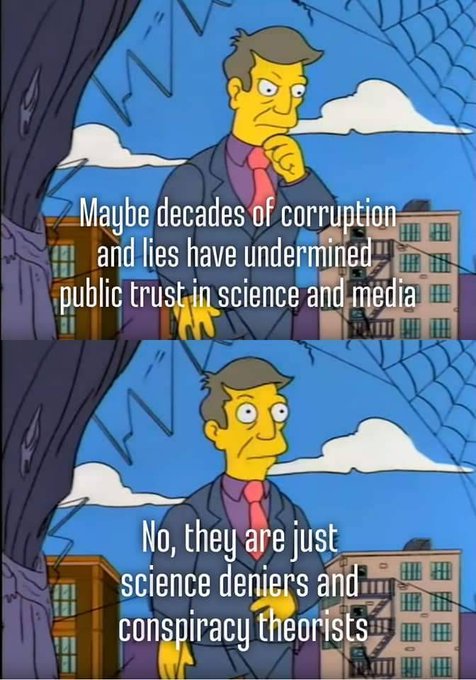
Scientist admits the ‘overwhelming consensus’ on the climate change crisis is ‘manufactured’

We are told climate change is a crisis, and that there is an “overwhelming scientific consensus.”

“It’s a manufactured consensus,” climate scientist Judith Curry tells me.

She says scientists have an incentive to exaggerate risk to pursue “fame and fortune.”

She knows about that because she once spread alarm about climate change.

The media loved her when she published a study that seemed to show a dramatic increase in hurricane intensity.

“We found that the percent of Category 4 and 5 hurricanes had doubled,” says Curry.

“This was picked up by the media,” and then climate alarmists realized, “Oh, here is the way to do it. Tie extreme weather events to global warming!”

“So, this hysteria is your fault!” I tell her.

“Not really,” she smiles.

“They would have picked up on it anyways.”

But then some researchers pointed out gaps in her research — years with low levels of hurricanes.

“Like a good scientist, I investigated,” says Curry.

She realized that the critics were right.

“Part of it was bad data. Part of it is natural climate variability.”

Keep reading

Hopes Dashed: LK-99 Falls Short Of Room-Temperature Superconductor Glory

Less than a week after South Korean researchers claimed in two new papers that they had developed a superconductor that operates at room temperature under standard atmospheric pressure,which would have mind-blowing implications for transmitting electricity with zero resistance at normal temperatures, all hopes have been dashed by an already-skeptical scientific community.

In response to the alleged discovery, several labs got to work recreating the superconductor, known as LK-99. Alas, none of them were a success, IFLScience reports.

“When we are measuring superconductors, the most obvious property of a superconductor is zero resistance,” said Professor Susie Speller of the Oxford Centre for Applied Superconductivity, in comments to IFLScience in a previous deep-dive on LK-99. “What you look for is for the material to have some resistance. You cool it down, and suddenly it should lose that resistance, and it should be absolutely zero when it’s in the superconducting state. You should see a very clear change in resistance at the temperature where it starts to superconduct.”

Keep reading

Scientist Suggests Feasibility of Faster-Than-Light Travel within the Boundaries of Einstein’s Physics

The idea of faster-than-light (FTL) travel has captivated human imagination for decades, fueled by science fiction’s portrayal of interstellar journeys that traverse the vast cosmos in the blink of an eye. While the concept has long been considered implausible due to Albert Einstein’s theory of relativity, recent claims by a daring scientist suggest that FTL travel might not be as far-fetched as previously thought. This potential breakthrough could revolutionize our understanding of the universe and reshape the boundaries of human exploration.

Einstein’s Relativity and the Cosmic Speed Limit

Albert Einstein’s theories of special and general relativity are pillars of modern physics, setting forth the framework for understanding the fundamental behavior of space, time, and gravity. One of the most renowned consequences of these theories is the assertion that the speed of light is the ultimate cosmic speed limit – nothing can travel faster than light in a vacuum. This assertion has not only been supported by countless experiments but has also been instrumental in shaping our understanding of the universe.

The Challenge of Faster-Than-Light Travel

The idea of FTL travel, while popular in science fiction, has been met with skepticism by the scientific community. The energy required to propel an object to or beyond the speed of light using conventional methods seems insurmountable, and the associated implications, including time dilation and causality violations, challenge the very fabric of reality as we know it.

However, recent developments in theoretical physics have sparked new discussions about the feasibility of FTL travel within the framework of Einstein’s theories. Dr. Amelia Rodriguez, a theoretical physicist at the forefront of this debate, claims that there might be loopholes in Einstein’s equations that could potentially allow for FTL travel without violating the laws of physics.

Warp Drives and Alcubierre’s Theory

Dr. Rodriguez’s work draws inspiration from Miguel Alcubierre’s “warp drive” concept proposed in the 1990s. Alcubierre’s theory involves the creation of a “warp bubble” around a spacecraft, effectively contracting space in front of it and expanding space behind it. This manipulation of spacetime would allow the spacecraft to “ride” on the wave created by the bubble, potentially enabling speeds faster than light without the spacecraft itself exceeding the speed of light within its local frame of reference.

Keep reading