What is the US “Gas Stove Ban” REALLY about?

The Biden administration is apparently looking to ban gas stoves, calling them a “hidden danger”. But while that sounds bad enough, a deeper dive shows – as usual – it’s not really about what they say it’s about.

Talk of banning gas stoves and “unregulated indoor air quality” could be a Trojan horse designed to get even more “smart” monitoring technology into your home.

Let’s jump in.

ARE GAS STOVES DANGEROUS?

Well, according to Alexandria Ocasio Cortez, the New Scientist and million other outlets and pundits who started talking about it in the last two days, yes.

Earlier this week near-identical articles from the National Review, Bloomberg and CNN detail how the US Consumer Product Safety Commission will be opening “public comment on the dangers of gas stoves sometime this winter”.

The articles claim:

The emissions have been linked to illness, cardiovascular problems, cancer, and other health conditions. More than 12 percent of current childhood asthma cases are linked to gas stove use, according to peer-reviewed research published in the International Journal of Environmental Research and Public Health last month.

Now would be a good time to talk about the phrase “linked to”. It’s always a good one to look out for in any mainstream publication. Journalists love it because it implies causation without stating it.

Consider, one hundred per cent of serial killers have been linked to the ingestion of water and the wearing of shoes.

If this manipulative use of language were not evidence enough of an agenda, the rather premature deployment of the race card proves it:

Senator Cory Booker (D., N.J.) and Representative Don Beyer (D., Va.) wrote a letter to the agency last month urging the commission to address the issue and calling the harmful emissions a “cumulative burden” on black, Latino and low-income households.

SO, WILL THEY BAN THEM?

Actually, probably not.

Considering that, according to Bloomberg, some 40% of US homes use gas stoves to cook, an outright ban would be impractical to the point of madness. You can’t criminalise 40% of the country. It would be almost unenforceable.

Perhaps they might try a “phasing out”, as they plan for petrol cars in California.

But most likely of all is that this was never really about banning stoves in the first place.

Keep reading

Shocking Investigation Finds Widespread Uranium Contamination in US Water Supply

A new investigation looks into the extent to which U.S. water supplies are contaminated with uranium.

Maybe it’s the good kind of uranium that turns you into Spider-Man or the Incredible Hulk and not the bad kind of uranium that turns you into Thyroid Cancer Man – one of the lesser-known Marvel superheroes.

ProPublica has come out with an investigation entitled “The Cold War Legacy Lurking in U.S. Groundwater.” After World War II, the Cold War started between the U.S.S.R. and the U.S. because the rich needed to stop the damn Communists from pushing their furry hats on everyone! There was a feverish need to build loads of nuclear weapons. To do that, the U.S. needed uranium, and its ruling class didn’t care how they got it.

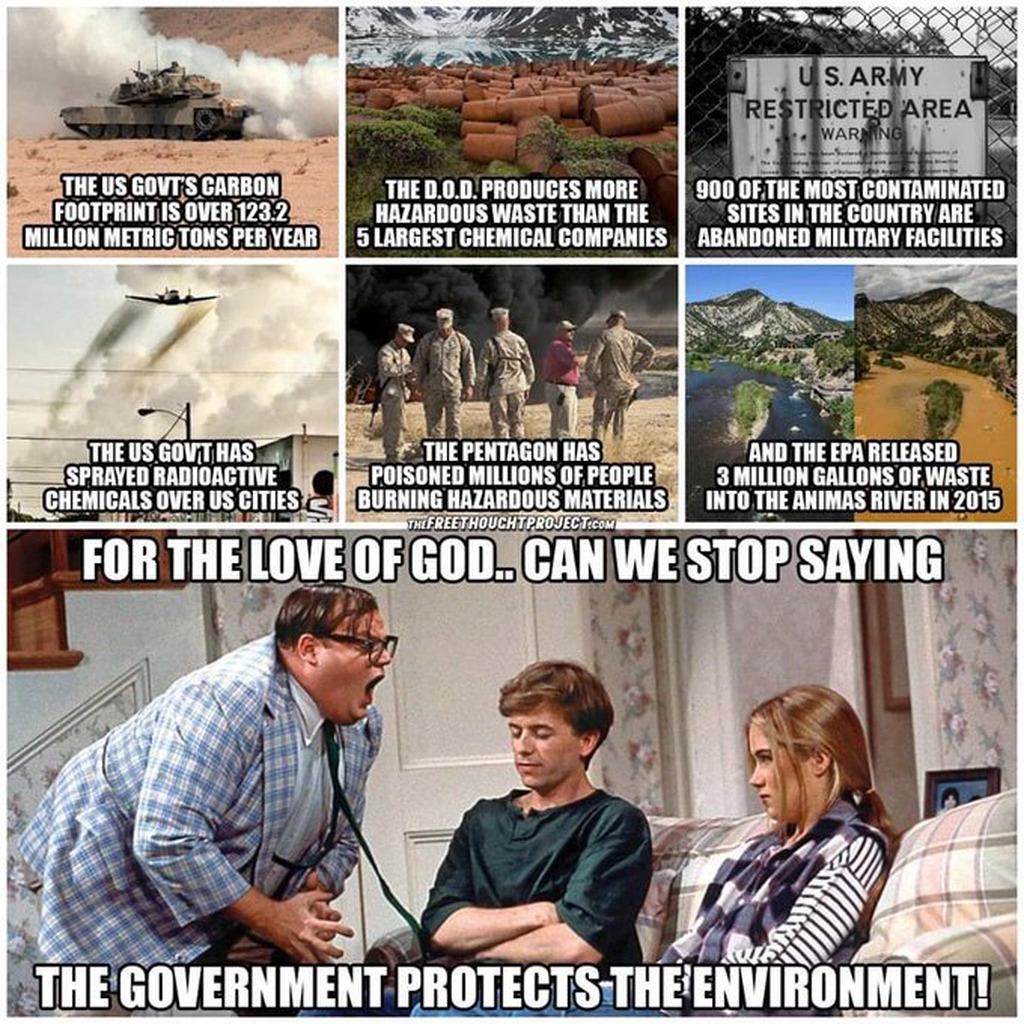
More than 50 uranium mines popped up across the Western U.S. But they didn’t just turn our weapons radioactive. They also “dumped radioactive and toxic waste into rivers like the Cheyenne in South Dakota and the Animas in Colorado. … Some of the more than 250 million tons of toxic and radioactive detritus… scattered into nearby communities, some spilled into streams and some leaked into aquifers.”

Luckily for the U.S. government at the time, most of the people having their lives destroyed by radioactive detritus were either Native Americans, poor, or both. And as we know well, none of those groups matter to the ruling class – not then and not now. They don’t care about anybody who doesn’t have enough money to have, at minimum, one backup tax haven for when their first tax haven floods due to climate change.

Providing clean water is the most basic responsibility of a government. The U.S. government – the richest in the world – can’t do that, which puts this country at the level of a failed state.

And this is nothing new. The U.S. government – which is a wholly-owned subsidiary of corporate America – has a long history of polluting its own people’s drinking water.

Of course, everyone knows about the lead-tainted water of Flint, Michigan. But did you know that in 2016, excessive lead levels were found in almost 2,000 water systems across all 50 states?

This year, shocking levels of lead were found in Chicago’s tap water. But of course, it goes far beyond lead.

Also this year, as reported by ABC News, “A lawsuit alleged the Navy ‘harbored toxic secrets’ after jet fuel leaked from a storage facility in Red Hill, Hawaii operated by the Navy, contaminating locals’ drinking water and sickening hundreds of families.”

Keep reading

Large Trucks and Buses Made Before 2010 Now Banned From California Roadways

Big rigs and buses made before 2010 are now banned from operating on California roadways.

The law, which went into effect on New Year’s Day, was part of a set of clean air regulations the California Air Resources Board passed nearly 15 years ago.

According to truck lobbying groups, the new law will prohibit about 10 percent of the commercial motor vehicles that are operating in the state.

“The rule applies to diesel vehicles that weigh at least 14,000 pounds. The air resources board said there are an estimated 200,000 vehicles that have yet to comply with the rule just days before the new year, including roughly 70,000 big rig trucks, or about 10% of the commercial motor vehicles operating in the state, according to trucking lobbying groups,” KCRA reports.

Keep reading

Millions Of Electric Car Batteries Retiring By 2030, Are We Ready To Deal With What Could Be Ticking Time Bombs?

The evolving landscape of lithium batteries is creating both contradictions and infrastructure hurdles that, according to some, need to be addressed sooner rather than later. A critical component of this is waste management.

More than 6 million electric vehicle (EV) battery packs will end up as scrap between now and 2030, and the recycling and reuse industries are racing to keep up. Some researchers project that recycling alone will be an over $12 billion industry by 2025.

U.S. President Joe Biden wants to make America a key player in the EV battery industry with a $3.1 billion spending package for automobile production to transition away from fossil fuels.

Much of this dream is pinned on a dusty stretch of soil in the Nevada high desert called Thacker Pass. It serves as the lynchpin in Biden’s push for increased domestic lithium production and more EV batteries. That’s because Thacker Pass is the largest hard rock lithium reserve in the United States.

Currently, China dominates the world’s EV battery production, with more than 80 percent of all units developed there.

Yet while Biden’s administration has its sights on the top spot for EV battery production, insiders are pointing out industry trapdoors.

Keep reading

Over 75% of Plastic in Pacific Garbage Patch Is from Chinese and Japanese Fishermen

A Dutch non-profit group called The Ocean Cleanup released a report on September 1 that found the bulk of the plastic debris in the so-called North Pacific Garbage Patch consists of discarded fishing equipment from Japan and China. 

The garbage patch is often depicted in Western media and popular culture as refuse created by heavy industry or thrown into the ocean by careless Americans and Europeans. Much of the trash heap supposedly consists of minuscule debris known as microplastics.

The North Pacific Garbage Patch (NPGP), first discovered in 1997, was created by intersecting ocean currents between the West Coast of the United States and the Hawaiian Islands. Researchers later found small debris moving through a “subtropical convergence zone” to another garbage patch on the far side of the Pacific, east of Japan. The NPGP is estimated to cover several million square kilometers, weighing in at tens of thousands of tons.

According to research by The Ocean Cleanup published in Scientific Reports, up to 86 percent of the debris in the North Pacific Garbage Patch actually consists of “items that were abandoned, lost, or discarded by fishing vessels.”

The Ocean Cleanup began its revolutionary study in 2019, a year after a surprising survey that found almost half of the debris in the garbage patch was from discarded fishing nets. The study that began in 2019 harvested over 6,000 plastic objects from the ocean by dragging huge U-shaped nets behind research vessels. To the surprise of the researchers, the bulk of the identifiable debris they collected was “fishing and aquaculture gear,” including equipment used to harvest fish, oysters, and eel.

Keep reading

Climate Czar John Kerry’s Jet Has Emitted 300 Metric Tons Of Carbon In Less Than Two Years

Will leftist elites ever practice the sacrifices they dream to force upon the masses? Biden climate czar John Kerry sure does not seem to think so — the Special Presidential Envoy for Climate owns a private jet that emitted over 300 metric tons of carbon dioxide, according to federal data.

Kerry’s jet, a Gulfstream GIV-SP, has made 48 trips that last more than 60 hours. Escapades made possible by the plane emitted an estimated 715,886 pounds, or 325 metric tons, of carbon since Joe Biden began occupying the White House, according to Fox News. The plane belongs to Flying Squirrel LLC., a charter company in which Kerry owns a financial stake of at least $1 million.

This is not Kerry’s first time breaking rules that he wishes to impose upon others. A previous report at BLP showed the climate envoy flaunting a mask mandate during a commercial flight as other Americans were being thrown off flights and threatened with federal prison for doing the same things.

Keep reading

Solar Panels Subsidized By Gov’t Are Winding Up In Landfills, Contaminating Groundwater With Toxic Metals

Oh, the irony…California’s massive push for adaptation of solar over the last several decades in order to ascertain more “clean” energy is now becoming a problem for landfills.

After 1.3 million solar installs later, the first push of panels are reaching the end of their “typical 25-to-30-year life cycle”, according to Yahoo.

And now for the coda to the “clean energy” story: many of the panels are “winding up in landfills, where in some cases, they could potentially contaminate groundwater with toxic heavy metals such as lead, selenium and cadmium” the report says.

One expert told yahoo that only 1 in 10 panels are actually recycled – the rest are contributing to “truckloads of waste”, some of which is contaminated, according to the report.

Sam Vanderhoof, a solar industry expert and chief executive of Recycle PV Solar told Yahoo: “The industry is supposed to be green. But in reality, it’s all about the money.”

California has been pushing for solar since 2006, when the state approved $3.3 billion in subsidies. Now, about 15% of the state’s power comes from solar – but that belies the environmental disaster disposing of the panels has become.

Keep reading