Nearly 1.6 billion disposable masks polluted oceans in 2020, will take 450 years to decompose

Nearly1.6 billion disposable face masks ended up in the earth’s oceans in 2020, out of the roughly 52 billion produced in response to the pandemic, according to a new study.

While governments around the world continue to support mask mandates in public spaces, the impact of disposable masks is only just emerging.

The report, by the Hong Kong-based marine conservation group OceansAsia, title “Masks on the Beach,” also estimated that roughly 5,500 tons of plastic pollution entered the ocean in 2020 from masks.

The figure is equal to 7% of the Great Pacific Garbage Patch, a mass of plastic debris floating in the ocean that is twice the size of Texas.

While a cigarette butt or plastic bag takes 20 years or less to degrade in the ocean, according to Visual Capitalist, a plastic bottle, disposable diaper or a disposable mask takes nearly 450 years to fully break down. 

The majority of disposable masks – like N95 respirators and surgical masks – were produced in China factories, which were reportedly producing 450 million masks per day in April 2020. 

Keep reading

An Inconvenient Truth: EVs May Offer A “Negligible” CO2 Difference From ICE Vehicles

Are the carbon footprints of EVs really as drastically lower than that of internal combustion engine vehicles? When considering the amount of carbon and CO2 created from assembling lithium ion batteries, one firm thinks the difference could be “negligible”.

Such was the topic of a new blog post by natural resource investors Goehring & Rozencwajg (G&R), a “fundamental research firm focused exclusively on contrarian natural resource investments with a team with over 30 years of dedicated resource experience.”

The firm, established in 2015, posted a blog entry entitled “Exploring Lithium-ion Electric Vehicles’ Carbon Footprint” this week, where they call into question a former ICE vs. EV comparison performed by the Wall Street Journal and, while citing work performed by Jefferies, argue that there could literally be “no reduction in CO2 output” in some EV vs. ICE comparisons. 

Their analysis “details the tremendous amount of energy (and by extension CO2) needed to manufacture a lithium-ion battery.” Because a typical EV is on average 50% heavier than a similar internal combustion engine, the analysis notes that the “embedded carbon” in an EV (i.e., when it rolls off the lot) is therefore 20–50% more than an internal combustion engine.

Keep reading

Researchers Say 4 Billion Masks Tossed Out Daily Could Cause Environmental Catastrophe

Around the world, every minute of every day, three million masks are tossed out. Let that sink in. THREE million masks are tossed out every MINUTE.

Every single day, on average, a little over four billion — with a “b” — masks are thrown out.

Every single month, 129 billion — again with a “b” — masks are tossed out.

And this does not include all the other protective equipment.

“Preventing masks from becoming the next plastic problem,” is the name of a research paper published this year and here’s the takeaway:

Recent studies estimated an astounding 129 billion face masks being used globally every month (3 million / minute) and most are disposable face masks made from plastic microfibers (Prata et al., 2020). With increasing reports on inappropriate disposal of masks, it is urgent to recognize this potential environmental threat and prevent it from becoming the next plastic problem.

Yes, there is a layer of plastic in all those disposable masks, and here’s a collection of photographs that bring the problem to life.

Keep reading

Covid Face Masks Killing Wildlife, Study Says

Researchers are blaming “corona waste,” including disposable face masks and latex gloves, for a recent increase in wildlife deaths.

The researchers in the Netherlands say wildlife across the world is getting entangled in discarded face masks and other safety gear.

“Researchers note incidents of foxes in the United Kingdom and birds in Canada all becoming entangled in discarded face masks,” according to studyfinds.org. “Hedgehogs, seagulls, crabs, and even bats are all encountering the disposable plastics in the environment.”

“In some cases, study authors say animals are eating this debris.”

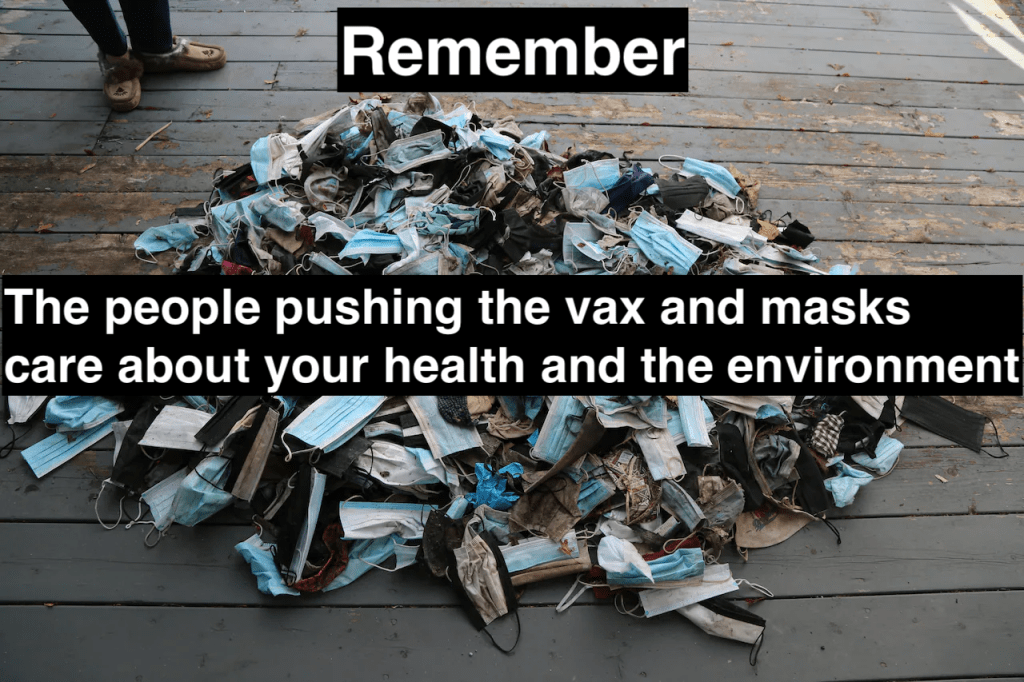
Informed readers will see the irony in that the very people pushing face mask mandates also claim to be concerned with “global warming” and the environment in general.

Keep reading