Looks like we finally have some secret police to call our own. Ongoing protests stemming from a Minnesota police officer’s brutal killing of an unarmed Black man have provoked a federal response. In some cases, the National Guard has been called in to quell the more violent and destructive aspects of some demonstrations. Others — like the 50+ days of continuous protests in Portland, Oregon — have been greeted with something far more frightening.
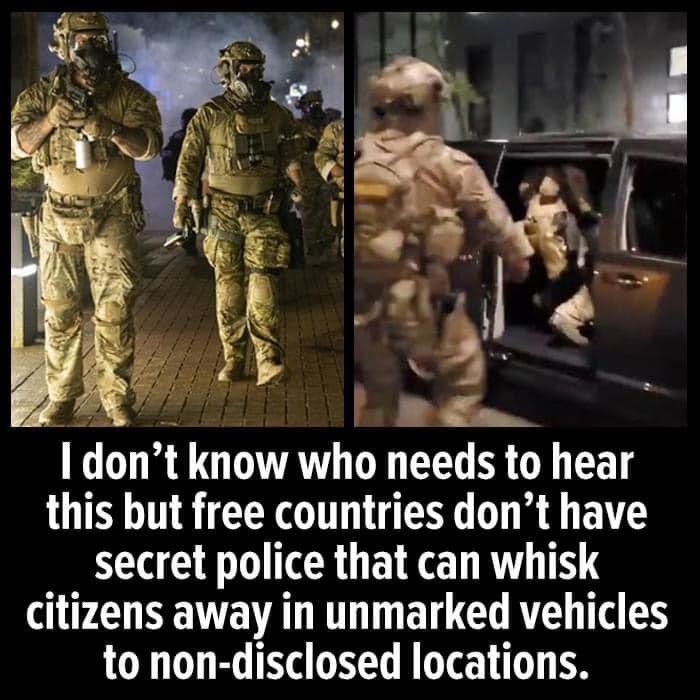
Jonathan Levinson and Conrad Wilson of Oregon Public Broadcasting were the first to break the news of unidentified federal officers yanking people off the street into unmarked vehicles and disappearing them for a few hours of interrogation.
In the early hours of July 15, after a night spent protesting at the Multnomah County Justice Center and Mark O. Hatfield Federal Courthouse, Mark Pettibone and his friend Conner O’Shea decided to head home.
[…]
A block west of Chapman Square, Pettibone and O’Shea bumped into a group of people who warned them that people in camouflage were driving around the area in unmarked minivans grabbing people off the street.
“So that was terrifying to hear,” Pettibone said.
They had barely made it half a block when an unmarked minivan pulled up in front of them.
“I see guys in camo,” O’Shea said. “Four or five of them pop out, open the door and it was just like, ‘Oh shit. I don’t know who you are or what you want with us.’”
Pettibone was grabbed by the unidentified officers, who wore nothing indicating which branch of the federal government they worked for, and shoved into a van with his hat pulled down over his eyes. He was taken to the federal courthouse (something he wasn’t aware of until he was released), patted down, photographed, and had his belongings searched. After all of this, he was put into a cell where he was finally read his Miranda rights. He refused to talk to the officers and they released him about 90 minutes later. At no point was he told what he had been detained for, nor was he given any paperwork documenting his detainment.
No one appears to know for sure which branch of the federal government is taking people off the street and detaining them without probable cause. The officers performing these sweeps use unmarked vehicles and dress in camouflage uniforms that contain no identfying info that might indicate what agency they work for.
The federal government has deployed a mixture of federal agencies to cities with ongoing protests, including the US Marshals Service, CBP, ICE, and Bureau of Prisons riot officers. Presumably the DEA is in the mix as well, since it invited itself along for this anti-free-speech ride.
Keep reading



 Hellbound and Down
You must be logged in to post a comment.