The US Government Threatens Tech Companies To Push Censorship Agendas

The elephant in the room with the ongoing controversy about the Biden administration’s push for more internet censorship is the fact that both the US government and the Silicon Valley tech companies who are being pushed to censor are acutely aware that those companies can be brought to their knees by antitrust cases and other regulation if they don’t censor people’s voices in accordance with the government’s wishes.

After Press Secretary Jen Psaki admitted on Thursday that the administration has given Facebook a list of accounts to ban for spreading “misinformation” about the Covid vaccine, she has now doubled down saying that people who circulate such materials online should be banned from not just one but all social media platforms.

“You shouldn’t be banned from one platform and not others for providing misinformation out there,” Psaki told the press on Friday.

When asked by the press for his thoughts on companies like Facebook, President Biden said the failure of those platforms to adequately censor posts about the vaccine makes them guilty of “killing people”.

Keep reading

The Increasing Aggressiveness Of Petty Tyrants

Somewhere along the way, we seem to have come to the point here in the United States where it’s all politics all of the time. That’s not literally true, of course, but it seems as if political tensions and conflicts obtrude on daily life with increasing frequency. It’s hard to get away from it.

Having written in the past about Americans’ traditional love for the simple joy of being left alonetoday we’re overrun with zealots who aggressively push their agenda every chance they get. They relish getting into our faces and going out of their way to exceed the normal boundaries of the offices and positions they occupy.

Who’s to blame? That’s largely a matter of one’s political perspective.

Conservatives like myself see in progressives an overwhelming sense of self-righteousness that breeds a sense that they’re justified, even entitled, to try to compel the rest of us to think like they do and support the same policy objectives. From sweeping messianic goals like saving the world from an (imaginary) imminent climate catastrophe down through every lesser goal of progressive utopia and conformity, the left’s actions are nothing, if not heavy-handed.

Progressives, on the other hand, view Americans who don’t share their world view and aren’t on board with their agenda as some combination of ignorant, unenlightened, retrograde, immoral, selfish creeps who need to be bludgeoned into cooperation since they so pathetically lack the good sense to conform to progressive orthodoxy.

Following are some of the ways in which progressives are going overboard to steamroll their opponents. Let’s start with several cases in which progressive office-holders are so eager to assert their rightness and the other side’s wrongness that they egregiously exceed the proper limits of their official powers.

Keep reading

Psaki Says Americans Who Post “Misinformation” Should be Banned From All Platforms

White House Press Secretary Jen Psaki on Friday doubled down on the government’s censorship of Americans.

Psaki on Thursday casually admitted the federal government is censoring American citizens and flagging “problematic” social media posts.

“We’ve increased disinformation research and tracking within the Surgeon General’s office,” Psaki said Thursday. “We’re flagging problematic posts for Facebook that spread disinformation.”

On Friday Psaki took it to another level and said Americans who post “misinformation” should be completely unpersoned and should have no access to online platforms.

Keep reading

Cop Who Murdered Man with Hands Up, Given an iPad in Jail to Access Child Porn Behind Bars

Another homicide of an unarmed mentally-ill civilian took place again in 2017 at the hands of law enforcement. And while most police officers enjoy special protections under the law, called “qualified immunity” in this particular instance, an Oklahoma City police officer was charged with second-degree murder and sentenced to 10 years.

In November 2019, a jury convicted former officer Keith Sweeney of second-degree murder and recommended he spend 10 years in prison for it. He has been in prison ever since. While folks thought they were safe from this danger to society, it appears he found a way to victimize society’s most vulnerable while behind bars.

This disgraced former cop is now facing 12 charges of child pornography after allegedly using an iPad and the Marshall County Detention Center’s Wi-Fi to prey on children. According to authorities, an Internet Crimes Against Children (ICAC) tip led them to to this murdering child predator behind bars, which is unusual, according to police.

“ICAC investigations don’t usually point us to an individual that’s behind bars,” said Sarah Jensen with the Norman Police Department. Jensen explained that the person who tipped off ICAC had ties to the city of Norman, though they were not immediately made clear.

“We were able to determine through IP addresses, and a number of other things, that it was occurring while inside the jail facility,” said Jensen.

While internet devices and iPads are normally considered contraband in many jails, apparently, Sweeney’s blue privilege extended behind bars and he was given an iPad and the password to the jail’s Wi-Fi. Now, the jail is playing dumb, claiming they had no idea how Sweeney was given an iPad.

The Marshall County Sheriff’s Office said Sheriff Donald Yow did not know Sweeney was given the iPad to use behind bars. Since then, the sheriff said he has changed all the passwords and confiscated all equipment, according to KFOR.

Apparently, Sweeney was able to access old files he had stored on the web, meaning before he murdered Dustin Pigeon, he was likely preying on children. According to KFOR, the Marshall County Sheriff’s office said a former jail administrator allowed Sweeney to have an iPad while behind bars which, “allowed prisoner Sweeney to have access to the detention center along with the password.” This allowed the former officer to “remotely access his old files and share them.”

Keep reading

Postal Censorship and Surveillance: A Timeline

1775

A year before independence, the Continental Congress creates the Postal Service—not as a government agency, but as one of several new independent alternatives to the British postal system. One advantage: This allows American dissidents to communicate without the authorities intercepting their letters.

1835

Southern mobs seize and burn abolitionist material sent through the mail. The postmaster general refuses to intervene, establishing a de facto policy of permitting the censorship of such literature in the slave states.

1844

The libertarian abolitionist Lysander Spooner establishes the private American Letter Mail Co. The government reacts by outlawing it, and in 1851 the experiment ends.

1861

The Civil War begins, and both the Union and the Confederacy adopt their own forms of postal censorship. The postmaster general spends a year refusing to deliver papers deemed disloyal to the Union cause.

1873

The Comstock Act makes it illegal to knowingly mail or receive any “filthy book, pamphlet, picture, paper, letter, writing, print, or other publication of an indecent character,” as well as any contraceptives, any abortifacients, or any information about acquiring or using contraceptives or abortifacients.

1878

The Supreme Court upholds the government’s right to bar “circulars concerning lotteries” from the mail—and, provided it has a warrant, to open and inspect packages to find such material.

1887

Police arrest the libertarian journalists Moses Harman, Edwin C. Walker, and George Harman for publishing and mailing a feminist argument against marital rape. The author’s description of such an assault is deemed obscene under the Comstock Act.

1917

After the U.S. enters World War I, the Wilson administration cracks down on anti-war and anti-draft literature. In the case of the anarchist magazine Mother Earth, the government doesn’t just bar the material from the mail—it arrests editor Emma Goldman for “conspiracy to induce persons not to register” for the draft, imprisons her, and eventually deports her.

1944

The government intercepts the international correspondence of tax resister Vivien Kellems—a prominent critic of the Roosevelt administration—and leaks it to columnist Drew Pearson and Rep. John M. Coffee (D–Wash.). Coffee quotes from it on the House floor while accusing Kellems of subversion.

1953

The CIA starts reading correspondence between people in the U.S. and the Soviet Union. The covert program quickly extends to a much larger watchlist, with the agency illegally opening more than 13,000 letters a year until the operation ends in 1973.

1970

As part of its campaign against the underground press, the FBI considers a scheme to spray copies of The Black Panther with a chemical called Skatole before the issues are shipped to distributors, thus giving them “a most offensive odor.” The bureau drops that particular plan but finds other ways to harass alternative papers using the mails.

2001

In the wake of the post-9/11 anthrax attacks, the government creates the Mail Isolation Control and Tracking system to collect the information on the exterior of virtually everything mailed in the United States. One cybersecurity specialist later sums up the program for The New York Times: “Let’s record everyone’s mail so in the future we might go back and see who you were communicating with.”

Keep reading

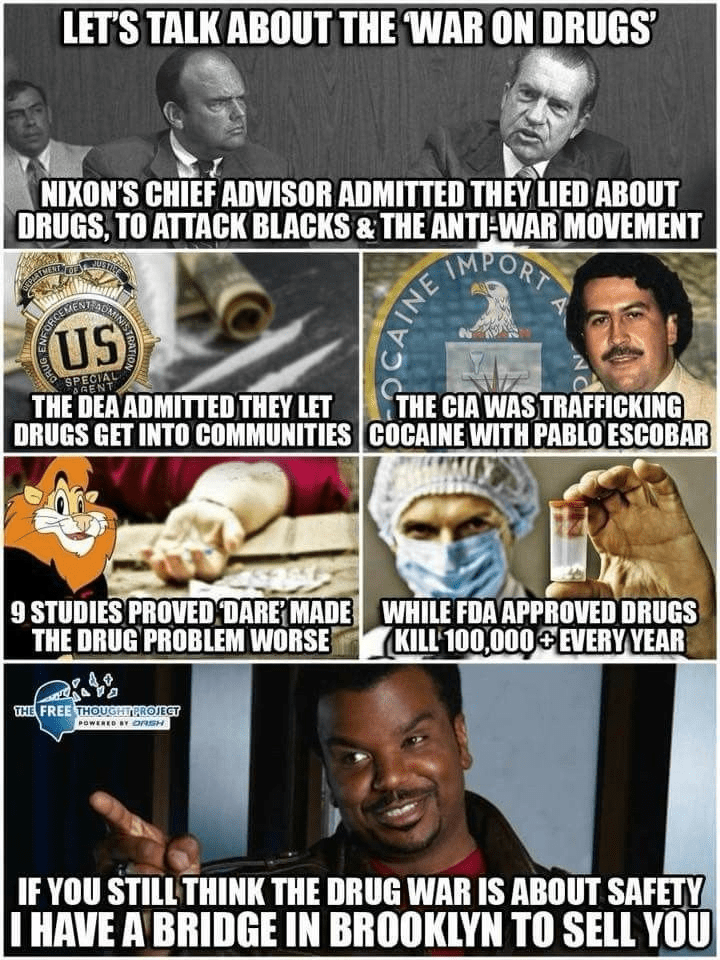
Democrats have a new plan to legalize marijuana federally

On Wednesday, Sens. Cory Booker (D-NJ), Chuck Schumer (D-NY), and Ron Wyden (D-OR) released a discussion draft of legislation that proposes sweeping reform to marijuana policy in the US. The Cannabis Administration and Opportunity Act would decriminalize marijuana federally, expunge federal non-violent cannabis convictions (and encourage states to do the same), and create “new grant programs to fund nonprofits that provide services to those adversely impacted by the War on Drugs.”

In the introduction to the 30-page draft legislation, the senators note that adult use of cannabis is already legal in 18 states, Washington D.C., the Northern Mariana Islands, and Guam. Medicinal marijuana is even more widespread, legal in 37 states, Puerto Rico, D.C., Guam, and the US Virgin Islands.

“These changes represent a dynamic shift in public opinion and support across the political spectrum,” the statement notes. “State-compliant cannabis businesses will finally be treated like other businesses and allowed access to essential financial services, like bank accounts and loans. Medical research will no longer be stifled.”

Despite recent state actions, marijuana remains illegal at the federal level and subject to prosecution by federal agencies even in states where cannabis use is permitted. In practice, those prosecutions have been limited, but the risk of federal action has meant that marijuana businesses have limited options when it came to banking and many non-recreational uses of the plant have been stifled.

Keep reading