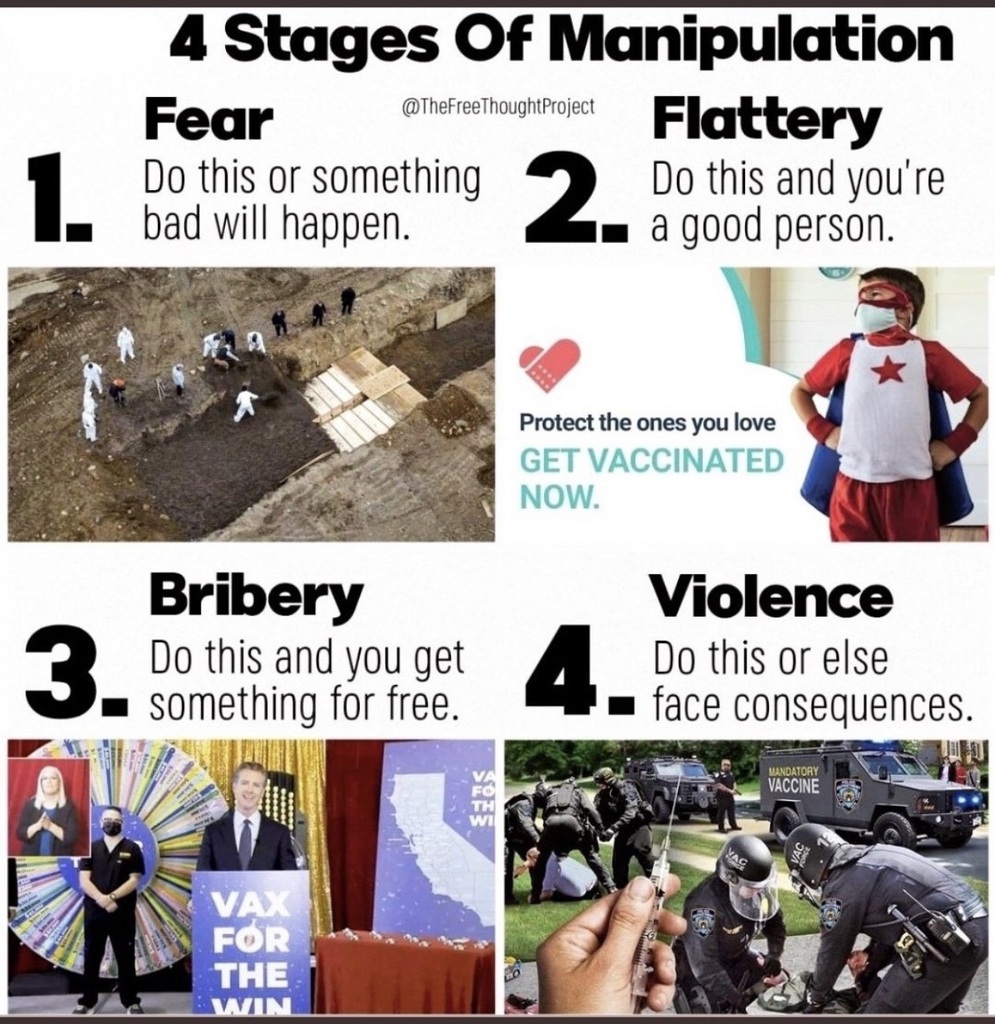
Stage 4 coming soon to a reality near you…

Documentation just obtained by Judicial Watch confirm that a request to cremate Ashli Babbitt’s body was submitted by the Chief Medical Examiner only two days after having obtained custody of the body, and further reveal that Babbitt’s fingerprints, emailed to an alleged government worker on January 6, caused the return of Microsoft “undeliverable” messages in Chinese characters.
The 1160 pages of documentation contain numerous revelations about the actions of government officials following the homicide shooting of unarmed Air Force veteran Babbitt by an unidentified law enforcement officer at the Capitol on January 6. The documents come from the Office of the Chief Medical Examiner (OCME) in Washington, D.C., and prove that OCME submitted a request to obtain permission to cremate Ashli Babbitt just two days after having custody of the body, an application labeled “completed successfully” on January 8. Deputy Chief Medical Examiner Francisco Diaz, based on the “high profile nature” of Babbitt’s case, further requested the creation of a limited access, secure electronic file for the records concerning Babbitt.
As early as January 6 itself, an OCME official was emailing Babbitt’s fingerprints, which were forwarded to someone with the result that “undeliverable” messages apparently in Chinese characters were returned.
The unarmed Babbitt had been attempting to climb into the Capitol through a “broken interior window. . .outside the Speaker’s Lobby off the House Floor” at the time of the shooting. According to videos from the same time, several law enforcement officers are reportedly able to be seen standing amidst the same crowd of protestors in which Babbitt was.
The independent watchdog agency which investigates potential wrongdoing by the National Security Agency (NSA) announced on Tuesday morning that it has opened an investigation into “recent allegations that the NSA improperly targeted the communications of a member of the U.S. news media.” Though the oversight unit, the NSA’s Office of the Inspector General, did not specify the journalist in question, the statement leaves no doubt that the investigation pertains to news reports that the identity of Fox News host Tucker Carlson had been improperly “unmasked” and illegally revealed within the intelligence community.
The NSA’s Inspector General, Robert P. Storch, is a long-time Executive Branch functionary. He was first appointed to this position by President Obama in 2016 but failed to receive Senate confirmation. He was then re-appointed by President Trump in 2018 and the Senate then confirmed him. A widely respected bureaucrat in Washington, he also previously served as deputy Inspector General in Obama’s Justice Department, and, prior to that, was a federal prosecutor. It is, to put it mildly, difficult to imagine him opening an investigation into frivolous allegations.
The scandal began when Carlson announced on his show in late June that he had heard from a source inside the government that the NSA was in possession of his communications, as proven by their knowledge of what he was doing. The NSA then issued a meaningless non-denial denial, insisting that the Fox host “has never been an intelligence target of the Agency.” Even Fox’s critics acknowledge the irrelevance of that claim: there are many ways for the NSA to spy on an American citizen without having them be a formal “target” of the agency. In a follow-up interview on Fox, Carlson said he was told by a second source that the NSA had discovered his attempts to interview Russian President Vladimir Putin and viewed leaking of that information as potentially damaging to his reputation.
Corporate media outlets largely sided with the NSA, mocking Carlson for being conspiratorial and even accusing him of fabricating a story. One might think that journalists would have more interest in finding out whether the NSA was abusing their powers to discredit a journalist than cheering the security state for partisan reasons, but one would be wrong. Disdain for Carlson’s claims were widespread in media circles.
But Carlson’s concerns appeared to be at least partially corroborated when Axios’ Jonathan Swan reported that “U.S. government officials learned about Carlson’s efforts to secure the Putin interview.” Though Swan emphasized that none of this meant that the NSA was targeting Carlson for surveillance or even that his communications had been “incidentally” collected — meaning that the NSA read his emails or heard his conversations because he was communicating with one of their targets — their knowledge of Carlson’s activities raised the question of whether Carlson’s identity had been “unmasked” by the agency. As Swan wrote:
In order to know that the texts and emails were Carlson’s, a U.S. government official would likely have to request his identity be unmasked, something that’s only permitted if the unmasking is necessary to understand the intelligence.
When the NSA learns about the communications or activities of an American citizen without having a warrant from the FISA court to spy on that person, they are required by law to engage in “minimization” efforts to protect the privacy of that citizen. In particular, when preparing reports involving such spying, they are required to conceal — to “mask” — the identity of the American about whom they learned information, referring to them only by a generic title sufficient to describe their work or status without revealing their specific identity (e.g., “an American journalist” or “a business executive”).
A bill proposed in Florida, which is receiving widespread support from police, House Bill 11, filed by Rep. Alex Rizo, (R-Hialeah), could be yet another massive blow to your right to film the police.
According to the bill, anyone who is “hindering” law enforcement in their duties, which could include filming them with a cellphone, could be arrested, fined, and even imprisoned.
The loosely written language of the bill allows for rife abuse left up to the officer’s scope of discretion. According to the bill:
Approaching a law enforcement officer after a warning with intent to impede, provoke, or harass.— (1) As used in this section, the term “law enforcement officer” has the same meaning as in s. 943.10(1). (2)(a) It is unlawful for any person, after receiving a warning from a law enforcement officer not to approach, to violate such warning and approach or remain within 30 feet of a law enforcement officer who is engaged in the lawful performance of any legal duty with the intent to:
1. Interrupt, disrupt, hinder, impede, or interfere with the law enforcement officer’s ability to perform such duty;
2. Provoke a physical response from the law enforcement officer; or
3. Directly or indirectly harass the law enforcement officer.
(b) A person who violates this subsection commits a misdemeanor of the second degree, punishable as provided in s. 31 775.082 or s. 775.083.
Think about every police brutality video you have seen in which the person filming or bystander begs the officer to “stop beating him” or saying, “he didn’t do anything,” and consider the language in the bill above.
Telling officer Derek Chauvin to stop beating George Floyd easily could have been interpreted by the officers as an attempt to “interrupt, disrupt, hinder, impede, or interfere.”
What’s more the people who filmed Chauvin kill Floyd were much closer than 30 feet, which would have made all of them criminals according to this legislation.
“I think they are trying to hide something, like you don’t want people recording. Why, if you not doing nothing wrong?” Fort Lauderdale resident, Dushont Morrison told Local 10 when asked about this bill.
But those who support the bill claim it’s to protect cops from attacks.

It’s not every day you receive a letter from the local police department congratulating you on your acceptance into an exclusive program. Such is the story shared by several residents in Pasco County, Florida, a community in the Tampa area. One problem: None of the recipients applied.
“We are pleased to inform you that you have been selected to participate in a Prolific Offender Program,” reads a letter from the Pasco County Sheriff’s Office (PCSO). “Research indicates that barriers to successful living may involve struggles with mental health, substance abuse, domestic violence, homelessness, finding a job, or several other challenges many people face on a daily basis. It is possible you have struggled with some of these issues. If so, please know the Pasco Sheriff’s Office is committed to support you in overcoming these challenges through this program.”
The “support” it offers, originally detailed in an investigation by the Tampa Bay Times, includes sending cadres of cops to people’s homes, where officers show up unannounced, harassing them and their family members, performing warrantless searches on their homes, and trying to nab them on petty offenses, like having grass that is too tall. The lucky winners were “selected as a result of an evaluation of your recent criminal behavior,” according to the PCSO, “using an unbiased, evidence-based risk assessment designed to identify prolific offenders in our community.”
In other words, the program is ostensibly trying to keep people out of trouble and deter future criminal behavior before anything goes dramatically awry. That sounds well-intentioned on the surface. But its “relentless pursuit” of community members has ruthlessly entangled people with the state—including targets’ family and friends—trampling over their Fourth Amendment rights in the process, says a recent lawsuit filed by the Institute for Justice, a libertarian public interest law firm.
Their clients received good news this week: Though the PCSO sought to have the suit dismissed on a litany of different grounds, a federal judge struck each down in a ruling issued on Wednesday, allowing the claim to proceed.
“The Fourth Amendment protects the right to be safe and secure in your person and property,” says Ari Bargil, an attorney on the suit. “This program violates that right,” he notes, “because it allows and requires Pasco County Sheriff’s Office deputies to approach people at their home, harass them, refuse to leave, and in some instances demand entry without a warrant. These are obvious and clear Fourth Amendment violations.”
Sheriff Chris Nocco, the brains behind the program, openly admitted that it’s intended to do more than what the congratulatory letter implies: He hopes it will “take them out” of the community, he said, with one of his former employees conceding that their job was to “make their lives miserable until they move or sue.”
Officials in Tai’an city, in China’s coastal Shandong Province, paid a resident $15,000 on Aug. 3. The individual reported a company group training in a hotel on July 30, according to local state media.
Authorities said organizers didn’t report the 12-day training to the local government, and its attendees came from several cities across China. After the attendees’ tests came back negative, they were ordered back to their homes.
It is the latest of a number of regions to introduce cash incentives as part of a recent campaign to battle the new outbreak. Authorities in cities, counties, districts, and even the lowest government level—neighborhood committees— from at least eight provinces announced financial rewards to members of the public for providing tip-offs about the CCP virus. The latest outbreak started in Nanjing city, with nine airport cleaners infected on July 20.
A neighborhood committee in Yangzhou city announced residents could receive a $310 reward if they reported others who had traveled from infected areas or had close contact with confirmed cases. A district office in the city offered to pay people $775 for providing information, and would double the reward if the case is confirmed, according to state news outlet ThePaper.cn.
Yangzhou, about one and a half hours drive from Nanjing, has become the latest hotspot, reporting 32 cases on Wednesday. Although this figure likely does not reflect the actual total, given that the Chinese regime is known for grossly underreporting its virus numbers, it accounted for almost half of the 73 confirmed across the country on Wednesday.
I suppose there’s one bit of good news for the tens of thousands of Illinois residents who’ve been waiting for a year or more for their Firearm Owner ID cards; thanks to the lengthy delays by the Illinois State Police their information wasn’t yet entered into a database that was the recent target of hackers attempting to gain access to the personal details of FOID card holders.
The official story from the Illinois State Police, at least at first, was that there was an “attempted” breach of personal information, but that hackers weren’t able to actually gain access. Over at The Truth About Guns, however, John Boch reported that he’s been hearing something different from a few local gun shops.
The Illinois State Police have reportedly told some gun dealers that hackers breached their security protocols. The gun dealers sharing this information with me wished to remain anonymous out of fear of retribution from the Governor’s office.
What’s more, according to those inside the ISP, an unspecified amount of gun owners’ personal data was reportedly downloaded by the hackers.
This past weekend, the website was shut down completely for an upgrade to remedy the security vulnerabilities that the hackers exploited.
And after keeping mum about the cyberattack for most of the week, on Friday afternoon, the Illinois State Police finally admitted that the personal details of more than 2,000 FOID holders have been “possibly” compromised.
In the Australian state of New South Wales, residents are dealing with an outbreak of the COVID-19 delta variant so serious that the top elected state official is urging citizens to rat on one another. Things are so dire that its top public health official wants you to stop having conversations with other people.
And who could blame them? After all, the state — Australia’s most populous and home to Sydney — reported 321 new cases on Saturday.
No, I’m not missing a zero or three there. On Aug. 6, 321 people tested positive for coronavirus. According to government data, 81 lives have been lost in NSW so far during the pandemic.
And yet, parts of the state are currently in nearly total lockdown, with stay-at-home orders for the Greater Sydney area and people only able to leave their home if they “have a reasonable excuse” — including obtaining food, going to work, getting medical treatment and exercising, according to the state government website.
No visitors to your residence unless you live alone — in which case, you can have a “nominated visitor,” provided they aren’t a nominated visitor for someone else. Places of worship aren’t open to the public. Outdoor gatherings are limited to two people. Most retail outlets are closed.
And for rule-breakers, NSW Premier Gladys Berejiklian is encouraging citizens to turn them in.
“Can I also stress that people should expect a greater police presence, a greater focus on compliance because we know the recurring incidents where the disease is transferring — it’s in workplaces and it’s within households,” she said on July 27, after the lockdown was extended another month.
“We really need people to do the right thing at all times.”
“Do not let your guard down. If you see somebody not doing the right thing, please, report it,” she said. “When any of us see anything which is not according to the health rules, or you see even in your own workplace, report it.
“We can’t put up with people continuing to do the wrong thing because it’s setting us all back.”

 Hellbound and Down
You must be logged in to post a comment.