
Reality gap…

“Let us resolve that never again will we send the precious young blood of this country to die trying to prop up a corrupt military dictatorship abroad. This is also the time to turn away from excessive preoccupation overseas to the rebuilding of our own nation. America must be restored to a proper role in the world. But we can do that only through the recovery of confidence in ourselves…. together we will call America home to the ideals that nourished us from the beginning.”—George S. McGovern, former Senator and presidential candidate
It’s time to bring all our troops home.
Bring them home from Somalia, Iraq and Syria. Bring them home from Germany, South Korea and Japan. Bring them home from Saudi Arabia, Jordan and Oman. Bring them home from Niger, Chad and Mali. Bring them home from Turkey, the Philippines, and northern Australia.
It’s not enough to pull American troops out of Afghanistan, America’s longest, bloodiest and most expensive war to date.
It’s time that we stop policing the globe, stop occupying other countries, and stop waging endless wars.
That’s not what’s going to happen, of course.
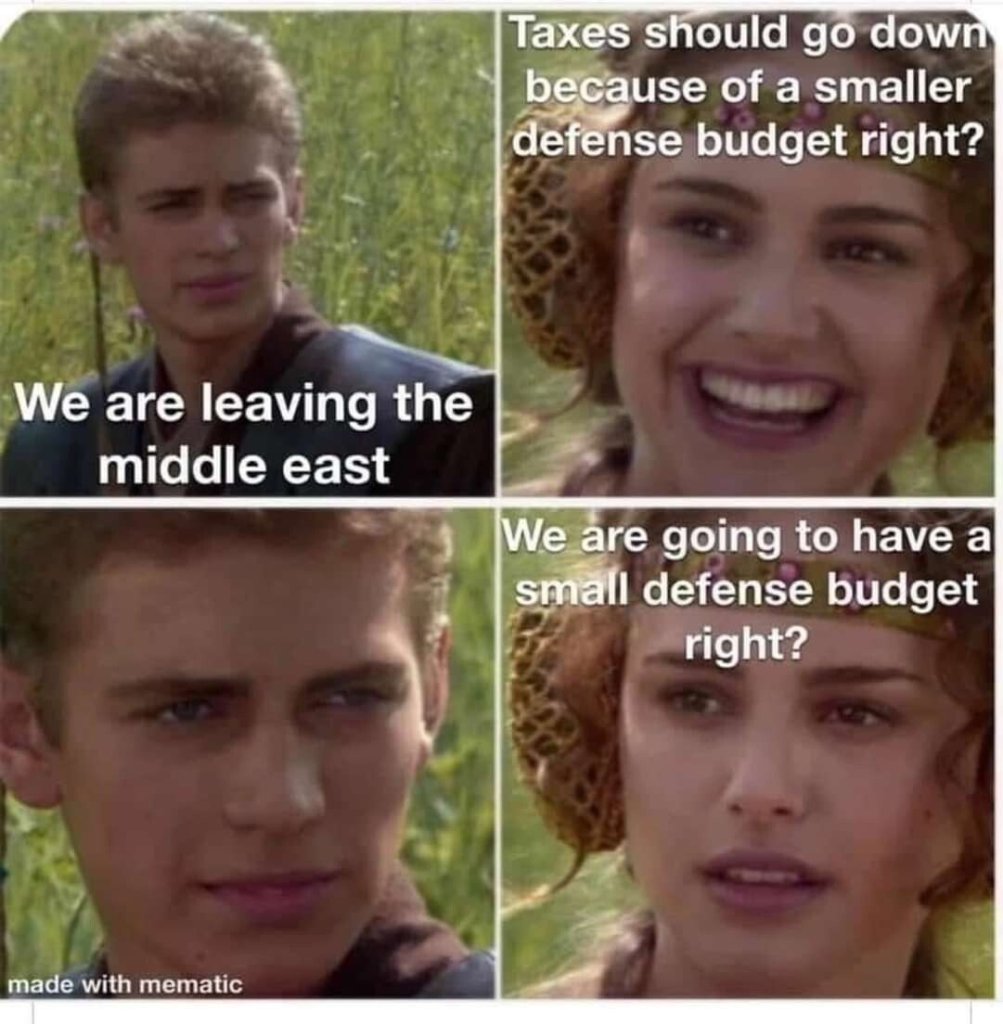
Just as the United States completed its troop withdrawal from Afghanistan on Monday after two decades of war and occupation, House Republicans announced plans to push for a $25 billion increase in annual military spending—a proposal that progressive lawmakers and advocacy groups swiftly rejected.
Led by Rep. Mike Rogers (R-Ala.), the top Republican on the House Armed Services Committee, the GOP intends to pursue a National Defense Authorization Act (NDAA) amendment that would add $25 billion to President Joe Biden’s $753 billion topline military spending request for Fiscal Year 2022.
The House Armed Services panel—which is awash in donations from weapons makers and other major industry players—is expected to begin marking up Biden’s request on Wednesday.
“Rogers’ amendment would dole out $15 billion to address a spate of military unfunded priorities that weren’t included in the Pentagon’s budget request,” Politico reported Monday. “It would add $9.8 billion to weapons procurement accounts, including money for four more Navy ships, more planes and helicopters for the Navy, Marine Corps, and National Guard, and upgraded Army combat vehicles.”
Approval of the GOP’s amendment would bring the House version of the NDAA—a sprawling annual defense policy bill that typically passes with overwhelming bipartisan support—into line with the Senate’s. Last month, as Common Dreams reported, the Senate Armed Services Committee agreed to pile $25 billion onto Biden’s proposal, which already calls for an increase over Trump-era Pentagon spending levels.
In the wake of the Afghanistan withdrawal influential promoters of western militarism have been absolutely fuming about the popular idea of ending the forever wars, and their tantrums are not even trying to disguise it as something else. They’re literally using that phrase, “ending the forever wars”, and then saying it’s a bad thing.
I mean, what a bizarre hill to die on. War is the very worst thing in the world, and forever is the very worst amount of time they could go on for, yet they’re openly condemning the “doctrine of ending the forever wars”. How warped does your sense of reality have to be to even think this is a view anyone who isn’t paid by defense contractors could possibly be sympathetic to?
Yet they are indeed trying. Citing the chaos of the Afghanistan withdrawal as though every single day of the twenty-year occupation has not been far worse, career-long warmongers are trying to spin “ending the forever wars” as a disdainful slogan that everyone should reject.
No matter how many times a commentary is provided on the subject, it is still nauseating to witness fervent tribalism perpetuated in real time. Weird how the one side of the demographic that was all in favor of finally “Ending the Forever Wars” for 4 years during the last Administration, are now the same ones clutching their pearls and regurgitating talking point after talking point of State Department nonsense to prolong that catastrophe. Where did all that “drain the swamp” rhetoric go?
Vice-versa, the ones that are now presumptuously patting themselves on the back — as if the dementia patient they empowered to currently reside in the Oval Office is in any way cognitively functional enough to do anything other than get out of bed in the morning — didn’t just spend the last four years foaming at the mouth at the dare mention of a withdrawal.
It is the false “Left vs. Right” paradigm on display. Odious and pestiferous as ever.
Neocolonialists are once again saturating the public with the same tired mantras of the Bush era; grandstanding with outdated Ronald Reagan quotes, draped in an American flag with the scent of apple pie. Pitting Americans against each other because “you don’t love your country enough”, “the little people of the world need help and America must save the day!”
Leaving out the fact that they “need rescuing” from the disaster we caused.
ISIS has reportedly claimed credit for an explosion near Kabul’s Hamid Karzai International Airport. As of this writing there are around 90 dead including 13 US military personnel, though to read western mainstream media reports you’d think only US troops died and not scores of Afghans as well.
This was the deadliest attack in a decade on US troops in Afghanistan, which is odd to think about considering how many people the US military has killed during that time; just between January and July of this year the war killed 1,659 civilians. The way the US war machine has shifted to relying more on highly profitable missiles and bombs and unmanned aircraft to avoid the bad PR of flag-draped bodies flying home on jets is making the murder of foreigners a safer profession than working at a convenience store.
Because US military casualties of this size have become more rare despite their being spread throughout the world in nations whose people don’t want them there, news of those 13 deaths is being met with shock and astonishment instead of being regarded as a very normal part of foreign military occupations. People are acting like these were mall cops in Ohio and not military forces overseeing the tail end of a 20-year war overseas, and pundits and politicians are demanding more bombs and more military interventionism in response to people on the other side of the world attacking them in their own country.
The chaos in Afghanistan created by the appalling organisation of withdrawing from the country by the Biden administration has already prompted globalists to begin fresh calls for a new US military occupation of the country, with Obama’s former Defense Secretary Leon Panetta declaring that US forces will have to return.
In an interview on CNN, Panetta, also a former CIA head, proclaimed “The bottom line is, our work is not done. We’re going to have to go after ISIS.
Following the suicide bombings Thursday that killed over 100 people, 13 of them US marines, Panetta said “We’re going to have to go back in to get ISIS. We’re probably going to have to go back in when Al Qaeda resurrects itself, as they will, with this Taliban. They’ve gave safe haven to Al Qaeda before, they’ll probably do it again.”
“We can’t leave the War on Terrorism, which still is a threat to our security,” Panetta added.
“I spent most of my time being a high-class muscle-man for Big Business, for Wall Street and for the Bankers. In short, I was a racketeer, a gangster for capitalism.” – Major General Smedley Darlington Butler (1881-1940) in his book “War is a Racket” (1935).
The ending of the 20-year-war in Afghanistan, the longest ever engagement in a single conflict by the United States armed forces, has been variously described as a “catastrophe”, a “disaster” and a “debacle”. Yet this national failure from which parallels have been drawn with the Vietnam War has not had the same ring of misfortune for some.
Indeed, long before the recent scenes of calamity and collapse in Kabul brought home with resounding finality the futility of a supposed nation-building exercise, the profit-motive for the initial US invasion and the preservation of an enduring occupation was an open secret to anyone who bothered to embark on the slightest inquiry.
The gravy train of American defence spending was in full effect, facilitated by the tentacles of what US President Dwight D. Eisenhower prophesied would become the Military Industrial Complex. For the last two decades have witnessed what has been described as a “wealth transfer from US taxpayers to military contractors”. But the war, apart from confirming Afghanistan’s reputation as the “Graveyard of Empires”, also validates the phrase coined by US Major General Smedley Butler that war is a racket.
The blame game currently being played out in the United States media by the political class risks obscuring one fundamental issue: the centrality of money and the profit motive in the waging of America’s two-decade-long war in Afghanistan.
The invasion of that country had been planned well in advance of the attacks of September 11th, 2001, the event which provided the impetus for mounting a military response including the country’s occupation. The United States has long coveted gaining access to the mineral and oil rich Caspian region and Central Asia, and the coming to power of the fundamentalist Islamic Taliban movement was not seen at the time by US policy makers as an impenetrable obstacle.
As the French writers Jean-Charles Briscard and Guillaume Dasquie wrote in their book Forbidden Truth: U.S.-Taliban Secret Oil Diplomacy and the Failed Hunt for Bin Laden, which was published in 2002, the American government had been prepared to accept Taliban rule on condition that they agreed to the construction of an oil pipeline across Central Asia.
After the US troop withdrawal established conclusively that the Afghan “government” they’d spent twenty years pretending to nation build with was essentially a work of fiction, thus proving to the world that they’ve been lying to us this entire time about the facts on the ground in Afghanistan, you might expect those who helped pave the way for that disastrous occupation to be very quiet at this point in history.
But, far from being silent and slithering under a rock to wait for the sweet embrace of death, these creatures have instead been loudly and shamelessly outspoken.
The Tony Blair Institute for Global Change has posted a lengthy essay by the former Prime Minister who led the United Kingdom into two of the most unconscionable military interventions in living memory. Blair criticizes the withdrawal as having been done out of “obedience to an imbecilic political slogan about ending ‘the forever wars’,” bloviating about “Radical Islam,” and asking, “has the West lost its strategic will?”
 Hellbound and Down
You must be logged in to post a comment.