
It’s for your own good…

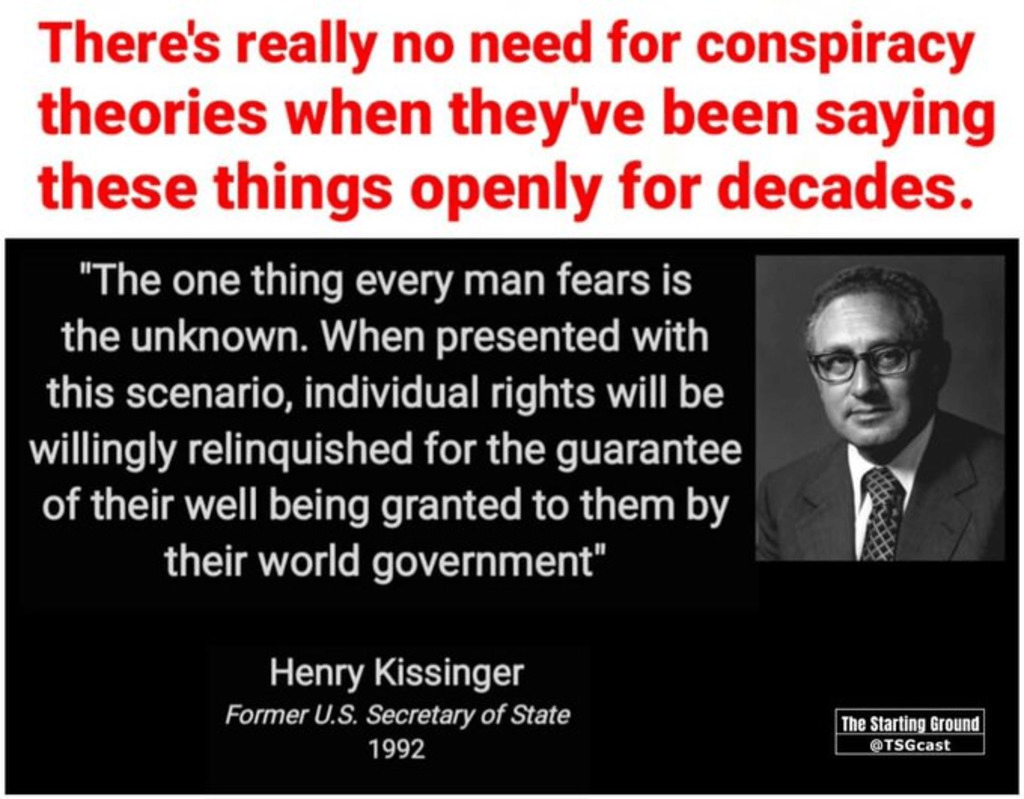
Illinois Representative Jonathan Carroll wants to push through a change to the state’s insurance law that would mean health insurers no longer have to cover unvaccinated people who get Covid, forcing people to pay their medical bills out of pocket.
The Democrat lawmaker told the Chicago Sun-Times:
I think it’s time that we say ‘You choose not to get vaccinated, then you’re also going to assume the risk that if you do catch COVID, and you get sick, the responsibility is on you,’”
The potential corruption and abuse of such a rule should be obvious to anyone familiar with just how mendacious insurance companies can be.
In all likelihood insurance companies will simply demand a negative Covid test before paying anything, and if you test positive, no matter what you were treated for, you will be called a “covid case” and forced to pay out of pocket.
The bill could, essentially, wipe all health insurance off the books for unvaccinated people.
The vaccinated should take no comfort from this, because their vaccinated status is entirely temporary, and subject to rules that could change on a whim.
Any “double jabbed” who misses a booster, or got a brand of vaccine that was subsequently unapproved or discontinued, or wasn’t updated for the latest variant, could suddenly find themselves one of the “unvaccinated” underclass.
Of course, once it applies to vaccination status it can apply to other things. You travelled to the wrong place, or you didn’t wear a mask, you “associated with known anti-vaxxers”.
And, even more concerning, is the potentially slippery slope this starts us down. Unvaccinated don’t get health insurance. Neither do smokers who get lung cancer. Or overweight people who get diabetes. And so on and so on.
New Zealand is banning young people from ever being allowed to buy cigarettes in a rolling scheme that aims to make the entire country smoke-free.
People aged 14 and under in 2027 will never be allowed to purchase cigarettes in their lifetime in the Pacific country of five million, under Prime Minister Jacinda Ardern’s radical new laws.
Each year the age limit will be increased until it is illegal for the entire nation.
‘We want to make sure young people never start smoking so we will make it an offence to sell or supply smoked tobacco products to new cohorts of youth,’ associate health minister Ayesha Verrall said on Thursday.
However, the new law will not impact vaping, with Dr Verrall saying tobacco smoking is more harmful and remains a leading cause of preventable deaths in New Zealand, killing up to 5,000 people each year.
The measures will make New Zealand’s retail tobacco industry one of the most restricted in the world, just behind Bhutan where cigarette sales are banned outright.
Official in New Zealand, where packets of 20 Marlboro cigarettes cost around NZ$33 (£17), have not said how they plan to police the ban, nor which retailers would be barred from selling tobacco products. More detail is expected to be provided when legislation is brought before parliament next year.
At the moment, tobacco retailers face fines of between NZ$500 and NZ$1,000 for selling cigarettes to minors.
Although many experts have welcomed the move, others have warned that it could cause a ‘gradual prohibition’ and create a black market for tobacco, prompting a crime wave.
As if the Biden administration wasn’t doing enough to infringe on your civil liberties with lockdowns and vaccine mandates, media reports over the last several days are suggesting that Biden’s new infrastructure bill will also include a mandate for auto manufacturers to install “kill switches” into vehicles.
Former Rep. Bob Barr, writing for The Daily Caller, calls the measure “disturbingly short on details”, but for the fact that the proposed device must “passively monitor the performance of a driver of a motor vehicle to accurately identify whether that driver may be impaired.”
Which, of course, is code for some kind of device that is constantly on and monitoring your vehicle – and will likely have the power to shut down your vehicle anytime it wants.
“This is a privacy disaster in the making, and the fact that the provision made it through the Congress reveals — yet again — how little its members care about the privacy of their constituents,” The Daily Caller writes.
Nevada will be the first state to charge state workers enrolled in public employee health insurance plans a surcharge if they aren’t vaccinated.
The state Public Employees’ Benefit Program Board voted on Thursday to charge unvaccinated workers up to $55 per month to offset the costs of testing those who haven’t gotten shots are required to undergo in certain workplaces.
“This is pandemic has been shouldered on the burden of everyone. And now this particular burden — the testing — should be shouldered on the burden of those who refuse to (be vaccinated),” said DuAne Young, Nevada Gov. Steve Sisolak’s policy director.
Surcharges for state workers and adult dependents on their plans will go into effect in July 2022.
Despite some of the tireless coverage from those of us in the independent media over the years, there still seems to be a contingent of holdouts clung to the idea that their own government would not intentionally put the well being of its citizens at risk. Particularly with regard to the closing out of 2020, it seemed no better a time to provide some historical context to the contrary.
We will begin with example from the prohibition era of the previous century, in 1928. The United States government in an attempt to act as the sole arbiter of morality took it upon themselves to defy the basic human right of self ownership and prohibited the consumption of alcohol nationally. Naturally, this was not received well by millions of individuals who believed it was their inherent right to decide what they could and could not ingest in their own bodies.
As prohibition often does, this led to a boon in black market industry of speakeasies and bootleg alcohol manufacturing and distribution. Of course the all powerful government, ever influenced by its messiah complex did not respond well to this act of defiance. How dare the peasantry exercise their rights as free thinking individuals? Thusly the government took the only next reasonable step it could think of — to poison its own citizens.
That’s right, rather than come to the logical conclusion that people should be allowed to decide what’s best for them, the federal government decided in an ill-fated attempt to enforce compliance of state-mandated moral guidelines to “save people from themselves”, to contaminate millions of barrels of alcohol with poison to dissuade people from drinking it.
Darkness descends over civilization and freedom. It flows not from any external threat but from within the human heart. We are beings capable of happiness and flourishing, but sometimes we push our fears and anxieties into the shadows. There they fester. And from those deep psychological bowers, fear and anxiety reemerge transformed.
To live right now, then, is to live in paradox. Despite conditions of relative peace and abundance, a psychosocial pathology has taken hold. It manifests itself as something like a replacement religion. Where people once turned to their temples and communities for reassurance, more turn now to political authority. Merchants of fear magnify the significance of certain human problems, which obscures complicated truths and feeds the dogmas of this new faith. Adherents believe they are on the side of the angels, but their faith threatens to bring about a new Dark Age. Why? Because more and more people in the grip of this religion are willing to use illiberal means.
How many federal agencies do we pay for? I bet you think, as I once did, that a quick internet search would tell. But researching for an essay a couple of years ago, I found numbers varying from 78 to 158, and websites saying the exact number was impossible to determine.
Looking at the USA.gov website recently, I discovered a tab for Federal Agencies A to Z (actually there are none past W). Scrolling around the list for two days, subtracting duplicate listings, like Useless Policy, Office of and Office of Useless Policy, I counted 456 (and a few more as I checked some links while drafting this essay).
The large number of agencies was my first, but not my only surprise. Each agency’s listing had a field for government branch, mostly filled with Executive, some Legislative, some Judicial. But sometimes that field contained: Independent, Quasi, or None. How can we have parts of government that are not part of a branch of our government?
It amused me that some agency names made it easy to guess when they were created. Delinquency was a focus in the 1930s; nuclear threats, 1950s; civil rights, 1960s; cyberterrorism, after 2001.
This just started with to know how many federal agencies we have. But discovering there are agencies decades past their freshness date, begs to be explored. This essay is a just cursory view.
 Hellbound and Down
You must be logged in to post a comment.