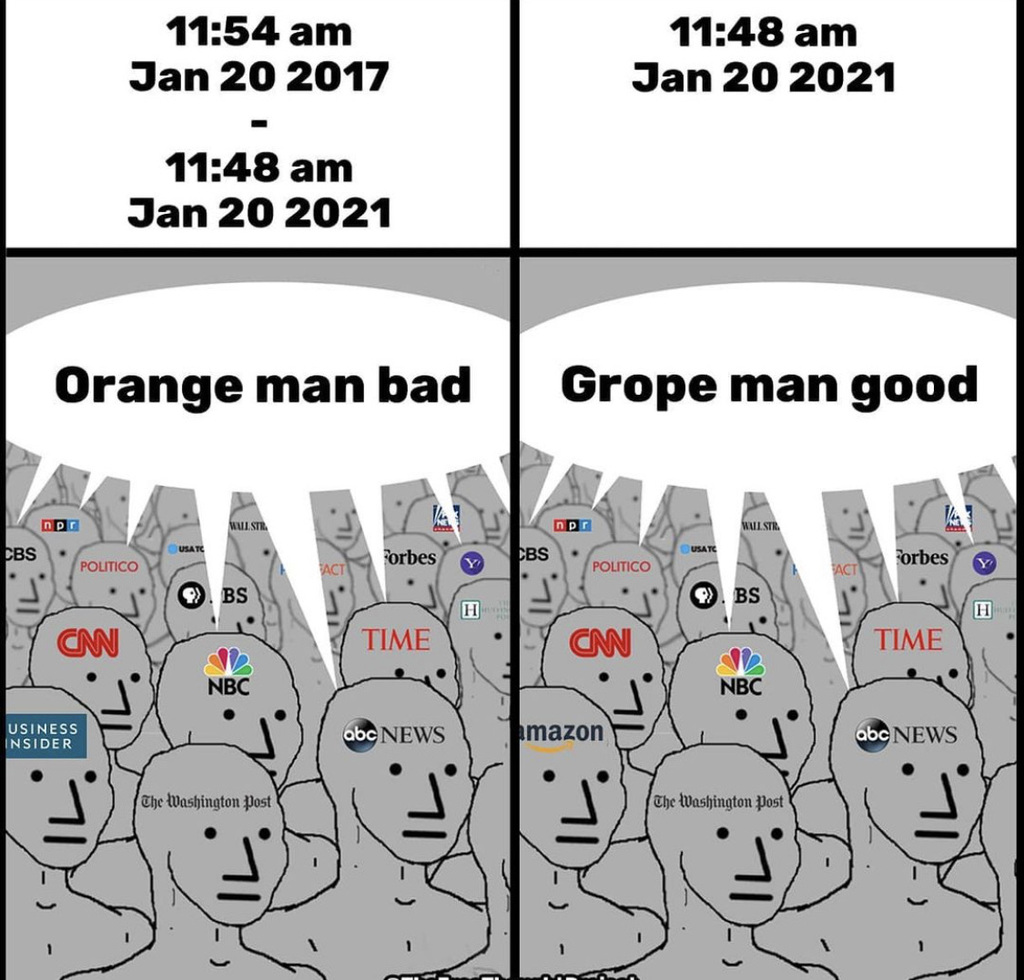
Don’t Be Fooled By Our Media Wars: Everybody Hates Free Speech

As America’s acid bath of a presidential campaign boils to a merciful close, the political clamor is becoming increasingly indistinguishable from a shouting match about, over, and against the media. Twitter is still blocking the New York Post‘s main account a week after the tabloid’s controversial article on Hunter Biden’s alleged corruption. President Donald Trump has been waging preemptive war against upcoming debate moderator Kristin Welker and 60 Minutes correspondent Leslie Stahl. Sacha Baron Cohen, in a Borat sequel that ends with a plea for viewers to vote, just tried to honey-pot Rudy Giuliani.

The partisan lopsidedness to this debate, between attempted authoritarian and “enemy of the people,” can give off the misleading impression that the divide over free speech and its applications is a clean philosophical schism, with conservatives on one side, progressives and most journalists on the other. In fact it is not.

The fight over media is more a fight over power, and who gets to wield it, than a fight over principle, and how it should be applied. Trump and Joe Biden both want to roll back the speech protections in Section 230 of the Communications Decency Act; the difference is that the president would do it in the name of protecting conservatives and the former vice president would do it in the name of restricting conservative misinformation. Sens. Ted Cruz (R–Texas) and Elizabeth Warren (D–Mass.) agree that Facebook and Twitter are guilty of “election interference”; it just depends on which election. Google faces antitrust enthusiasm from House Democrats and Bill Barr’s Justice Department alike. (This morning, on Fox Business Network’s Mornings with Maria, Donald Trump, Jr., asserted that this election would be a referendum on the First Amendment, because only his father could be trusted with following through on his promise to break up Big Tech, because Democrats who talk a big game are actually in bed with their censorious Silicon Valley overlords.)

The more politics (and its worst form, war) subsumes life, the more free speech is treated as a means to an end rather than as a magnificent if always-threatened achievement of the Enlightenment. It is no accident that the bipartisan clampdown on speech in the governmental realm is coinciding in the intellectual realm with a noisy right-left rethink of the Enlightenment itself.

Keep reading

USA Today Refused To Publish Hunter Biden Scandal Op-Ed, So Here It Is

SO USA TODAY DIDN’T WANT TO RUN MY HUNTER BIDEN COLUMN THIS WEEK. My regular editor is on vacation, and I guess everyone else was afraid to touch it. So I’m sending them another column next week, and just publishing this one here. Enjoy! This is as filed, with no editing from USAT.

*  *  *

In my 2019 book, The Social Media Upheaval, I warned that the Big Tech companies — especially social media giants like Facebook and Twitter — had grown into powerful monopolists, who were using their power over the national conversation to not only sell ads, but also to promote a political agenda.

That was pretty obvious last year, but it was even more obvious last week, when Facebook and Twitter tried to black out the New York Post’s blockbuster report about emails found on a laptop abandoned by Democratic presidential candidate Joe Biden’s son Hunter.

The emails, some of which have been confirmed as genuine with their recipients, show substantial evidence that Hunter Biden used his position as Vice President Joe Biden’s son to extract substantial payments from “clients” in other countries. There are also photos of Hunter with a crack pipe, and engaging in various other unsavory activities. And they demolished the elder Biden’s claim that he never discussed business with his son.

That’s a big election-year news story. Some people doubted its genuineness, and of course it’s always fair to question a big election-year news story, especially one that comes out shortly before the election. (Remember CBS newsman Dan Rather’s promotion of what turned out to be forged memos about George W. Bush’s Air National Guard service?)

But the way you debate whether a story is accurate or not is by debating. (In the case of the Rather memos, it turned out the font was from Microsoft Word, which of course didn’t exist back during the Vietnam War era.) Big Tech could have tried an approach that fostered such a debate. But instead of debate, they went for a blackout: Both services actually blocked links to the New York Post story. That’s right: They blocked readers from discussing a major news story by a major paper, one so old that it was founded by none other than Alexander Hamilton.

I wasn’t advising them — they tend not to ask me for my opinion — but I would have advised against such a blackout. There’s a longstanding Internet term called “the Streisand effect,” going back to when Barbara Streisand demanded that people stop sharing pictures of her beach house. Unsurprisingly, the result was a massive increase in the number of people posting pictures of her beach house. The Big Tech Blackout produced the same result: Now even people who didn’t care so much about Hunter Biden’s racket nonetheless became angry, and started talking about the story.

Keep reading

How hysterical punditry failed America

It seems like only yesterday that America’s leading organs of elite consensus were engulfed by a full-fledged panic that the country was on the cusp of all-out Civil War. The means by which this prophesied conflict would be instigated — much less fought — were never made exactly clear, but that wasn’t the point. After all, logistical or operational specifics are immaterial when it’s already been ordained that something unimaginably, harrowingly catastrophic is just around the corner.

“This is not a drill. The Reichstag is burning,” blared a five-alarm-fire warning in the Washington Post by Dana Milbank, who may want to consider a title change from “columnist” to “in-house hysteric”. Not to be outdone, establishment weather-vane Thomas Friedman joined the fray in the New York Times with an equally shocking exhortation: “I can’t say this any more clearly,” he hyperventilated. “Our democracy is in terrible danger — more danger than it has been since the Civil War, more danger than after Pearl Harbor, more danger than during the Cuban missile crisis […]”.

If these fevered prognostications even bore the faintest resemblance to political conditions in the United States, it might seem a bit odd that the pundits in question have since moved on to other subjects. Or to put it this way: if they really believed their own fantastical rhetoric, shouldn’t they have spent the past few weeks taking action more tangible than rattling off a few throwaway columns and browsing Twitter? Not that any “resistance” brigade composed of pallid middle-aged journalists would be especially formidable on the battlefield, but the point is that their conduct doesn’t come anywhere close to matching the incredible alarmism of their words.

Keep reading

Factional warfare erupts in New York Times over the 1619 Project

The immediate trigger for Sulzberger’s memorandum was a Friday column written by Times opinion writer Bret Stephens, “The 1619 Chronicles.” Stephens is one of the Times’ leading columnists. An anti-Trump conservative, he pointed to the absurdity of many of the Project’s historical claims as well as its disregard for basic journalistic principles. Stephens concluded that the 1619 Project was “a thesis in search of evidence.”

Stephens quoted at length from historian James McPherson’s interview with the World Socialist Web Site, to which he provided a link. In early September 2019, the WSWS produced the first major exposure of the racialist falsifications of the 1619 Project, a few weeks after its rollout amidst an unprecedented media blitz. The WSWS followed this with interviews with scholars who dismantled the 1619 Project’s major claims—McPherson, Victoria Bynum, James Oakes, Gordon Wood, Dolores Janiewski, Adolph Reed, Jr., Richard Carwardine, and Clayborne Carson.

The Stephens column brought into the open the bitter conflict raging at the Times over its creation and promotion of the 1619 Project.

Keep reading